Rechercher dans ce blog

Sunday, August 2, 2020

The anatomy of a very brief bear market - Financial Times

unitedstatepolitics.blogspot.com

The writer is chairman of Fulcrum Asset Management

The Covid-19 economy has had many unprecedented events packed into a few months, but none more extraordinary than the switchback in global equities. 

The advanced economies experienced a savage but brief bear market up to 23 March, followed by a spectacular recovery that eliminated all the year-to-date losses within 17 more weeks. Any investor who succeeded in navigating both legs of this reversal was either very skilled, or very lucky.

Economists are already investigating the episode — what have they learnt?

The first question is whether the market behaved “rationally”? in the sense that the entire decline and rebound in equity prices can be explained by alterations in growth expectations, driven by the economic shutdowns to control the virus in March, followed by the start of unlocking in April and May. That does not appear to be the case.

To understand why, start with the idea that the stock market’s total value equals the present value of the benefits equity holders expect in the future. This changes for two reasons. First, expectations about the size of the benefits — corporate earnings and dividends — rise and fall. Second, the present value of these future benefits is affected by what is known as the equity discount rate. This is equal to the return on safe assets like Treasuries plus what investors expect to be paid for the extra risks — losses, bankruptcy — of owning shares. 

Augustin Landier and David Thesmar have presented evidence that suggests only a small part of the US equity price changes were explained by corporate earnings expectations. In the downward leg, a survey of investment analysts’ earnings forecasts for 2020-23 shows that the present value of these earnings fell only a few per cent from the start of the year, assuming the discount rate remained the same as that pre-Covid-19. During the equities recovery, earnings expectations continued to decline, thus explaining none of the bounceback.

Calculations based on dividend expectations paint a similar picture. Niels Gormsen and Ralph Koijen of Chicago Booth School of Business show that dividend futures, which measure expected dividend growth, fell much less in the crisis than stock prices. Fulcrum economists show that while earnings expectations fell in March, those for dividends changed little.

So amid such volatility, “rational” changes in growth expectations do not seem to explain the behaviour of stock prices. Many economists and equity analysts apparently viewed the Covid-19 shock as a fairly short-term event that would last just 12-24 months, thus making little difference to the present value of future company earnings.

What, then, accounted for the dramatic events? If the path for earnings or dividends was not enough, the discount rate applied to that path must have risen to explain the bear market. Professors Landier and Thesmar indicate that the discount rate had grown 3 percentage points by 23 March.

Given that the risk-free rate on US treasury bills dropped by around 1.5 percentage points over that time, the equity risk premium must have jumped by nearly 4.5 points in the market collapse. Furthermore, almost all the recovery in the market was driven by the ERP returning to normal.

That is not particularly unusual. Nobel Prize winner Robert Shiller showed in the 1980s that large equity price swings are usually driven by the discount rate, not by changes in dividend expectations. More recently, he has suggested that changes in the risk premium were exacerbated by “vivid stories” about the spread of the virus, and the dramatic easing of US fiscal and monetary policy within a day of the market trough.

These narratives certainly played a part, but Prof Shiller may be underestimating another factor. The structure of the financial system, in particular new rules that cut the risk capital available to bond market makers, led to disruptive behaviour there, undermining confidence in the financial system. Goldman Sachs’ financial conditions indicator tightened by more than 3 percentage points during this period, and equities were severely damaged.

The Federal Reserve’s March 23 emergency easing may have been the key factor in addressing these problems, allowing risk appetite to be restored in equities, credit and long-duration government bonds.

Now the Fed has demonstrated its willingness to take unlimited action to prevent further illiquidity and disruption, the equity risk premium should be much less volatile, even in the event of a further major wave of economic damage from the virus.

Let's block ads! (Why?)


"Market" - Google News
August 02, 2020 at 06:00PM
https://ift.tt/2Pi1cPj

The anatomy of a very brief bear market - Financial Times
"Market" - Google News
https://ift.tt/2Yge9gs
https://ift.tt/2Wls1p6

Saturday, August 1, 2020

North Prairie Farmers Market celebrates 13 years - KX NEWS

unitedstatepolitics.blogspot.com

[unable to retrieve full-text content]

North Prairie Farmers Market celebrates 13 years  KX NEWS

"Market" - Google News
August 02, 2020 at 07:28AM
https://ift.tt/31awjlp

North Prairie Farmers Market celebrates 13 years - KX NEWS
"Market" - Google News
https://ift.tt/2Yge9gs
https://ift.tt/2Wls1p6
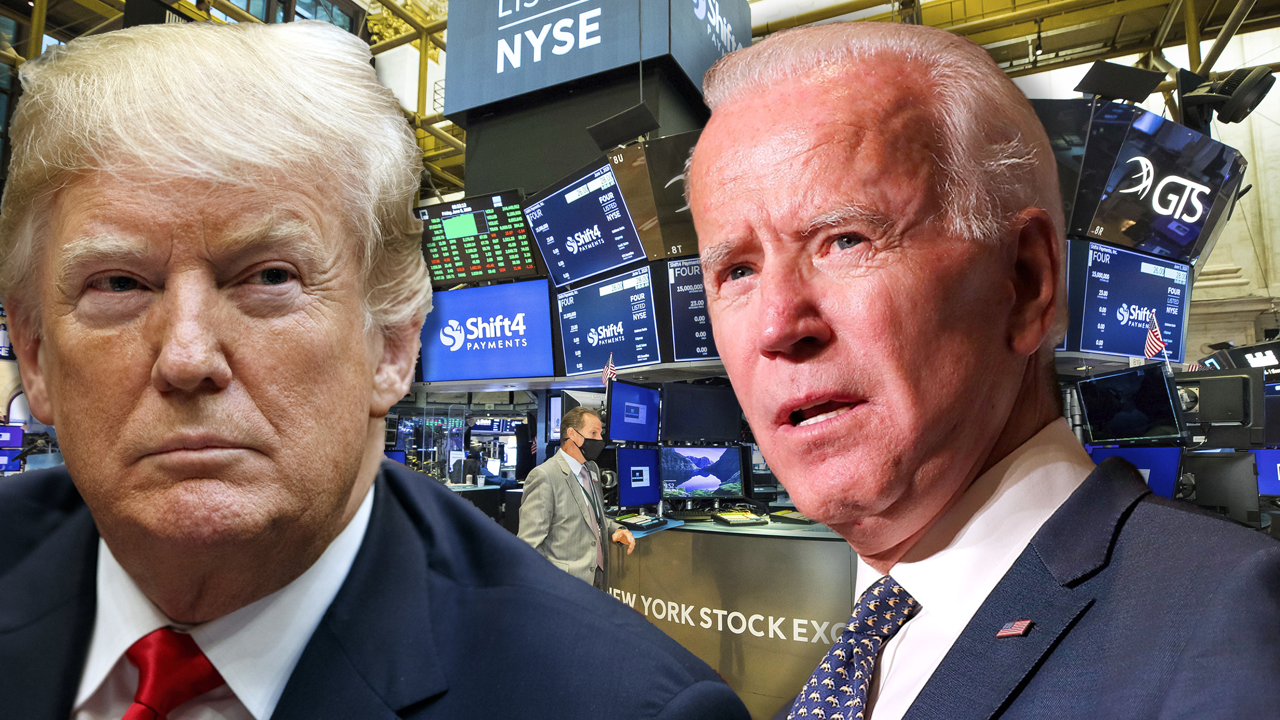
Silicon Valley stocks plot market's path to 2020 election - Fox Business

unitedstatepolitics.blogspot.com

Blockbuster earnings from tech behemoths Alphabet, Amazon, Apple and Facebook, with a combined market value of $4.9 trillion, are setting the course for the stock market before what's typically the most difficult stretch of the year -- one that ends just three days before the presidential election.

Continue Reading Below

Performance in the August-through-October period has averaged -0.03 percent going all the way back to 1928, according to Dow Jones Market Data. It was the only three-month interval that saw a negative return.

This year, though, investors are keeping a close eye on the time span in case the influential tech companies buoy markets enough to reverse the decades-long trend downward.

If they do, investors may see the upswing as a boost for President Trump's odds of retaining the White House after weeks of polling that have shown him trailing rival Joe Biden.

“The reality is that the strong are getting stronger, with FAANG names such as Amazon, Facebook, Google, and Apple beneficiaries of the current environment,” wrote Wedbush analyst Dan Ives. That dynamic, he said, "will put further fuel into the tech rally moving forward

Ticker Security Last Change Change %
AMZN AMAZON.COM INC. 3,164.68 +112.80 +3.70%
FB FACEBOOK INC. 253.67 +19.17 +8.17%
GOOG ALPHABET INC. 1,482.96 -48.49 -3.17%
APPL n.a. n.a. n.a. n.a.

While the mega-cap techs, which represent 17.1 percent of the S&P 500, will likely serve as the market’s backbone moving forward, other sectors will need to step up for the index to hold what CLSA technical analyst Laurence Balanco calls “pivotal support at the 3,185 area,” or 1.5 percent below current levels.

Ticker Security Last Change Change %
SP500 S&P 500 3271.12 +24.90 +0.77%

Some evidence has appeared that cyclical sectors such as energy, materials, financials and industrials will be able to power the market higher in the months ahead.

Those sectors had seen gains of between 7 percent and 9 percent in the two weeks after earnings season began on July 9, according to Deutsche Bank. Tech, meanwhile, had fallen by 2.5 percent.

The firm noted that while investments into long-term growth equity funds touched an average of $1.7 billion over the past four weeks, down from $10 billion weekly at the peak, money has continued to pour out of cyclical stocks and those sectors haven’t seen increased interest from retail investors, who have been instrumental in the market’s advance from coronavirus lows.

Left to right: Sundar Pichai, Jeff Bezos, Mark Zuckerberg and Tim Cook are the heads of Google, Amazon, Facebook and Apple, respectively.

“New retail investors have continued to ramp up exposure to long-term growth stocks but have not added to holdings of cyclicals after a strong surge initially during the rally,” wrote Deutsche Bank strategist Parag Thatte.

“Performance across sectors has been closely correlated with increases in retail exposure," he said.

Retail investors can’t discover those value stocks soon enough for President Trump, who has lamented COVID-19's destruction of a previously thriving economy that was to play a pivotal role in his re-election campaign.

CLICK HERE TO READ MORE ON FOX BUSINESS

The S&P 500’s performance in the August-through-October period has correctly picked the election winner 87 percent of the time and every time since 1984, according to Ryan Detrick, senior market strategist at LPL Financial.

“When the S&P 500 Index has been higher the three months before the election, the incumbent party usually won, while when stocks were lower, the incumbent party usually lost,” he wrote.

Let's block ads! (Why?)


"Market" - Google News
August 01, 2020 at 09:15PM
https://ift.tt/3feI9A0

Silicon Valley stocks plot market's path to 2020 election - Fox Business
"Market" - Google News
https://ift.tt/2Yge9gs
https://ift.tt/2Wls1p6

Risk of delayed, disputed election results looms over market rally - Fox Business

unitedstatepolitics.blogspot.com

President Trump linked his controversial suggestion last week to delay the 2020 election to his repeated warning that mail-in voting would yield "the most fraudulent and inaccurate election in history."

Continue Reading Below

But that possibility, which many experts have dismissed, isn't the only risk.

The volume of mailed ballots this year, pushed up by people avoiding crowded polling places and the resulting higher chances of COVID-19 infection, means vote-counting may take significantly longer than normal, with results not known for days.

In such an instance, the uncertainty would almost surely cause tremors in the stock market.

And a disputed election is another “wild card you can’t rule out,” Greg Valliere, chief U.S. policy strategist at Ontario, Canada-based AGF Investment, told FOX Business in July. Trump has already declined to commit to accepting the results.

The potential for election upheaval arrives amid a pandemic that has infected more than 4.5 million people in the U.S., the most of any country in the world, and is expected to prompt more Americans than ever before to cast ballots by mail.

At least 77 percent of American voters, including those who use absentee ballots, will have the opportunity to do so, the Washington Post reported.

Trump and other critics have warned not only of the possibility of fraud and the potential for a lenghty vote tabulation process because of that, but the possibility of vote leakage and other problems.

There is also concern that states are not prepared to deal with the influx of mail-in votes and that a beleaguered Postal Service can't handle the volume efficiently, especially with pandemic-related service reductions.

A recent report from the Brookings Institution gave 19 states a “C” grade for their readiness, compared with 21 states that received an “A” or a “B.” The remainder received a “D” or an “F.”

Such challenges might lead not only to confusion about the outcome in the immediate aftermath but the second contested election in 20 years. Translation: Uncertainty.

And if there's anything the stock market loathes, it's uncertainty.

The results of the 2000 election between former President George W. Bush and former Vice President Al Gore hung in the balance for five weeks amid a battle over vote-counting in Florida. It wasn’t until Gore conceded defeat on December 13, a day after the U.S. Supreme Court blocked a Sunshine State recount, that the winner was known.

The confusion contributed to a 12 percent drop in the S&P 500 from Election Day through December 20, according to Lori Calvisina, head of U.S. equity strategy at RBC Capital Markets, who also noted investor confidence was low following the collapse of the dotcom bubble.

Two decades later, the market has been roiled by the worst economic downturn since the Great Depression, which might compound the fallout of an uncertain or contested outcome.

CLICK HERE TO READ MORE ON FOX BUSINESS

While Valliere said he “isn’t predicting” a contested election, he believes the chances of that happening “are not zero.”

Let's block ads! (Why?)


"Market" - Google News
August 01, 2020 at 10:43PM
https://ift.tt/318dIXd

Risk of delayed, disputed election results looms over market rally - Fox Business
"Market" - Google News
https://ift.tt/2Yge9gs
https://ift.tt/2Wls1p6

Why August in a pandemic for stock-market investors is a time for vigilance - MarketWatch

Here's What Happened in the Stock Market in July -- and What to Watch in August - Motley Fool

unitedstatepolitics.blogspot.com

July was a pretty strong month for the stock market, with most major indexes finishing in positive territory, and with considerably lower volatility along the way than in other recent months. Despite the continued elevated coronavirus case numbers, the S&P 500 is now in the green for 2020, fueled by generally strong earnings from the largest U.S. companies and hopes that a vaccine will be available by the end of the year.

Here's a look at the stock market's performance in July, as well as some of the major trends that shaped its performance over the past month and that could determine what your investments do in August and beyond.

Man raising hand in air in celebration while looking at laptop screen

The stock market had another strong month in July, continuing the recent rally. Image source: Getty Images.

How did the stock market perform in July?

Before we take a look at the main investing themes from July, here's a quick look at how the major benchmarks performed for the month, and how they've done so far in 2020.

Index

July 2020 Performance

Change (YTD)

Dow Jones Industrial Average

2.3%

(7.8%)

S&P 500

4.2%

0.5%

Nasdaq Composite

4.3%

18%

Russell 2000

4.8%

(10.4%)

Data source: YCharts. Performance through June 30. YTD = year to date.

A couple of key takeaways here. First, the S&P 500 is now positive for the year. When you consider that the index had fallen by more than 40% from its pre-pandemic highs in March, that's a pretty stellar rebound. And while the Nasdaq remains the biggest winner of 2020, as many big tech stocks benefited from the stay-at-home economy, its performance in July was in line with most other key benchmarks.

Virus numbers remain high

In June, coronavirus case numbers soared as the U.S. economy reopened. In July, many states took action -- pausing or even rolling back reopening plans, implementing mask mandates, and more. Even many political leaders who had been resistant to the idea of face coverings have started to embrace the idea.

Well, the good news is that cases seem to have leveled off -- for now at least.

US Coronavirus Cases Per Day Chart

US Coronavirus Cases Per Day data by YCharts

I wouldn't go so far to say this is a positive catalyst for stocks, but it's certainly a good development. Cases remain elevated, but if they begin to fall in August, it could help the market's rally continue. Plus, a vaccine is still on track to be available by the end of 2020, and any news on this front is likely to be a market mover.

GDP was bad -- or was it?

We knew that second-quarter GDP would be bad. After all, many parts of the U.S. economy were essentially nonfunctional for much of April and May. So, it shouldn't be too much of a shock that second quarter-GDP contracted by 32.9% -- the worst quarterly performance ever. The service sector was the largest contributor to the plunge, as you might expect.

However, it's worth pointing out that this is slightly better than the 34.7% decline economists were expecting, so the market largely shrugged off the numbers.

On the other hand, unemployment remains elevated and initial unemployment claims are rising. About 1.4 million people filed for unemployment in the last full week of July, the second straight weekly increase. So far, most news on the unemployment front has been positive, so it's worth keeping an eye on these numbers going forward, as further increases could put investors on edge.

Earnings season ended the month on a high note

Since the U.S. economy slowed dramatically in the second quarter, we knew corporate earnings would generally be bad, but so far there haven't been many negative surprises. In fact, the opposite has been true in many cases.

The big banks kicked off earnings season in mid-July, and most institutions reported rather strong results. While all big banks set aside billions in anticipation of loan losses, actual charge-offs and delinquencies remain quite manageable. And investment banking has been a big positive surprise -- JPMorgan Chase (NYSE:JPM) reported stellar investment banking results and Goldman Sachs (NYSE:GS) achieved its second-highest quarterly revenue ever.

Megacap tech stocks have also reported surprisingly strong results. The "big four" tech stocks -- Facebook (NASDAQ:FB), Amazon (NASDAQ:AMZN), Apple (NASDAQ:AAPL), and Alphabet (NASDAQ:GOOGL) (NASDAQ:GOOG) -- all reported better-than-expected results. Apple beat sales expectations by a wide margin and declared a 4-for-1 stock split. And Amazon reported an absolute blowout quarter, as the pandemic provided a big tailwind for online shopping -- in fact, sales jumped by roughly 50% year over year on the e-commerce platform.

Stimulus worried are keeping investors on edge

Finally, it's important to note that we're ending the month with more questions than answers on the economic front, particularly in regard to the highly anticipated stimulus package being negotiated in Congress.

The $600 weekly unemployment boost is arguably the biggest issue that could affect the stock market. States stopped paying out the extra cash after last week, and lawmakers have yet to reach any sort of compromise to extend it. With about 30 million people relying on this additional income to make ends meet, it's fair to say that any prolonged gap in benefits could have serious consequences for the economy -- and for the stock market.

Let's block ads! (Why?)


"Market" - Google News
August 01, 2020 at 06:08PM
https://ift.tt/2Phhk3w

Here's What Happened in the Stock Market in July -- and What to Watch in August - Motley Fool
"Market" - Google News
https://ift.tt/2Yge9gs
https://ift.tt/2Wls1p6

Black Market historical marker placed in Peoples Park - The Bloomingtonian

unitedstatepolitics.blogspot.com
July 31, 2020 – Bloomington, Indiana USA: An historical marker stands in the location of the Black Market firebombing location in Peoples Park, Friday, July 31, 2020, in Bloomington, Ind. (Photo by Jeremy Hogan/The Bloomingtonian)

A historical marker with the history of the Black Market, which once stood at the site of Peoples Park, was dedicated Friday morning.

The text on the marker reads:

“Black Market Firebombing

In 1968, amidst sweeping political and social activism in the U.S., African American student Clarence “Rollo” Turner led protests against racial discrimination which were met with hostility. That fall, Turner opened the Black Market here, which sold products made in Africa or by African Americans, and acted as a cultural center for Black students at Indiana University.

On December 26, 1968, a local man with Ku Klux Klan ties firebombed the Black Market, destroying the entire store. Though it never reopened, students, faculty, and the community raised funds to cover the store’s inventory. In 1970, Indiana University students began developing the vacant lot into Peoples Park, a space for activism, recreation, and free expression.”

July 31, 2020 – Bloomington, Indiana USA: An historical marker stands in the location of the Black Market firebombing location in Peoples Park, Friday, July 31, 2020, in Bloomington, Ind. (Photo by Jeremy Hogan/The Bloomingtonian)

Rate this post

Click on a star to rate it!

    Average rating 5 / 5. Vote count: 8

    No votes so far! Be the first to rate this post.

    Liked it? Take a second to support The Bloomingtonian on Patreon!

    Let's block ads! (Why?)


    "Market" - Google News
    August 01, 2020 at 06:18AM
    https://ift.tt/2Xhs1aQ

    Black Market historical marker placed in Peoples Park - The Bloomingtonian
    "Market" - Google News
    https://ift.tt/2Yge9gs
    https://ift.tt/2Wls1p6

    Search

    Featured Post

    Politics - The Boston Globe

    unitedstatepolitics.blogspot.com Adblock test (Why?) "politic" - Google News February 01, 2024 at 03:47AM https://ift.tt...

    Postingan Populer