Bruce Berglund (@brberglund) taught Russian and East European history for two decades at Calvin University and the University of Kansas. A three-time Fulbright scholar, he has written about nationalism, religion, and politics in the region. His latest book is "The Fastest Game in the World: Hockey and the Globalization of Sports." His next book is a history of the referee in world sports. The views expressed here are his own. Read more opinion on CNN.
(CNN)In his address to members of the International Olympic Committee before the Beijing Winter Games, IOC President Thomas Bach asserted that the mission of the Olympics was to bring the world together in peaceful competition. "We can only accomplish this mission," Bach stated, "if the Olympic Games stand above and beyond all political differences."
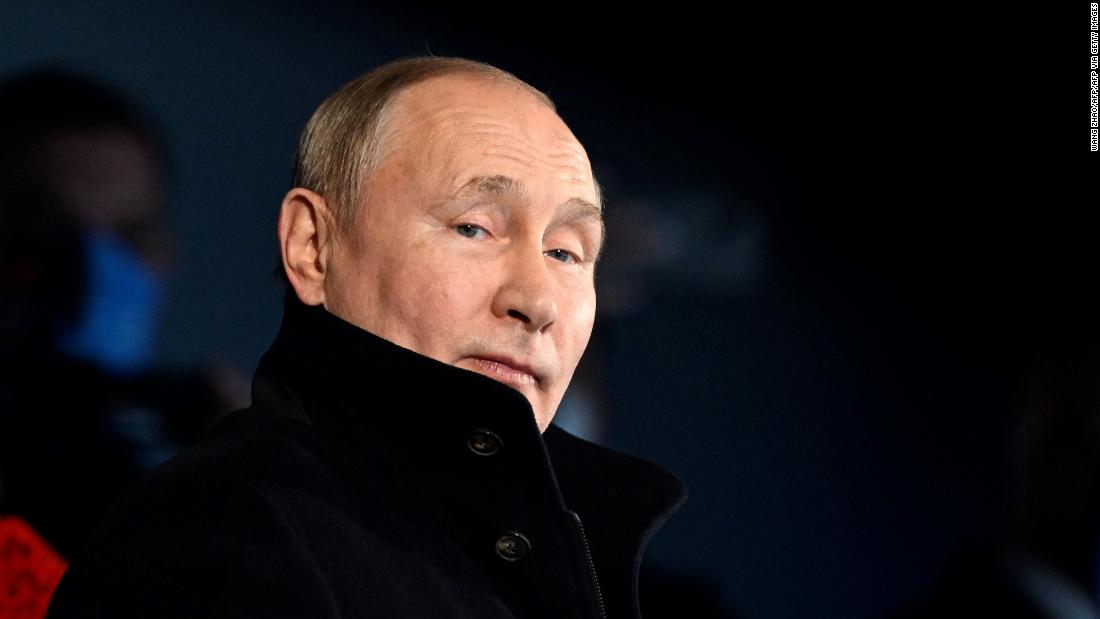
Mere weeks later, Bach's statement already sounds like the last gasp of an outmoded ideal. For many years, the IOC and other governing bodies of world sport have insisted their competitions remain separate from international politics. But in many cases, this supposed neutrality ended up serving the interests of Russian leader Vladimir Putin, who has used sports to solidify his position at home and present himself as a respectable world leader, even while attacking Russia's neighbors.
Only now, in the aftermath of Russia's unprovoked invasion of Ukraine, are international sports organizations breakingties with Putin's Russia. Athletes from Russia will pay the price, but the steps are necessary to take away one of Putin's most reliable political tools and further isolate him internationally.
A number of world sports organizations have pulled events from the country or severed ties with Russian entities. The European soccer federation, UEFA, moved this year's Champions League final from St. Petersburg to Paris, while Formula One canceled the Russian Grand Prix scheduled for late September. Other governing bodies, leagues and clubs followed suit. On Monday, UEFA and the Fédération Internationale de Football Association (FIFA) took the extraordinary step of barring the Russian national soccer team from the qualifying tournament for the 2022 World Cup.
Even the IOC has changed course and joined the actions against Russia. On the day of the invasion, Bach condemned Russia's "breach of the Olympic Truce," a consensus resolution adopted by the United Nations General Assembly in December 2021, which started seven days before the Beijing Winter Olympics and lasts until seven days after the Paralympics. On Monday, the IOC went further, recommending all sports federations ban Russian and Belarusian athletes (because of their country's crucial enabling of Putin's aggression) from competing in events.
While the international governing bodies of various sports are now positioning themselves as taking the principled lead, many of the steps against Russia have come in response to outrage from within their sports.
In the case of soccer, the Polish, Swedish and Czech football federations refused to play Russia in the World Cup qualifying tournament. National team members were involved in each federation's decision not to play, and some players publicly stated their support. "It is the right decision!" tweeted Robert Lewandowski, the Polish team's top scorer.
Other European federations joined the Poles, Swedes and Czechs in rejecting FIFA's initial attempt to strike a compromise by allowing Russians to play as the "Russian Football Union," without association to the country's flag or anthem. Facing significant pushback, FIFA and UEFA then instituted a complete ban on Russia's participation.
In hockey as well, Hall of Famers Wayne Gretzky and Dominik Hasek called for Russian players to be excluded from contests in North America. Gretzky said Russia should be banned from the world junior men's championship, while Hasek, who grew up in Czechoslovakia when the country was occupied by Soviet troops, demanded that the NHL remove Russian players from its rosters. "The NHL must immediately suspend contracts for all Russian players!" he tweeted.
The athletes who have spoken out insist a ban against Russian participation in world sports is a necessary step. Having competed on the world stage, they understand that athletes inevitably serve as ambassadors of their nations. "Every athlete represents not only himself and his club, but also his country and its values and actions," tweeted Hasek. Allowing Russian athletes to participate in sports can advance the image Putin wants to project to the world -- all while Russian soldiers are striking Ukrainian civilians. It's simply not acceptable.
From a political standpoint, removing Russia from international sports is part of the broader strategy of isolating Russia from international finance, trade and travel. And it prevents Putin from using one of his most effective tools.
Since he rose to power, Putin has used international sports events to restore his country's global standing in the wake of the Soviet Union's collapse. He played a direct role in lobbying members of the IOC and FIFA so Russia could host the Winter Olympics in 2014 and the Men's World Cup in 2018. These successful bids were heralded as proof of Russia's return to the top rank of advanced nations. "The decision shows that Russia is trusted," Putin said in 2010 when FIFA announced his country would host the World Cup.
International events enabled Putin to "sportswash" his government's military aggression. In August 2008, Russia invaded neighboring Georgia on the same day Putin was in Beijing for the opening ceremonies of the Summer Olympics. In 2014, Russian troops began moving into Crimea on the final day of the Winter Games, and the crisis in that region escalated against the backdrop of the Winter Paralympics in Sochi.
The supposedly apolitical environment of the Olympics provided a shield against any criticism of these actions. "The Games are supposed to be outside politics," said Aleksandr Zhukov, former head of the Russian Olympic Committee, when asked before the 2014 Sochi Games about Putin's actions. "Those who try to pin some political tails on them are just being undignified."
Leaders of world sports organizations turned a blind eye and deflected questions. When FIFA President Sepp Blatter met Putin in Sochi in April 2015, Russian troops were occupying the Donbas region of eastern Ukraine. "Some people are wanting the World Cup to be taken away from Russia," Blatter said, "but we will give one answer to this -- we are involved in football and we will not allow politics to get in the way."
At the time FIFA President Gianni Infantino glossed over these incidents, saying, "There are many injustices in the world." And instead of calling Putin out, Infantino declared, "This country, Russia, has changed ... Everyone has discovered a beautiful country, a welcoming country, full of people who are keen to show to the world that what maybe is sometimes said is not what happens here."
After having been played for years by the Russian leader, the world's "sportocrats" now look like stooges. Their insistence on the separation of sports and politics rings hollow.
By contrast, it's the athletes who have stepped forward to assert that political events do matter in sports. Many of them acknowledge that banning Russian athletes is unfortunate. Still, action is necessary. "Russian footballers and fans are not responsible for this," tweeted Lewandowski, "but we can't pretend that nothing is happening."
The athletes also remind us that sports have to be viewed in proper perspective. It seems the heads of international sporting organizations often have a single-minded view of their mission. They deflect any challenge to the prestige and profits their tournaments generate, and they cooperate with any world leader willing to advance their sports, no matter how odious that leader's actions might be. In their calls to exclude Russia from international sports, athletes are rightfully pointing out that games cannot be sealed off and viewed in a vacuum, divorced from world events. It's not possible to watch Russian troops shelling Ukrainian cities and then allow Russian athletes to represent their country in a soccer or hockey match.
Many fans likewise see sports as a self-contained space, separate from the concerns of life. To them, sports are an escape -- a form of entertainment -- and it serves no purpose to mix them with politics. We see this view amonghockeyfans, angry that Hasek would demand the suspension of Russian NHL players.
But athletes like Hasek, who are calling for bans against Russia, argue that we have to view sports in a broader context -- one that acknowledges the world's outrage over events in Ukraine. "It is not an easy decision," tweeted members of the Polish national team after deciding not to play Russia, "but there are more important things in life than football."
"politic" - Google News
March 06, 2022 at 04:50AM
https://ift.tt/Qs2USqX
Putin made Russian athletes his political tools. Banning them is the right thing to do - CNN
"politic" - Google News
https://ift.tt/YdviQa2
https://ift.tt/Qm6Y4MI
When Françoise Olivas sat down for her first candidate endorsement interview on Feb. 28, she was expecting questions about the issues.
A first-time candidate for New York state Senate, Olivas, 47, set up for the Zoom meeting in her living room while her 4-year-old daughter colored in her room. The virtual meeting with approximately 20 members of North Brooklyn Progressive Democrats (NBPD), a Greenpoint-based political club she had worked with in the past, was one of her first campaign events. Olivas had prepared a short script.
She introduced herself as a small-business owner, a working mom and an environmentalist. Then she walked through the issues she was most passionate about: passing universal child care so New York parents could return to work; helping local retailers; investing in education; cleaning up air and waterways and creating sustainable “green” jobs.
When the floor opened for questions, Olivas was ready to talk about her background and the advocacy she had done in her Brooklyn neighborhood. But the first question she received floored her: How did she plan to juggle being a mom and running for a Senate seat?
Minutes later, she was asked whether she could balance motherhood and politics a second time.
This time, the questioner pressed her: “Especially if the child is a certain age … that child needs a parent, a mother or father, most of the time.”
“I was in such a state of shock,” Olivas said. “It’s an absurd question to be asked in 2022, especially by a club that has ‘progressive’ in the name.”
Both exchanges in the remote, closed meeting were recorded by Monique Erickson, a friend of Olivas, on her cellphone and shared with The Washington Post. Olivas’s campaign also shared the recording with the political action committee Vote Mama, which supports Democratic mothers running for office. The group posted an excerpt of the exchange on Twitter.
In a statement shared to Twitter on Tuesday night, NBPD said the members’ comments “do not reflect the opinion of the Executive Committee.” The organization said it did not have any additional comment at this time.
While there have been significant gains for moms seeking public office, the questions Olivas faced on Monday demonstrate that these candidates still face persistent bias, said Kelly Dittmar, an associate professor at the University of Rutgers-Camden and director of research at the Center for American Women and Politics (CAWP).
“This is the type of question that women on the campaign trail and as officeholders have heard throughout history. It’s not unique to this moment, but it is unique that we have a tape of it,” Dittmar said.
When these questions come up, Dittmar added, are typically raised by voters, who can come from a wide range of backgrounds and hold differing opinions about gender roles. But, she said, it’s unclear how much these concerns are raised behind closed doors: “If the questions are raised in public, are they also raised in private, influential places?”
The first person to ask Olivas about her ability to balance motherhood and campaigning was a woman member of the volunteer organization.
“How do you plan to juggle being a mom and running for a seat when sometimes you have issues coming to some of the meetings and doing Zoom because you have a child, and this is more of a responsibility?” she asked.
Olivas said she was taken aback by the question, but instinctively launched into “likable mode” in her response.
“It takes a village,” said Olivas, who added that she sometimes brings her child to events with her. “To be frank, I am doing this for her future, for the future of our planet,” Olivas told the group. “We have to have more mothers in office because it’s a lived perspective that’s not there.”
Although the question and answer portion was only five minutes long, Olivas was asked another question about parenting, this time by a male member of NBPD.
“As a senator, there are certain responsibilities that you have … you have to go to Washington, D.C., I guess, you have to go up to Albany and things of that nature and travel around,” the member said. “How do you plan to do that and have a child at the same time?”
Reflecting on the question after the event, Olivas said that it was “so sexist”: “I just don’t understand how anyone in this day and age in New York City could not just have that thought, but have that thought and ask the question out loud.”
But what rattled Olivas most was the silence from everyone else on the Zoom, particularly from the group’s executive committee, she said. (The other voices heard on the recording shared to Twitter were those of Olivas’s friend and her family, and were not heard by other members of the meeting.) The quiet of the room “stung” and led her to question herself, she said: “Was it okay to ask these questions?”
Stuart Sherman, a legal aide attorney and member of NBPD’s executive board at the time, didn’t think so. He was “shocked” that the question would come up twice over the course of five minutes.
During his own campaign for city council last year, he was never questioned about his ability to parent and run for office, despite the fact that he was raising a newborn, Sherman said.
Although Sherman said he called the questions “inappropriate” in the group’s chat, he didn’t speak up on the Zoom. He feared that doing so would have led to an argument and taken away from Olivas’s time to speak to the group, he added.
Sherman noted that as part of a volunteer organization, he didn’t think it was fair to ask Olivas about her ability to attend NBPD meetings. Generally, meetings were not well-attended, he said.
Sherman resigned from the organization on Wednesday night, in part because he was disappointed with what he considered a lackluster response form the group, he said. The questions do not reflect all the members of NBPD, he added, but he believes they show how pervasive sexism is, "in all workplaces and political affiliations.”
CAWP’s Dittmar said the impact of having to repeatedly answer these questions is hard to quantify. Women don’t necessarily lose votes because of concerns about their capacity to parent and hold office, but they do lose other things, she said.
“You could look at questions around electability in a similar way,” Dittmar said. “You can answer this question effectively and really push down some of the doubts … but that is time spent and energy spent that could have been spent elsewhere on the campaign, and that their male counterparts often don’t have to expend.”
That doesn’t mean parenthood shouldn’t come up at all for candidates, Dittmar added, but it matters how it’s framed and to whom it’s asked. Particularly during the pandemic, women still bear the brunt of caregiving and household responsibilities, said Dittmar, and those experiences do shape the kind of policies candidates champion when they take office.
And reporters are becoming savvier about leveling the field: Dittmar pointed to a 2019 Vox article in which reporter Anna North asked dads running for president what they would do for child care as one such example.
But ultimately, this recent exchange is part of a long history of questioning whether women ought to take on political power, said Dittmar: “Are they asking whether a woman can do it? Or is it really a question about whether she should do it?”
"politic" - Google News
March 05, 2022 at 05:24AM
https://ift.tt/vep4DXW
A candidate was asked if she can juggle politics and kids. That doesn't happen to men, experts say. - The Washington Post
"politic" - Google News
https://ift.tt/JyXEsSz
https://ift.tt/ZFmpfDz
The antics of Representatives Marjorie Taylor Greene and Lauren Boebert, as well as recent stumbles by other Republicans, have drawn unflattering attention to their party.
WASHINGTON — Representatives Marjorie Taylor Greene and Lauren Boebert are two backbench freshmen in the House minority, powerless in the official hierarchy and unlikely to gain much power even in a likely Republican majority next year.
But their antics, violations of decorum and association with white nationalists have elevated their profile far beyond their positions, and Democratic operatives are determined to make them the face of the Republican Party in the looming election season.
The two are not the only Republicans bringing unwanted attention to the party, and some of the division in the party’s ranks is being amplified by internal disputes, not by Democrats. Senator Rick Scott of Florida, the chairman of the Senate Republicans’ campaign arm, earned a public rebuke this week from Senator Mitch McConnell of Kentucky, the Republican leader, for putting out a campaign manifesto that called for raising taxes on the poor and cutting Social Security.
On Wednesday, a little-known Republican, Representative Van Taylor of Texas, abruptly dropped his re-election bid after operatives on the party’s right flank — angered by his vote to create a bipartisan commission to examine the Jan. 6, 2021, attack on the Capitol — revealed pornographic text messages that he had sent to a paramour.
But it is the faces of Ms. Boebert of Colorado and Ms. Greene of Georgia that are splashing across social media, political videos and advertising, after they both stood and heckled President Biden during his State of the Union address on Tuesday. Ms. Boebert shouted at the president just as he was referring to the death of his son Beau Biden.
Not since President Donald J. Trump used racially charged language in 2019 to castigate the liberal women of color in “the Squad” have freshmen House members received quite so much attention. Representative Ilhan Omar, Democrat of Minnesota and Mr. Trump’s favorite Squad target, said there were big differences.
For one, Ms. Boebert and Ms. Greene intentionally provoke responses to stay front and center, she said, while she and Representatives Alexandria Ocasio-Cortez of New York, Ayanna Pressley of Massachusetts and Rashida Tlaib of Michigan were more often sought out by critics.
On Monday, Ms. Greene was publicly rebuked by the House Republican leader, Representative Kevin McCarthy of California, over her appearance at a far-right conference with ties to white supremacy. The next day, she and Ms. Boebert heckled Mr. Biden and tried unsuccessfully to strike up a chant of “build the wall” during his State of the Union address.
And while Democrats routinely condemn their own for statements they consider out of the mainstream, Republicans rarely do, instead providing Ms. Greene, Ms. Boebert and others on the far right with platforms to broadcast their messages, such as the recent Conservative Political Action Conference in Florida.
“With us, the opinion pieces by Democratic pundits are already prewritten, and there’s a lot of scolding that happens within the caucus,” Ms. Omar said. “That’s not what happens with their party.”
Mr. McCarthy did say that Ms. Greene’s appearance last week at the far-right conference was “appalling and wrong,” promising to have a talk with her, but that does not compare to the criticism that rained down on Ms. Omar when she used an antisemitic trope to suggest that support for Israel was driven by money. Mr. McCarthy has also said Ms. Greene will be given back the committee assignments that Democrats stripped from her if Republicans control the House next year.
Speaker Nancy Pelosi, at her weekly news conference on Thursday, repeated perhaps the only criticism that a Republican leveled at Ms. Boebert and Ms. Greene after their heckling at the State of the Union.
“Let me just say this,” Ms. Pelosi said. “I agree with what Senator Lindsey Graham said: ‘Shut up.’”
Republican leaders have an easier political task than Democrats as they seek to keep voters focused on what they are seeing in their daily lives, such as inflation, soaring energy prices and ongoing frustrations with the coronavirus pandemic.
“Democrats don’t have a clue what moves voters and are desperately trying to distract from their record of higher prices, soaring crime and a crisis along our southern border,” said Michael McAdams, the communications director for the National Republican Congressional Committee.
Ms. Boebert’s staff did not respond to requests for comment, and Ms. Greene declined to speak to The New York Times. But she has remained defiant in the face of criticism. In December, she told the former Trump adviser Stephen K. Bannon, “We are not the fringe; we are the base of the party.”
For that reason alone, Democratic operatives say they have every right to elevate the visibility of Ms. Greene and Ms. Boebert and tie them to other Republicans who have refrained from criticizing them even as they have castigated the two Republicans serving on the committee investigating the 2021 attack on the Capitol, Representatives Liz Cheney of Wyoming and Adam Kinzinger of Illinois.
Representative Sean Patrick Maloney of New York, the chairman of the Democratic Congressional Campaign Committee, said the House Democrats’ campaign arm had not decided how central to make the two lawmakers in the coming campaign season.
The committee is “making investments where they do the most good,” he said. “If that means making them the face of the party, we will do it. If it means ignoring them, we will do it, because the point is to win the House, not to win an argument.”
“But,” he added, “their actions are disgraceful, from attending white supremacy conferences to yelling at the president when he’s talking about his fallen son.”
Democratic allies are not so reticent. Jon Soltz, the chairman and co-founder of VoteVets, a liberal veterans organization, said the group was testing messages with voters to tie incumbent House Republicans in districts that lean Democratic to far-right figures in the Republican Party.
The attack might not work in conservative-leaning districts, he said, but it could against Republicans whose seats emerged from redistricting as more Democratic, such as Representative Nicole Malliotakis’s in New York and Representative Mike Garcia’s in Southern California.
Representative Lauren Boebert shouted at President Biden just as he was referring to the death of his son Beau Biden.Pool photo by Sarahbeth Maney
“There’s some rather crazy rhetoric that comes out of their mouths, and behavior like you saw from them at the State of the Union,” Mr. Soltz said. “There are a lot of independents in suburban districts that might have leaned to Biden by five or six points, but Democrats now have to go get those voters back.”
Another Democratic political operation, American Bridge, is tying Ms. Greene to Herschel Walker, the former University of Georgia football star recruited by Mr. Trump to challenge Senator Raphael Warnock, Democrat of Georgia, this fall.
Jessica Floyd, the president of American Bridge, said on Thursday that the group’s efforts were crafted to make the midterm elections a choice between what she called a Republican Party of extremists against a Democratic Party focused on the economy and governance — not a referendum on Mr. Biden, whose approval ratings are dangerously low.
Voters “know and don’t like the sort of extreme positions that Marjorie Taylor Greene and Lauren Boebert embody,” she said.
She added, “That’s an opportunity for Democrats, and I think that we should seize on it.”
"politic" - Google News
March 04, 2022 at 09:53AM
https://ift.tt/k3g6liO
In Greene and Boebert, Democrats See a Helpful Political Target - The New York Times
"politic" - Google News
https://ift.tt/JyXEsSz
https://ift.tt/ZFmpfDz
Republican Governor Greg Abbott will face Democratic challenger Beto O’Rourke in November after both easily won their party’s nominations for Texas governor on Tuesday.
Abbott, who has embraced harsh anti-immigrant rhetoric, is seeking a third term in the largely Republican US state and has amassed a $50m war chest.
O’Rourke, who has slammed United States President Joe Biden’s administration for not doing enough to secure the US-Mexico border, is fighting an uphill battle to become the first Democrat elected governor of Texas since 1994.
The early voting in Texas marks the beginning of the primary election season across the US as the parties select their preferred candidates for governor in 36 states and in nationwide elections that will determine who controls Congress for the next two years.
“The Republican Party has migrated very far to the right in its voter base, and Republican officials have moved to the right in sync with that,” said James Henson, a professor of politics at the University of Texas.
Abbott’s drive in the past month to punish parents of transgender children gained national and statewide attention, bringing the conservative base of Republican voters into his camp, Henson said.
The governor had told health authorities in the state that medical treatments for transgender children should be treated as “child abuse”, effectively criminalising care. It’s not clear how it would be enforced, and is already being challenged in court.
“That was an aggressive move that appeared to have worked for Abbott. You’ve got a Republican Party with almost no moderates left, almost in a reactionary way, and candidates are rewarded for that,” Henson told Al Jazeera.
Democratic voters in Texas, meanwhile, sorted through choices between moderates or progressives as a generation of new, younger candidates stepped forward in Tuesday’s primaries.
“Despite Texas being a very [Republican] state, progressives have found pockets of support,” said Brandon Rottinghaus, a professor of politics at the University of Houston.
“In Texas, it does signal that the right message can be persuasive and the right messenger can form a progressive coalition of the Democratic party.”
Texas Governor Greg Abbott, dogged by questions over his handling of major power outages last year, pursued an anti-immigrant and anti-LGBTQ agenda in the Republican primary [Eric Gay/AP Photo]
Representative Henry Cuellar, a conservative Democrat, was forced into a runoff contest against progressive upstart Jessica Cisneros, who challenged Cuellar on his anti-abortion stance. Cisneros drew support from Democratic progressives including New York Representative Alexandria Ocasio-Cortez.
A 28-year-old immigration attorney who supports national healthcare for all, Cisneros would likely win election to Congress in November in the heavily Democratic district if she were to topple Cuellar in the runoff vote scheduled for May 24.
An FBI raid at Cuellar’s house in January gave Cisneros a boost. The agency has not commented on the matter, and Cuellar, who has not been charged with a crime, has said he is confident he will be cleared of any wrongdoing. Cuellar had successfully fended off a challenge by Cisneros in 2020.
Greg Casar, a left-leaning Austin City Council member who had championed a $15 citywide minimum wage, won the Democratic primary contest against Eddie Rodriguez, an establishment Democrat, in a newly redrawn House district stretching from Austin to San Antonio.
Representative Van Taylor is vulnerable in his Republican district because he criticised the January 6 insurrection and voted to certify Trump’s loss in the 2020 election [File: Caroline Brehman/Poolvia AP]
Republican Van Taylor also faces a runoff in his north Texas district after failing to win more than 50 percent of the vote – evidence of how former President Donald Trump continues to play a role in US politics.
Taylor was targeted by the right after he voted to certify US President Joe Biden’s electoral victory and supported an official probe of the January 6 US Capitol insurrection. Taylor faced four primary challengers who supported Trump.
Wesley Hunt, a Black Republican conservative and US Army veteran, held a commanding lead over several opponents in the 38th District, one of two new congressional seats created this year thanks to Texas’ booming population. It stretches northwest from Houston and was drawn by Republicans to be safely conservative.
Hunt was backed by US Senator Ted Cruz and endorsed by Trump.
In the newly redrawn and more conservative 2nd Texas Congressional District, Republican Dan Crenshaw fended off a challenge from a trio of pro-Trump contenders. Crenshaw easily cleared the runoff threshold, pulling in 75 percent of the primary vote.
The former Navy SEAL, who lost an eye in Afghanistan, had been dismissive of Republicans in Washington, DC who backed Trump’s claims that the 2020 election was rigged.
"politic" - Google News
March 03, 2022 at 04:02AM
https://ift.tt/9SA3Zg4
Abbott to face O’Rourke as Texas primaries set political field - Al Jazeera English
"politic" - Google News
https://ift.tt/1vBinsI
https://ift.tt/t0MniCa
Climate change, a central part of Biden’s agenda, was barely mentioned in the State of the Union. And Europe is confronting its heavy reliance on Russian gas.
War and politics are complicating the efforts of the two biggest polluters in history — the United States and Europe — to slow down global warming, just as scientists warn of intensifying hazards.
On Tuesday evening, President Biden barely made a mention of his climate goals in the State of the Union speech despite promises to make climate an issue that drives his presidency. European politicians have their own problem: They are struggling to get out from under one of the Kremlin’s most powerful economic weapons — its fossil fuel exports, which Europe relies on for heat and electricity.
Oil and gas prices are soaring globally. That is a boon to those who extract and sell the very products that drive fatal heat waves, wildfires and sea level rise. And it is leading to new demands for increased drilling in the United States, already one of the world’s biggest producers of oil and gas.
The developments come just days after an exhaustive report from the United Nations that implored world leaders to sharply reduce emissions of carbon dioxide, methane and other greenhouse gases that are dangerously heating the planet. To fail, they said, is to face a harrowing future where the rate of global warming outpaces humanity’s ability to adapt.
In Washington, Mr. Biden’s ambitious climate legislation has been blocked by unanimous Republican opposition as well as a senator from his own party, Joe Manchin, who represents the coal-producing state of West Virginia and has strong backing from the fossil fuel industry. The Supreme Court could further limit Mr. Biden’s ambitions in a case that began this week that could restrict the federal government’s ability to regulate greenhouse gas emissions.
In his State of the Union address — traditionally considered a president’s best opportunity to rally the nation around an agenda — Mr. Biden cited climate in the context of his proposals to create jobs by repairing roads, airports and other crucial infrastructure. “We’ll do it all to withstand the devastating effects of the climate crisis,” he said.
President Biden’s State of the Union speech addressed rising gasoline prices.Sarahbeth Maney/The New York Times
But high gas prices pose a risk to Democrats ahead of midterm elections, and his remarks were intended to blunt that, too. He said he would release oil reserves — 30 million barrels worth — to keep prices down for Americans. “We are going to be OK,” he said.
Energy experts said that Mr. Biden missed an opportunity to connect the war in Ukraine to the need to more swiftly sever an economic reliance on fossil fuels. “The president did not articulate the long-term opportunity for the U.S. to lead the world in breaking free of the geopolitical nightmare that is oil dependency,” said Paul Bledsoe, a strategic adviser to the Progressive Policy Institute, a Washington-based think tank.
Vedant Patel, a spokesman for the White House, said Mr. Biden has shown “unwavering support” for climate solutions.
The Russian invasion in Ukraine has brought world leaders to a new, difficult crossroad. The European Union is feeling its effects most acutely.
Russia supplies nearly 40 percent of the gas that Europeans use for heat and electricity. In exposing the enormous leverage that Russia has enjoyed with its energy exports, the Ukraine conflict is forcing European leaders to make some urgent choices: Should it build new fossil fuel infrastructure so that it can replace Russian fuel with liquefied natural gas from elsewhere, chiefly the United States? Or should it shift away from fossil fuels faster?
Next week the world will get an early glimpse of Europe’s leanings, because officials in Brussels are due to announce a new energy strategy aimed at weaning the continent off Russian gas.
A draft of the report, reviewed by The New York Times, suggests that the new strategy will propose speeding up energy efficiency measures and renewable energy installations. It views imports of liquefied natural gas, or L.N.G., from the United States and elsewhere as a short term measure to offset Russian piped gas.
“This war will have deep repercussions one way or another on our own energy system,” Kadri Simson, the European Union energy commissioner, told reporters this week after an emergency meeting with energy ministers from the 27-member bloc.
Analysts have said European countries can quickly reduce gas dependence with energy efficiency measures and ramping up renewable energy investments, which are already in line with Europe’s ambition to stop pumping additional greenhouse gases into the atmosphere by midcentury. The conflict in Ukraine could fast-track some of that. It could also lead to what Lisa Fischer, who follows energy policy at E3G, a research group, called “a tectonic shift” — using renewables, rather than ample gas storage, to achieve energy security.
John Kerry, Mr. Biden’s special envoy for climate change, emphasized that in an interview this week, saying Mr. Putin has “weaponized” fossil fuels, particularly gas.
“It’s related, and people need to see it that way. Energy is a huge part of the geopolitics of what the options are,” Mr. Kerry said. “Energy is a key weapon within this fight, and if there were far less dependency on gas there would be a different set of plays.”
The United States, for its part, has ramped up exports of L.N.G. to Europe to counter the decline in Russian piped gas. By the end of this year, the United States is poised to have the world’s largest L.N.G. export capacity.
A Russian natural gas project on the Kara Sea in the Arctic Circle. Natalia Kolesnikova/Agence France-Presse — Getty Images
Current sanctions that nations have imposed on Russia do not directly target its oil and gas sector, but the Ukraine invasion is expected to disrupt supply routes and has stoked fears that Russia could curtail shipments.
In the United States, Republicans have said the Russian invasion of Ukraine underscores the need to aggressively drill for more oil and gas in the United States to provide Europe with an alternative. Senator Kevin Cramer, Republican of North Dakota, on Tuesday called Mr. Biden’s opening of the strategic reserve “a thimble in the ocean.”
White House officials said Mr. Biden wove climate change and clean energy throughout his speech. He noted that Ford and GM are investing billions of dollars to build electric vehicles, creating millions of manufacturing jobs in the United States. He also noted that funding from the infrastructure package will build a national network of 500,000 electric vehicle charging stations.
But climate change policy is at a critical juncture in the Biden administration. The President’s centerpiece legislative agenda, which he had called the Build Back Better act, is dead. Democrats still hope to pass approximately $500 billion of clean energy tax incentives that had been part of the package, but opportunities to do so are waning. If that investment does not come through and the Supreme Court also restricts the administration’s ability to regulate emission, Mr. Biden’s goal of cutting United States emissions roughly in half compared with 2005 levels could be essentially unattainable.
Even if climate wasn’t the stated focus of Mr. Biden’s Tuesday address, administration officials said that Russia’s war against Ukraine has not pushed climate change off the agenda. They noted that Mr. Biden has made climate change an emphasis in virtually every federal agency, and has moved ahead with major clean energy deployments including a record-breaking offshore wind auction last week that brought in more than $4 billion.
"politic" - Google News
March 03, 2022 at 05:25AM
https://ift.tt/rWdgbXx
Ukraine War and U.S. Politics Complicate Climate Change Fight - The New York Times
"politic" - Google News
https://ift.tt/1vBinsI
https://ift.tt/t0MniCa
New political maps are scrambling the fates of many politicians.
The State Capitol in Sacramento.Max Whittaker for The New York Times
Call 2022 the Year of Redistricting.
Nationwide, political maps redrawn based on 2020 census data are being put to the test. On Tuesday, Texas held the year’s first primary election, transformed by these new district lines.
If you aren’t familiar with the redistricting process, here’s a refresher before I dive into how this affects California:
Every 10 years, states use the latest census data to draw the political districts used to elect members of Congress and state legislators. The goal is to adjust the maps based on population shifts, so that the number of people in each district stays the same.
Here in California, a 14-person independent commission in charge of drawing the maps finalized them in December. The changes take effect with the state’s June 2022 primary.
The new boundaries have scrambled the fates of many California politicians and shifted hundreds of thousands of voters into new districts.
If you’re wondering whether your district has changed, this CalMatters tool allows you to easily find out. (I learned that where I live in Los Angeles is in new congressional, State Assembly and State Senate districts.)
The final map of new congressional districts in California.California Citizens Redistricting Commission
Under the census, California lost a House seat for the first time ever, because of slowed population growth. The maps show that the loss in congressional representation was achieved by effectively eliminating a seat in the Los Angeles region.
The new districts give Latinos far more voting power in California than they had before, bringing the share of Latino-majority districts to 30 percent. That could help Democrats defend their slim majority in the U.S. House in the 2022 midterms, but not necessarily.
As for more local politics, the redrawn lines appear to have prompted an unusually high number of state legislators to decide to retire or seek other jobs. Some politicians are now in districts they are less likely to win, or they would have to run against people from their own party to retain their positions.
There are countless ramifications here, and they’ll most likely play out for years. The new maps will be in place, shaping the state’s political landscape, for the next decade.
Surveyors measuring the snowpack at Phillips Station near Echo Summit on Tuesday.Kenneth James/California Department of Water Resources, via Associated Press
The rest of the news
California snowpack: After a dry winter, forecasters don’t think the state’s melting snowpack is enough to fill up our reservoirs this year, CNN reports.
New legislation: California could grant fast food workers unprecedented power, The Guardian reports.
Financial aid: Financial aid applications from incoming college students were down 12 percent statewide as of Feb. 23 compared with the same time last year, despite hopes that a return to in-person learning would prompt more students to apply, LAist reports.
SOUTHERN CALIFORNIA
Hollywood drug business: A sprawling drug delivery service in Hollywood was uncovered after a man overdosed in his Beverly Hills home, The Los Angeles Times reports.
Fresno State: The California State University trustees are independently investigating how Fresno State handled sexual assault cases, The Fresno Bee reports.
NORTHERN CALIFORNIA
Mask mandates: Hundreds of Rocklin Unified School District educators took leave on Monday to protest their district’s defiance of state-imposed mask mandates, The Sacramento Bee reports.
Oakland mayor: Treva Reid, an East Oakland Council member, said Tuesday that she was running for mayor, The San Francisco Chronicle reports.
China Cove at Point Lobos.Eros Hoagland for The New York Times
Where we’re traveling
Today’s tip comes from Louis Lebherz, who lives in Cardiff-by-the-Sea. Louis recommends Point Lobos near Monterey:
“I have lived up and down California for many years. Having spent my working years as an opera singer, I have had extensive tours throughout the U.S.A. and Canada. I would not live anywhere but California, even with its flaws.
My favorite spot can be found north of Big Sur and south of Carmel. It’s Point Lobos. There one be can be somewhat alone as one traipses through this national reserve on its many well maintained trails. The wildflowers are spectacular in the spring time. The crashing surf on the north side; the calm, otter filled south side; and the many seals and sea lions with their constant barking on the most western point, are all calling me back again and again.”
Tell us about your favorite places to visit in California. Email your suggestions to CAtoday@nytimes.com. We’ll be sharing more in upcoming editions of the newsletter.
And before you go, some good news
Can there be an upside to wildfires that ravaged some California vineyards?
More than a century ago, Woodrow Wilson gave the first in-person presidential address to Congress since Thomas Jefferson ended the practice in 1801. The new tradition stuck and eventually became the template for the president’s annual “message to Congress.” It was Franklin Roosevelt who coined the phrase, “the State of the Union” in one of those speeches, and by the late 1940s, it had become our national shorthand for the speech. The 20th century transformed what had been, for most of American history, a staid, written report into a giant annual spectacle of presidential majesty and congressional hooting and hollering.
In recent years, thanks to the increasingly commingled worlds of politics and popular entertainment, the annual State of the Union address has evolved into an even grander and creakier spectacle: a nationally broadcast circus of government whose uncanny resemblance to an awards show or grand fund-raising gala has only grown as its cast of characters expanded. Today, the State of the Union functions as a kind of political Super Bowl, Oscars, Met Gala and Rotary Club dinner all in one. As self-serious as amateur theater and as monumental as a coronation, it is one of the weirdest evenings in American life. Only habituation makes it seem normal, and even habit has its limits.
National politicians have always had a kind of fame, but the rise of social media thrust politics into a realm of popular celebrity and turned the campy solemnity of the State of the Union into mere farce. Even the lowliest members of the House of Representatives used to sit at some statesmanlike remove from us, democratic avatars of actual constituencies, yes, but also a kind of abstraction. Now, via social media, we are privy to their passing thoughts, their workout routines and workplace rivalries, their classical American infatuations with crackpot theories. There was once something edifying and even a little mystical about virtually the entire American national government gathering in one place for a grand and unabashedly imperial spectacle. No longer. It has all the mystery and half the charm of a slapped-together awards show, a too-familiar crowd of celebrities who spend the evening alternating between looking overly enthusiastic and terribly bored.
For most of the past century, presidents have given the address in January or February. President Biden’s has been postponed until March. This delay has been attributed to the Covid pandemic, to the ratings competition of the Winter Olympics, and to the hope that last-minute politicking might rescue a few pieces of Mr. Biden’s legislative agenda from obdurate Republican opposition and the dogged lack of cooperation from Democratic Senators Joe Manchin and Kyrsten Sinema. This hope is almost certainly doomed. Mr. Biden will march down the gantlet of glad-handing members of Congress with his approval ratings at one of their lowest points, a tenacious pandemic, national worry over rising prices and a generally poisonous national mood, not to mention a terrifying Russian invasion of Ukraine that the administration and its European allies could predict but not forestall, and whose course could become more volatile and unpredictable.
A rival nuclear power starting a shooting war in Europe just a few days earlier presents the kind of circumstance in which a State of the Union address could hypothetically be vital. But it is still likely destined to merely be bland news cycle chum. The chatterboxes on the cable channels and the pundits in the political press will debate the “expectations” for the speech, and we will all earnestly pretend to wonder whether our president — older now than Ronald Reagan was when he left office — will be able to summon some heretofore unobserved rhetorical genius to conciliate our sick and tired nation.
I hope that he will subvert expectations deliberately. Mr. Biden’s intrinsic political genius is his ability to act as a mourner and as a bearer of bad news. His greatest act of political bravery was to tell America, after 20 years of lies, that the war in Afghanistan was over and lost, and then to mostly keep quiet and stick to his guns. The stakes are much lower for a gaudy speech like the State of the Union, but he should really do the same. Go up the hill, deliver a dull litany of bullet points, get to bed early and consign this silly ritual to C-SPAN, where it belongs.
In 1796, writing to his great friend, Filippo Mazzei, an Italian physician, farmer, pamphleteer and gunrunner for the American Revolution, Thomas Jefferson complained of the great changes in America since its independence. “In place of that noble love of liberty and republican government which carried us triumphantly thro’ the war, an Anglican, monarchical and aristocratical party has sprung up,” he wrote, lamenting the adoption of British “forms” of pomp and circumstance, especially by the executive and judicial branches. Mazzei’s enthusiasm overcame his discretion, and he promptly dispatched copies of Jefferson’s observations to friends around Europe. They were published in French and Italian, and then made their way back across the Atlantic to the United States, where they reputedly caused a personal rift with George Washington, whose regal presidency — complete with annual addresses to joint sessions of Congress, which Jefferson considered far too similar to a British monarch’s “speech from the throne” — was understood to be a target of Jefferson’s contempt.
Jefferson’s dream of a nation of independent yeoman farmers was a fantasy even in his own time (not to mention a bit hypocritical — can anyone imagine the squire of Monticello driving a horse and plow through 40 rocky acres of Appalachian Virginia?), but his hostility toward the monarchical trappings of an imperial presidency was not wrong. His dream would be undone as America became a continental empire, then a hemispheric power, then an overseas empire and a great industrial and military titan. The centrality and power of the presidency could only increase as America evolved into a modern, bureaucratic state. It was inevitable, with the advent of modern mass broadcast communications, that the president would become a figure of enormous cultural significance as well. By the 1930s, presidents were everywhere on the radio; by the 1960s and the gilded, media-centric presidency of John F. Kennedy, they were culturally ubiquitous, singular synecdoches for America itself.
We are too close to these people now. Pomp can stand a little silliness; it may even require it. But it can’t survive absurdity. The advent of social media ruined celebrity by imitating proximity, and the transformation of politicians into ruined celebrities further destroyed politics. To see an actor whom you only know from movies and glossy magazines glide down a red carpet once or twice a year in a wild dress and borrowed jewels is to be astonished; to live with her everyday eructations of bad musical opinions and worse food photographs is to be annoyed. Likewise in politics. Our ostensible leaders are social media addicts like the rest of us, only more so. Their court rituals and pagan traditions have lost all of their high masonic mystery. We find ourselves watching a regional industry dinner, the sorry spectacle of insiders wallowing in self-congratulation over rubber chicken amid too much applause.
The form is exhausted. Mr. Biden has largely avoided the more ostentatious imperial vibes of his office, in part because he is the least telegenic president since George H.W. Bush. He has none of Ronald Reagan’s actorly charm; he cannot mimic Bill Clinton’s gregarious air of a debauched but beloved country preacher; he lacks Mr. Bush’s jingoistic cheerleading, Mr. Obama’s grandiosity, Mr. Trump’s nasty but effective comic timing. If he were wise, he would embrace his relative plain-spokenness and dislike of spectacle and diminish this absurd tradition.
The founders themselves imagined a new constitutional convention every few generations; perhaps every hundred years is also a good time to come up with new binding national political rites. We could do away with the speech entirely, and simply give out more civic medals for ordinary workers — the supposedly essential Americans whose daily, unseen labor makes the country run even as they are steadily alienated from mass politics and the highflying economy. Otherwise, the speech will continue to be more tendentious, reality-show entertainment. Will Sam Alito mouth off again? Will Nancy Pelosi do another ironic clap? Who will leap to applaud which lines, and who will sit on their hands? Enough is enough. Make the State of the Union boring again. We have been sufficiently entertained.
Jacob Bacharach (@jakebackpack) is the author, most recently, of “A Cool Customer: Joan Didion’s The Year of Magical Thinking.”
The Times is committed to publishinga diversity of lettersto the editor. We’d like to hear what you think about this or any of our articles. Here are sometips. And here’s our email:letters@nytimes.com.
"politic" - Google News
March 01, 2022 at 05:00PM
https://ift.tt/NjE1JLO
Opinion | How the State of the Union Became One of the Weirdest Nights in American Politics - The New York Times
"politic" - Google News
https://ift.tt/6JBgEmx
https://ift.tt/z7qvcHt


/cloudfront-us-east-1.images.arcpublishing.com/bostonglobe/VNG7YMZTRWJ5WBFTJ5NVETPCQI.jpg)


