Rechercher dans ce blog

Tuesday, April 5, 2022

How far-right figures like Ammon Bundy cause chaos in US politics - The Guardian

unitedstatepolitics.blogspot.com

[unable to retrieve full-text content]

How far-right figures like Ammon Bundy cause chaos in US politics  The Guardian

"politic" - Google News
April 05, 2022 at 03:01PM
https://ift.tt/pD7Gvxl

How far-right figures like Ammon Bundy cause chaos in US politics - The Guardian
"politic" - Google News
https://ift.tt/bZe4GYt
https://ift.tt/zavtC7m

Republicans to open political multicultural center in Munjoy Hill - Press Herald

unitedstatepolitics.blogspot.com

The Maine Republican Party is hoping to make inroads into the Democratic Party’s liberal base by opening a political multicultural center in the heart of Portland on Tuesday, using voter education and mobilization to establish a foothold in Maine’s newest communities.

Located in a former real estate office next door to Hilltop Coffee, the center will provide political training to amplify new voices in the Portland community and throughout Maine, and also will offer job training, immigration assistance and language classes, party spokesman Jason Savage said.

“The center is a volunteer-driven effort created by a number of volunteers of varying backgrounds that are energized about reaching new communities to assist them and show them that the GOP is active in their communities,” Savage said by email on Monday.

The number of active Republican voters in Portland is growing – from 5,528 in 2014 to 6,246 in 2018 to 6,844 in 2022 – but is still just a fraction of the Democratic voting bloc, which in 2022 numbers 36,451. Republicans still would be outnumbered even if all 16,685 unenrolled voters in Portland were to join their ranks.

That makes Portland a very friendly place for top-of-the-ticket Democrats and a tough spot for the GOP.

In 2014, then Republican Gov. Paul LePage won a second term in a three-way squeaker despite losing big in Portland to Democrat Mike Michaud, 20,833 to 6,724. In 2018, Democrat Janet Mills handily defeated Republican Shawn Moody in a three-way race after clobbering him in Portland, 26,237 to 5,675.

The opening was welcome news to Reza Jalali, the executive director of the Greater Portland Immigrant Welcome Center. While his nonprofit is decidedly nonpartisan, they share many of the same goals, such as voter education and registration, which are key parts of promoting civic engagement, he said.

“As an advocate for immigrants, I feel really very good about this,” Jalali said. “It highlights the power and the influence that new Mainers’ voices can have. It means we are finally becoming visible. People are paying attention to the power we have in terms of potential voters.”

Some people like Jalali were surprised to learn the Republicans and LePage were venturing to Portland, but upon reflection it made both short-term and long-term sense to Ronald Schmidt, a political science professor at the University of Southern Maine.

Courting Portland voters and the state’s communities of color could help soften LePage’s image as he seeks election this fall to an unprecedented third term in the Blaine House, Schmidt said. And, it only helps the Republican Party over the long run as even Maine demographics begin to gradually diversify.

“Don’t forget that some of the most incendiary stuff LePage said as governor was about race,” Schmidt said. “This may be Republicans saying: we’re going back to LePage, but we’re not going back to talking about African Americans from New York named Shifty coming to Maine to sell drugs.”

In 2016, LePage made racist remarks in Bridgton at one of his regular policy town halls about African American drug dealers with names such as Shifty and D-Money driving to Maine to sell drugs and impregnate local white girls. He was talking about his strategy to end the opioid epidemic.

The GOP may be trying to return to its roots, Schmidt said. For decades, from the mid-20th century until the Olympia Snowe era, the Maine Republican Party held a liberal position on the party spectrum, one that appealed to many socially conservative immigrant groups, Schmidt said.

LePage and Party Chair Demi Kouzounas will attend the grand opening of the center, which is located in the former F.O. Bailey Real Estate office. The owner, David Jones of Falmouth, is a big Republican Party donor and LePage supporter who has previously given the candidate use of his properties to campaign.

The center will be led by Suheir Alaskari, an Iraqi native who came to Maine in 2014. She has a master’s degree in public policy from the University of Southern Maine. She sits on the city’s economic opportunity advisory council and teaches self empowerment and career development classes to immigrant women.

The co-chair, Aqeel Mohialdeen, is a Baghdad native who came to the U.S. on a special immigrant visa through his work in USAID projects in 2010. He earned his bachelor’s degree in political science from USM in 2021. He works as a caseworker at Preble Street and volunteers for the League of Women Voters.

“This is about people working to improve their community and country, and the resonance of Republican values like freedom against the backdrop of failed policies of the left,” Savage said. “In contrast, we’ll be talking about our ideas to improve Mainers’ lives.”

Savage believes the Republicans’ interest in cutting the government red tape that drives up energy and housing costs and stifles the private sector growth that creates good employment opportunities will resonate with immigrant voters.

“A strong private sector provides opportunity for everyone and a stronger social safety net for those who need it,” Savage said. “It also offers dignity, purpose and hope for a life most people can only pursue in America.”


Use the form below to reset your password. When you've submitted your account email, we will send an email with a reset code.

filed under:

Adblock test (Why?)


"politic" - Google News
April 05, 2022 at 08:47AM
https://ift.tt/hz6LCFB

Republicans to open political multicultural center in Munjoy Hill - Press Herald
"politic" - Google News
https://ift.tt/bZe4GYt
https://ift.tt/zavtC7m

Monday, April 4, 2022

Analysis | Political wrangling delays release of U.N. climate report - The Washington Post

unitedstatepolitics.blogspot.com

Good morning and welcome to The Climate 202! We're excited to share our colleagues John Wagner and Mariana Alfaro are launching Post Politics Now, The Washington Post's new live analysis approach to political coverage.

To seamlessly guide readers through the politics of the day, Post Politics Now integrates breaking news coverage with political analysis, visuals and insights from reporters across the newsroom. You can find it in The Post's homepage every weekday from 8 a.m. to 8 p.m. But first:

Political wrangling delays release of U.N. climate report

The U.N. Intergovernmental Panel on Climate Change was originally scheduled to unveil a report on the sweeping societal changes needed to stave off catastrophic warming at 5 a.m. Eastern this morning.

That didn't happen. Instead, the negotiations over the final text were the longest in the IPCC's 34-year history, delaying the report's release until 11 a.m. Eastern today to the frustration of many journalists and observers.

Scientists and officials from nearly 200 countries haggled late into Sunday night over thorny questions such as how much funding wealthy nations should provide for developing countries to tackle climate change, and what emphasis to give policies such as phasing out subsidies for fossil fuels, the Guardian's Fiona Harvey reports.

  • India demanded key changes on issues including climate finance, according to the Guardian.
  • Saudi Arabia, the world's largest oil producer, sought changes related to ensuring a continued role for fossil fuels as governments transition to renewable energy.
  • Russia, which has faced international condemnation over its invasion of Ukraine, played a more muted role than some scientists and officials had feared.

“Every statement is loaded with implications for countries,” a person familiar with the report told our colleague Sarah Kaplan, speaking on the condition of anonymity because they were not authorized to publicly discuss the negotiations.

Seemingly simple language about the need for renewable power sources can be fraught with consequences for low-income countries struggling to guarantee energy access for their citizens, as well as wealthier nations that might be asked to provide financial and technical support for the transition, the person said. 

Paris goals vs. reality

Today's document is the IPCC's first report on “mitigation" — options to reduce greenhouse gases in the atmosphere — since the 2015 Paris agreement, in which countries agreed to limit global temperature rise to “well below” 2 degrees Celsius (3.4 degrees Fahrenheit) above preindustrial levels.

That partly explains why the negotiations took so long, said Eddy Perez, the international climate diplomacy manager for Climate Action Network – Canada who has been following the approval process. It reveals how nations are nowhere near meeting the goals they set eight years ago.

“Countries were looking deep inside, into their own policies, to contrast them with what this report says must be done,” Perez told our colleague Sarah.

The role of policymakers

The report itself, which will stretch hundreds of pages, was largely settled on Sunday night. The last-minute haggling was over the “summary for policymakers,” which will be about 40 pages and will serve as the key document for governments.

While scientists drafted the report on their own over the past eight years, the summary for policymakers was edited with input from every U.N. member state that wanted to participate, leading to 40 consecutive hours of last-minute negotiations.

Some scientists and observers have criticized the involvement of policymakers, saying it results in a watered-down document and undermines the IPCC's credibility as an institution. They say policymakers should wait to push their agendas until the next U.N. climate summit, known as COP27, set to be hosted by Egypt in November.

But Jean-Pascal van Ypersele, a Belgian climatologist who participated in the approval process, took to Twitter to defend the IPCC process and its outcomes.

“The scientists authoring the report always have the last word on what is in the [summary for policymakers], even if they don’t on what is not in it, because we work by consensus,” he said. “The strong, and sometimes tense discussions between country delegates and the authors have a big advantage over a report that would be written by scientists alone, in their ivory tower: a common sense of ownership.”

Environmental justice

Gordon Plaza was sold as a dream for Black home buyers. It was a toxic nightmare.

New Orleans city officials allowed developers to build homes on land contaminated with 149 toxic substances — 49 of which the Environmental Protection Agency says are linked to cancer —  but didn’t tell the Black home buyers they encouraged to live there, The Washington Post's Darryl Fears reports. 

Fifty-seven families live atop untreated soil of the former Agriculture Street Landfill in the Gordon Plaza subdivision, considered by many to be one of the worst examples of environmental injustice in the nation. 

Before the EPA warned the community that the ground was toxic, it spent nine years telling them it was safe. Between 1986 and 1993, the EPA reassessed how it categorized toxicity of a number of contaminants and finally revealed the site was hazardous.

"Everybody knows somebody in the neighborhood who has cancer and has died from cancer,” said Joshua Allen Akeem, who was raised in the community. 

Agency alert

Transportation Department finalizes rule to raise fuel economy standards for cars, light trucks

The Transportation Department on Friday finalized tailpipe pollution standards that would require the fuel efficiency of new cars and light trucks to reach 49 miles per gallon in less than four years, The Post’s Michael Laris reports. Biden administration officials said the new rule could help slash greenhouse gas emissions and lower costs for American drivers amid soaring gas prices.

The new rule requires the nation’s automakers to increase fuel efficiency by 8 percent starting late next year, an additional 8 percent the year after, and 10 percent for model year 2026 — echoing standards established in an agreement between California and multiple carmakers in 2019 when the Trump administration sought to remove Obama-era regulations. 

The transportation sector is the largest source of greenhouse gas emissions in the country, and mileage standards are a crucial tool for cutting tailpipe pollution. Transportation Secretary Pete Buttigieg called the rule “a big step, and just one part” of a broader strategy to address climate change by shifting toward cleaner energy and electric vehicles.

To accelerate President Biden’s goal of cutting emissions in half by 2030, Buttigieg on Friday also urged Congress to pass Democrats' stalled reconciliation bill, which would provide tax credits to buyers of electric cars.

Pressure points

Tesla sales spiked in the first quarter, overtaking industry trends

Tesla, the world’s top electric car manufacturer, on Saturday reported an increase in global sales in the first three months of the year, overcoming supply chain issues and inching closer to the production levels of luxury companies such as BMW and Mercedes-Benz, Jack Ewing reports for The New York Times. 

The company said it delivered 310,000 vehicles from January through March, up from 185,000 cars during the same period in 2021, following expectations from Wall Street and building on its momentum after nearly doubling sales last year. But its increase is in stark contrast with other major carmakers, which reported struggling sales on Friday because of shortages of key materials such as computer chips. 

The market for electric cars is growing among established automakers as they begin to introduce more battery-powered models to compete with Tesla, which sells far more electric vehicles than any other carmaker. Sales of battery-powered cars overall are projected to increase even further by the end of the year as gas prices remain high.

On the Hill this week

It's another busy week on Capitol Hill for climate and energy policy wonks, as two congressional committees look to scrutinize the oil industry amid riising gas prices sparked by the war in Ukraine. Here's what we have on tap:

On Tuesday: The Senate Commerce, Science and Transportation Committee will hold a hearing titled “Ensuring Transparency in Petroleum Markets.” The House Oversight and Reform Committee will also hold a hearing on the Postal Service’s decision to buy mostly gas-powered delivery trucks despite calls from the Biden administration to transition to an electric federal fleet. 

On Wednesday: The Senate Environment and Public Works Committee will meet to examine President Biden’s proposed budget of $11.9 billion for the Environmental Protection Agency for fiscal year 2023. The House Energy and Commerce Subcommittee on Oversight and Investigations will also hold a hearing titled “Gouged at the Gas Station: Big Oil and America’s Pain at the Pump,” with the following oil executives testifying:

  • David Lawler, chairman and president of BP America
  • Michael K. Wirth, chairman and CEO of Chevron
  • Richard E. Muncrief, president and CEO of Devon Energy
  • Darren Woods, CEO of ExxonMobil 
  • Scott D. Sheffield, CEO of Pioneer Natural Resources
  • Gretchen Watkins, president of Shell USA

On Thursday: The House Select Committee on the Climate Crisis will hold a hearing on the role of energy efficiency investments in promoting energy security and cutting energy bills. The House Natural Resources Committee will also hold a hearing on demand for critical minerals and the effects of recycling those elements. 

Thanks for reading!

Adblock test (Why?)


"politic" - Google News
April 04, 2022 at 07:20PM
https://ift.tt/XYaBWvQ

Analysis | Political wrangling delays release of U.N. climate report - The Washington Post
"politic" - Google News
https://ift.tt/bZe4GYt
https://ift.tt/zavtC7m

South Sudan's political rivals agree to unify army command - ABC News

unitedstatepolitics.blogspot.com

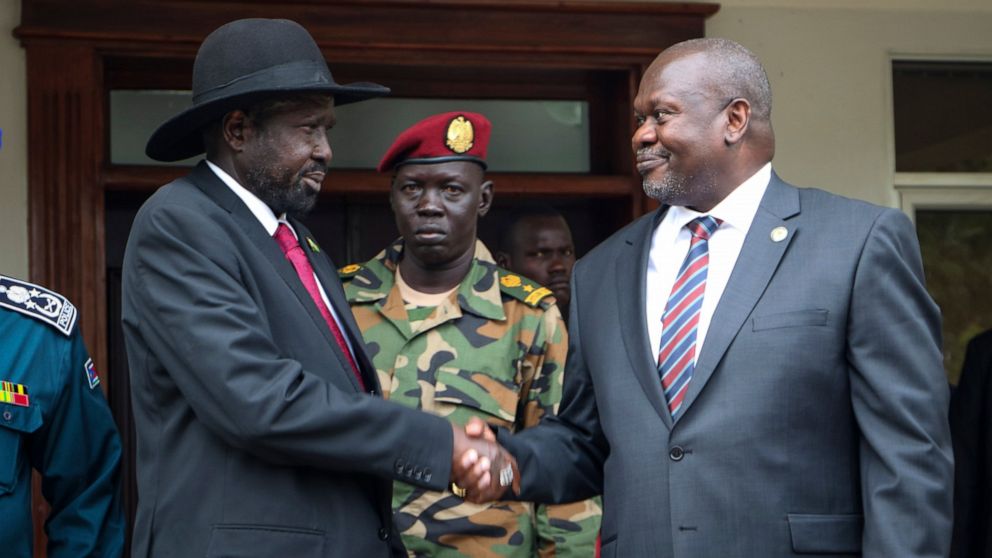
South Sudan’s president and his deputy have signed an agreement to unify the military command of the security forces

JUBA, South Sudan -- South Sudan's president and his deputy signed an agreement Sunday to unify the command of the security forces, a deal that eases political tensions in the East African country.

Clashes in recent days between government troops and forces loyal to Vice President Riek Machar raised the threat of another outbreak of serious fighting. In a letter to regional mediators, Machar had accused President Salva Kiir of violating a 2018 truce, citing attacks on his forces.

Sunday's agreement calls for a unified structure in the security services, including the army and the police, with 60-40 distribution in favor of Kiir's side.

Other details, including the positions allocated to each party, were not immediately available.

Both Kiir and Machar witnessed the signing ceremony in Juba, the South Sudan capital, where on Monday there was heavy military deployment, highlighting growing tensions.

“This is to inform everyone that we have agreed to unify the military command. We are for peace and that all of us should strive for peace,” said Tut Gatluak, a presidential advisor on national security.

Martin Gama Abucha, the mining minister who is a member of Machar's team, said the event was key to maintain peace in the country.

“It is important that we silence the guns, so that South Sudan can prosper,” he said.

There were high hopes for peace and stability when oil-rich South Sudan gained its long-fought independence from Sudan in 2011. But the country slid into civil war in December 2013 largely based on ethnic divisions when forces loyal to Kiir battled those loyal to Machar.

Tens of thousands of people were killed in the civil war which ended with a 2018 peace agreement that brought Kiir and Machar together in a government of national unity.

But challenges remained, including the government’s failure to implement promised reforms such as completing the unification of the army command.

The U.S., the U.K. and Norway — the troika supporting South Sudan’s peace deal — said recently they were concerned that the new outbreak of fighting threatened to undermine the government’s unity.

Adblock test (Why?)


"politic" - Google News
April 04, 2022 at 02:30AM
https://ift.tt/60RM4zZ

South Sudan's political rivals agree to unify army command - ABC News
"politic" - Google News
https://ift.tt/iqndlJ7
https://ift.tt/j9hUSQe

Saturday, April 2, 2022

Disney shareholder tells CEO Chapek to stop wasting money on 'political crusades' - Fox Business

unitedstatepolitics.blogspot.com

A Disney shareholder is speaking out against the company's involvement in Florida politics by actively opposing the Republican-led "Parental Rights in Education" bill championed by Republican Gov. Ron DeSantis.

Ray Keating, an economist and editor of DisneyBizJournal.com, said when companies dive into politics, it rarely turns out and well.

Disney CEO Bob Chapek

FILE - In this Sept. 11, 2015, file photo, Disney chief executive Bob Chapek speaks during a ceremony at Hong Kong Disneyland. Disney's 2021 second-quarter revenue dropped as the pandemic continued to weigh on its parks and theme parks. (AP Photo/Kin Cheung / AP Newsroom)

"Here’s a suggestion for Disney CEO Bob Chapek: Get back to business, that is, excellence in storytelling, and stop wasting shareholder’s money on political crusades that have nothing to do with Disney’s business," Keating told Fox News Digital.

HERITAGE ACTION CALLS OUT DISNEY: 'IT REALLY IS A WOKE WORLD AFTER ALL'

"We all have the right to have our voices heard on issues, but not on the shareholders’ dime."

DeSantis signed the legislation into law this week that bars instruction on sexual orientation or gender identity in kindergarten through third grade. Critics have depicted the bill as hurtful to LGBTQ inclusiveness and dubbed it the "Don't Say Gay" bill. 

Disney World Orlando

ORLANDO, FLORIDA - SEPTEMBER 30: General view of Rededication Moment and debut of "Disney Enchantment" during "The World's Most Magical Celebration" Walt Disney World Resort 50th Anniversary at Magic Kingdom on September 30, 2021 in Orlando, Florida. (Gerardo Mora/Getty Images / Getty Images)

Under pressure from LGBTQ activists and progressive employees – some of whom who have walked out of the job in protest – Disney's Chapek’s eventually criticized the Florida legislation, paused all political giving in Florida and apologized to employees. 

"You needed me to be a stronger ally in the fight for equal rights and I let you down," Chapek said in a statement on March. 11. "I am sorry."

FLORIDA REPUBLICANS CONDEMN 'WOKE' DISNEY, URGE MORE BOYCOTTS BY CONSERVATIVES AGAINST THE 'ACTIVIST MACHINE'

Disney this week said it will work to repeal the legislation in Florida because it's dedicated to standing up for the rights and safety of the LGBTQ+ community. 

"Florida’s HB 1557, also known as the ‘Don’t Say Gay’ bill, should never have passed and should never have been signed into law," the Disney statement said. "Our goal as a company is for this law to be repealed by the legislature or struck down in the courts, and we remain committed to supporting the national and state organizations working to achieve that."

Florida Gov. Ron DeSantis

MELBOURNE, FLORIDA, UNITED STATES - 2021/03/22: Florida Governor, Ron DeSantis speaks at a press conference at the Eau Gallie High School aviation hangar. (Photo by Paul Hennessy/SOPA Images/LightRocket via Getty Images / Getty Images)

Keating, who has written about how Disney's activism is bad for business, said Disney's decisions on the Florida bill has meant the company is catching heat from both sides of the political spectrum. Ever since Chapek spoke up, critics on the right have condemned Disney as being too "woke" and even talked of boycotting the resort.

GET FOX BUSINESS ON THE GO BY CLICKING HERE

"Disney’s management succumbed to political pressure from activists on the Left, and now it’s getting hit from the Left and the Right," Keating told Fox News Digital. "If I weren’t a shareholder, I’d find it amusing."

Nothing in the Florida legislation itself mentions the word gay. It states that "classroom instruction by school personnel or third parties on sexual orientation or gender identity may not occur in kindergarten through grade 3 or in a manner that is not age appropriate or developmentally appropriate for students in accordance with state standards."

Adblock test (Why?)


"politic" - Google News
April 03, 2022 at 03:45AM
https://ift.tt/WeGqo8p

Disney shareholder tells CEO Chapek to stop wasting money on 'political crusades' - Fox Business
"politic" - Google News
https://ift.tt/gZABFJ4
https://ift.tt/8QyEkxM

Friday, April 1, 2022

What The MLB Lockout Can Tell Us About Political Fandom And Sports Partisanship - FiveThirtyEight

unitedstatepolitics.blogspot.com

Welcome to Pollapalooza, our weekly polling roundup.


Yesterday was supposed to be Opening Day of the 2022 Major League Baseball season, but it was delayed a week (to next Thursday, April 7) by a contentious labor dispute between players and team owners that lasted much of the winter. The MLB lockout left fans feeling frustrated — especially with team owners — and, they claim, less interested in the sport. But that doesn’t necessarily mean they’ll stop root-root-rooting for the home team. And that holds a lesson even for those who aren’t baseball fans: Be skeptical when a poll says an issue will make people more or less likely to do something (like, say, vote a certain way).

First, some background: At the end of Dec. 1, the collective bargaining agreement that governed MLB players’ relationship with their employers (i.e., the 30 MLB teams) expired. In response, the team owners implemented a lockout (essentially the management version of a strike) preventing the players from going to work1 until the owners and players’ union reached a new agreement. For the next few months, the two sides slowly negotiated everything from specific rule changes to the biggest bone of contention, player salaries. Eventually, on March 10, they agreed to a new deal, but not before the first several games of the season were called off (they have now been rescheduled for later in the year).

According to two polls conducted just before the lockout ended, fans generally sided with the players in the dispute. Forty-five percent of self-identified MLB fans told Morning Consult that the owners were most responsible for the two sides’ failure to agree, while only 21 percent said the players were most responsible. Similarly, a SurveyMonkey/Los Angeles Times poll found that 31 percent of MLB fans blamed the owners most for the lockout, while only 12 percent blamed the players most (however, 49 percent said they blamed both sides equally). According to SurveyMonkey/the Los Angeles Times, fans agreed, 65 percent to 26 percent, that the players were negotiating in good faith, but fans narrowly disagreed that the owners were doing so, 49 percent to 42 percent.

Interestingly, in past labor disputes, fans generally sided with MLB owners. For example, during the notorious 1994-95 strike (which canceled the 1994 World Series), an NBC News/Wall Street Journal poll found that 45 percent of fans held the players more responsible and only 27 percent held the owners more responsible (24 percent volunteered that both sides were equally responsible). Why the reversal? 

For one thing, in a very literal sense, the owners were responsible for the recent lockout: They didn’t have to implement it (legally, the business of MLB could have continued under the old collective bargaining agreement while a new one was being negotiated), but they chose to do so to gain leverage over the players. In addition, owners reportedly pulled a fast one on the players at times during negotiations, such as inserting new provisions into a proposal at the last minute and refusing to make a counterproposal after saying they would. Media coverage of the lockout was also more sympathetic to the players, both explicitly and implicitly by highlighting how much wealthier the owners are than the players and how the players’ share of MLB’s revenue has dropped in recent years.

Regardless of whom they blamed, though, fans weren’t happy during the lockout. Forty-six percent told Morning Consult they were “frustrated,” and 75 percent told SurveyMonkey/the Los Angeles Times that they agreed that the main issue in the lockout was “greed, not baseball.” And 60 percent of fans in the SurveyMonkey/Los Angeles Times poll said that the dispute had caused them to lose interest in the 2022 baseball season.

You might expect that last number to set off alarm bells in MLB headquarters (and maybe it did — these polls, or at least the sentiments expressed in them, could help explain why a new agreement was signed just a few days later). But later on in the same poll, a plurality of fans also said the lockout probably wouldn’t affect how much time or money they spent on baseball this year. Fifty percent of fans said they would attend about the same number of games that they would have if there hadn’t been a lockout, 49 percent said they would watch about the same number of games and 47 percent said they would buy about the same amount of merchandise.

Granted, a healthy minority of fans — 32-36 percent — said they would do these things less because of the lockout, but since the poll was taken while the lockout was still going on, some fans may have assumed that the lockout would cancel a good chunk of, if not the entire, season. (In a separate question, only 59 percent of respondents predicted that the lockout would be resolved by Memorial Day.)

And even those who weren’t may have been using this question to express their displeasure with the dispute. We’ll have to wait until the end of the season to check attendance, viewership and revenue numbers to know for sure, but the smart bet is probably that the lockout won’t significantly harm MLB’s bottom line.2 You see, polling questions like this are a honeytrap for political analysts, too. Pollsters routinely ask people whether certain policy stances, political decisions or scandals will make them more or less likely to vote for a politician, but these questions should rarely be taken literally. 

That’s because respondents themselves rarely take the question literally, instead using it as an opportunity to register their feelings about the stance, decision, scandal or politician in question. For example, according to a SurveyMonkey/NBC News poll from back in 2016, 39 percent of likely voters said that the “Access Hollywood” tape would make them less likely to support Donald Trump for president. But that included 65 percent of Democrats — few of whom ever had any likelihood of supporting Trump anyway. Among Republicans — i.e., a group that was inclined to support Trump before the tape’s release — only 12 percent said the tape made them less likely to support him, while 81 percent said it made no difference. 

An Ipsos/FiveThirtyEight poll from 2019 illustrates how this can apply to nonelectoral questions, too. In it, 38 percent of Americans said that Trump’s impeachment hearings had made them more likely to believe he committed an impeachable offense; only 20 percent said it made them less likely to believe it. But 95 percent of those who said the hearings made them more likely to believe Trump committed an impeachable offense already believed that he had. And an identical 95 percent of those who said the hearings made them less likely to believe it already believed that he was innocent.

These types of questions are really relevant only among the subset of respondents whose minds are genuinely not made up — and even then, you’re putting a lot of trust in them to accurately predict their future behavior. (For instance, Trump did dip in the polls after the “Access Hollywood” tape was released — but he recovered a few weeks later, suggesting that voters put aside their misgivings with the tape because they found another reason to vote for Trump.)

And sure, maybe MLB fans’ game-watching habits are more malleable than partisans’ political beliefs, but sports fandom can inspire people to do extreme things and twist themselves up in logical knots, just like partisanship. There’s a reason that sports fandom and political fanaticism are often compared. 

Other polling bites

  • Will Smith’s net favorability rating among Americans has fallen by 30 percentage points after he slapped Chris Rock at the 94th Academy Awards last weekend, according to a March 27 poll from CivicScience. (If you’ve been living under a rock: Smith attacked Rock after Rock made a joke about Smith’s wife, Jada Pinkett Smith, who has alopecia.) CivicScience, which has been tracking Smith’s favorability ratings weekly since 2011, found Smith’s net favorability — the share who have a favorable view of Smith minus the share who have an unfavorable view — dropping from +50 points to +20 points post-slap. Seventy-eight percent of Americans sided with Rock, according to this poll, while 61 percent said in a March 28 YouGov poll that what Smith did was wrong.
  • The share of Americans supporting Ketanji Brown Jackson’s confirmation to the Supreme Court seems relatively unchanged by her confirmation hearings, though some Americans may have gone from being undecided to opposing her confirmation. A March 25-27 poll from Morning Consult/Politico found that 47 percent of registered voters thought that the Senate should vote to confirm Jackson, while a March 26-29 poll from The Economist/YouGov showed 43 percent support among Americans. Those numbers are similar to Jackson’s support in our analysis of polls conducted prior to the hearings. When compared with their previous polls, the share of respondents who had “no opinion” or were “not sure” dropped by 7 percentage points in both polls. The Morning Consult/Politico poll also found that opposition to Jackson’s confirmation rose by 7 points, but The Economist/YouGov survey found basically no change in opposition.
  • Views of American leadership have dramatically improved across almost all NATO countries, according to a Gallup poll conducted in February but before Russia’s invasion of Ukraine. Compared to 2020, 26 of the 27 countries polled had a more favorable view of U.S. leadership. The greatest increases came from Portugal (52 percentage points), the Netherlands (45 points) and Norway (42 points). The only country with lower approval of U.S. leadership was Lithuania, where favorability decreased by 6 points.
  • A strong majority of Americans (77 percent) supported the CDC’s decision to relax social distancing and face mask guidelines in areas with low rates of COVID-19, according to a March 10-14 poll from Monmouth University. Additionally, 62 percent thought that face mask and social distancing guidelines should not be instituted in their state currently, while 55 percent opposed requirements to show proof of vaccination to do in-person work. But a majority of Americans seemed fine with changing these guidelines as the situation changes — 50 percent said they preferred for the government to continue adjusting guidelines and mandates, while 34 percent said they wanted no guidelines and 14 percent said they wanted the government to settle on something consistent.
  • Americans are growing increasingly concerned about Russia’s nuclear weapons and global influence, according to a March 17-21 poll from the Associated Press/NORC Center for Public Affairs Research. Seventy-one percent of Americans said that Russia’s invasion of Ukraine had increased the likelihood of nuclear weapons being used anywhere in the world, with the majority saying that this made them extremely or very concerned about Ukraine (61 percent) or other European countries (50 percent) being potential targets. Compared with a February poll taken just prior to the invasion, the share of Americans in the more recent poll who were extremely or very concerned that Russia’s influence around the world posed a direct threat to the United States rose 11 percentage points, to 64 percent.

Biden approval

According to FiveThirtyEight’s presidential approval tracker,3 41.2 percent of Americans approve of the job Biden is doing as president, while 53.1 percent disapprove (a net approval rating of -11.9 points). At this time last week, 41.6 percent approved and 53.0 percent disapproved (a net approval rating of -11.4 points). One month ago, Biden had an approval rating of 40.9 percent and a disapproval rating of 53.3 percent, for a net approval rating of -12.3 points.

Generic ballot

In our average of polls of the generic congressional ballot,4 Republicans currently lead by 2.1 percentage points (44.7 percent to 42.6 percent). A week ago, Republicans led Democrats by 2.0 points (44.5 percent to 42.5 percent). At this time last month, voters preferred Republicans by 2.3 points (45.0 percent to 42.6 percent).

Adblock test (Why?)


"politic" - Google News
April 01, 2022 at 05:00PM
https://ift.tt/RoVSlgm

What The MLB Lockout Can Tell Us About Political Fandom And Sports Partisanship - FiveThirtyEight
"politic" - Google News
https://ift.tt/gZABFJ4
https://ift.tt/8QyEkxM

How New York's Bail Law Became a Political Lightning Rod - New York Magazine

unitedstatepolitics.blogspot.com
A coalition of Jewish organizations, rabbis, and elected officials express their support for bail reform at a City Hall rally on January 16, 2020. Photo: Gabriele Holtermann-Gorden/Sipa USA via AP

After two NYPD officers were gunned down while responding to a domestic disturbance call in January, critics of the state’s bail-reform law pressed Governor Kathy Hochul to roll back the reforms that they blamed for a surge in violent crime. When asked about the issue at a press conference at the time, Hochul accused Republicans of attempting to “politicize” it.

“I will absolutely stand behind the fundamental promise on why we needed bail reform in the first place,” Hochul said.

Today, Hochul is the one trying to roll back bail reform. In a ten-point plan for public safety she unveiled to lawmakers in Albany in mid-March, four of the points concern changes to the bail-reform law. The plan would make hate crimes and crimes against transit employees eligible for arrest rather than just a desk-appearance ticket, make certain gun offenses eligible for bail, allow arrests for repeat low-level offenses, and permit judges more discretion in considering criminal history when determining bail for serious felonies.

The politics surrounding bail reform have continued to change as proponents of the legislation attempt to balance their support for criminal-justice reform against vocal critics who believe the bill is responsible for an increase in crime in New York City and statewide — though there is no strong evidence to prove this.

The fight to change the law to spare people from pretrial detention because they can’t afford bail had long been a priority of criminal-justice reformers. But it was supercharged following the 2015 death of Kalief Browder, who was detained on Rikers Island as a teenager for three years because his family was unable to pay his $3,000 bail. Browder, who had been accused of stealing a backpack full of valuables, spent a significant portion of his time in solitary confinement and endured attacks from guards and his fellow inmates. In 2015, two years after the charges were dismissed and he was released from Rikers, he committed suicide — which his family says was the result of the trauma of being imprisoned .

The effort to change the law so that people wouldn’t be detained just because they could not pay bail culminated in 2019 when the state legislature passed legislation eliminating bail and pretrial detention for most nonviolent felonies and misdemeanors. Almost as soon as the law went into effect in January 2020, attacks on it began. The reform coincided with a rise in violent crime across the country during the onset of the pandemic. In New York, law-enforcement officials and politicians critical of the reforms latched onto them as the cause of the crime spike in the city, arguing that bail-reform essentially returned violent criminals caught by police to the streets where they reoffended.

With criticism of the bail law continuing to mount, state politicians passed an amendment of the law in April 2020 as part of that year’s budget, which increased the number of bail-eligible offenses and provided judges more leeway in setting bail for repeat offenders. The change received the approval of Governor Andrew Cuomo and Mayor Bill de Blasio who had been advocating for additional revisions to the law.

Through the next year, concerns about crime were a major focus of the 2021 mayoral race. The new mayor, Eric Adams, is a former police officer who made public safety the signature issue of his campaign. He has repeatedly advocated for reforms to the state’s bail law, even traveling to Albany in February to press lawmakers on his position. Hochul’s plan includes other changes that Adams has called for, such as adjusting the “Raise the Age” law, which increased the age at which a minor can be prosecuted as an adult to 18.

After Hochul rose to the governor’s seat following her predecessor’s resignation, debates about bail reform continued to simmer as state Republicans wielded the issue in last November’s elections to great success.

Bail reform is expected to play a significant role in this year’s elections as well. Hochul, who is currently running for a full term, has received pushback from both her Democratic and Republican rivals, simultaneously fielding arguments that her changes go either too far or not far enough. (The governor’s office did not respond to a request for comment.)

A recent Siena College poll found that 56 percent of total voters believe that the 2019 bail-reform law has been bad for New York. Sixty-four percent of those same voters said that they believed that the law has resulted in an increase in crime. However, when asked how concerned they were that giving judges increased discretion to set bail will result in poor people and people of color being unfairly incarcerated, 24 percent of voters said they were “very concerned” while 32 percent said they were “somewhat concerned.”

Many advocates for the law reject the notion that bail reform can be linked to a recent rise in crime. Brad Lander, the city’s comptroller, said that discussions about the issue have become “divorced from the data.” A report released by his office office last week found that recent increases in crime in New York City — mirrored by upticks around the country — are not a result of the reforms. According to the report, 14,545 people were subject to bail in 2021, compared to 24,657 people in 2019. However, in 2021, $268 million in bail was posted on behalf of defendants, an increase from $186 million posted in 2020. The analysis also found that in December 2021, 96 percent of the people who were released pending trial were not rearrested, and that 99 percent of people were not rearrested on a violent felony charge, regardless of the pretrial conditions in place.

Advocates of the 2019 bail reform feel that any rollback of the legislation will only increase racial disparities in the justice system, and have an adverse effect on poor New Yorkers who might struggle to pay excessive bail.

“I wouldn’t call it a public-safety plan. I call it a mass-incarceration plan,” said Marie Ndiaye, a supervising attorney with the Legal Aid Society. She labeled the proposal “regressive,” citing the provision that would allow judges to account for community safety when setting an individual’s bail. Mayor Adams has called for judges to be able to factor in “dangerousness,” while many detractors say such a standard risks potential racial bias in sentencing.

Akeem Browder, Kalief’s older brother, believes that Hochul’s proposal undoes years of reform work from advocates without tackling underlying societal problems, adding that he doesn’t believe the governor is “genuine in her approach.”

Browder, who founded the Kalief Browder Foundation, which advocates for pretrial detention reform, said that, as a single father raising a son in the Bronx, he knows violence in the city is a concern. But he believes politicians aren’t doing enough to invest in underfunded communities and to address issues of poverty and mental health.

“We do need safety, but we don’t need over-policing, because what will happen is what has happened in the past. Over-policing only happens in our communities of Black and brown, poor or disenfranchised communities. So, over-policing, arrests and incarceration and surveillance is what will happen,” Browder said.

He continued, “What we need is safe housing and good health care, child care, reliable transportation. We need a better living wage. But that’s not what’s going to be looked at when we’re talking about public-safety concerns.”

Adblock test (Why?)


"politic" - Google News
April 01, 2022 at 09:29PM
https://ift.tt/aZqMsp2

How New York's Bail Law Became a Political Lightning Rod - New York Magazine
"politic" - Google News
https://ift.tt/gZABFJ4
https://ift.tt/8QyEkxM

Search

Featured Post

Politics - The Boston Globe

unitedstatepolitics.blogspot.com Adblock test (Why?) "politic" - Google News February 01, 2024 at 03:47AM https://ift.tt...

Postingan Populer