President Trump is taking a beating from the Jan. 6 panel, with ex-White House aide Cassidy Hutchinson this week offering particularly damaging testimony about the former president’s temperament and knowledge of what was happening in the attack on the Capitol.
The hearing underscored the panel’s effort to build a public case that Trump is unfit to serve as president again as he moves toward launching a possible new bid for the White House.
Yet it’s unclear how much the testimony of Hutchinson and others is breaking though.
A poll published Friday by Emerson Polling found Trump with a sizable lead among potential 2024 GOP primary candidates. Fifty-five percent of respondents said they’d back Trump for the nomination, with Florida Gov. Ron DeSantis (R) garnering 20 percent.
And in a hypothetical 2024 rematch between Trump and President Biden, the Emerson poll found Trump leading with 44 percent support to Biden’s 39 percent.
The poll was conducted June 28-29, meaning the effects of Hutchinson’s testimony may not have been fully taken into account by some respondents.
Multiple former Trump aides have argued the Jan. 6 hearings amount to a television production that is bipartisan in name only given the two Republican members, Reps. Liz Cheney (R-Wyo.) and Adam Kinzinger (R-Ill.), are among the most outspoken Trump critics.
GOP strategists also believe that while the Jan. 6 hearings may cost him with voters who were reluctant to vote for him in 2016 before backing him in 2020, it may not be enough to cost Trump in a hypothetical matchup with Biden, particularly given all the other problems the country is facing.
“It’s all too soon to say. We’ll see what the final product is,” one GOP strategist with ties to Trump’s orbit said.
“I think that the biggest problem for folks that want this commission to be everything and anything is the American people are facing real life daily problems and that can be directly attributed to the policies of the Biden administration,” the strategist added.
Hutchinson, who served as a top aide to then-chief of staff Mark Meadows, painted a picture with her testimony on Tuesday of a former president with a temper who disregarded warnings things could get violent on Jan. 6 and seethed with anger when he was unable to join his supporters at the Capitol that day.
The most explosive piece of testimony – that Trump lunged for the wheel of his SUV and then at a Secret Service agent when told he couldn’t go to the Capitol – has faced pushback from some of the individuals involved in the episode, though they have not testified publicly to dispute the account.
But Hutchinson’s testimony that Trump and his chief of staff were warned some in the crowd had weapons and that Trump wanted to go the Capitol with the scores of supporters who went on to storm the complex have not been refuted by others involved.
Hutchinson’s appearance before the committee built on a larger narrative the House panel has laid out: That Trump was told repeatedly by officials that his claims of election fraud were not supported by evidence but pushed his claims that the 2020 election was stolen anyway, culminating in the attack on the Capitol on Jan. 6, 2021.
One hearing featured Department of Justice officials testifying in detail about how Trump pushed the agency to investigate fraud claims even as those same officials said they explained one-by-one why those claims were false.
Another hearing featured officials close to former Vice President Pence testifying about how Trump and his allies pressured Pence to overturn the 2020 election results without legal basis.
And at the end of Tuesday’s hearing, Rep. Liz Cheney (R-Wyo.) showed text messages that indicated Trump allies may have engaged in witness intimidation.
With at least a few more public hearings still to come, followed by the committee’s final report, Trump’s standing among potential 2024 voters could still take a hit. And there are signs that the public is taking the committee’s findings seriously.
An Associated Press-NORC poll published Thursday found 48 percent of adults believe Trump should be charged with a crime for his role in the Jan. 6 riots, while 31 percent said he should not be charged.
The poll, which was conducted before Hutchinson’s public testimony, also found 58 percent believe Trump bears a great deal or quite a bit of responsibility for the events of Jan. 6.
A pair of conservative editorial boards this week also raised concerns about Trump’s viability should he run in 2024.
The Washington Examiner editorial board wrote that Hutchinson’s testimony “ought to ring the death knell for former President Donald Trump’s political career. Trump is unfit to be anywhere near power ever again.”
The Wall Street Journal noted that some of Hutchinson’s testimony was second hand and wrote that the committee “is steeped in partisanship.”
“But that doesn’t mean Republicans should look away from the considerable evidence it is producing about Mr. Trump’s behavior that would surely be relevant to voters if he runs in 2024,” the editorial board wrote.
The World Health Organization (WHO) welcomes the political declaration to be adopted by Member States during the High-level Meeting of the UN General Assembly on Global Road Safety. It commits to cut road traffic deaths and injuries by 50% by 2030, a milestone for road safety and sustainable mobility.
The meeting takes place on 30 June – 1 July 2022 under the theme “The 2030 horizon for road safety: securing a decade of action and delivery”.
Road safety affects everyone. We step from our homes every day onto roads that take us to our jobs, schools and to meet our vital daily needs. Yet our transport systems remain far too dangerous. No death should be acceptable on our roads. The future of mobility should promote health and well-being, protect the environment and benefit all,” said Dr Tedros Adhanom Ghebreyesus, Director-General, WHO. “It will require transformative leadership from the highest levels of government to act on the Political Declaration to make that vision a reality.”
Worldwide, road crashes currently kill around 1.3 million people each year – more than 2 every minute, and more than 90% occur in low- and middle-income countries. Crashes are the biggest killer of children and young people globally. More than 50 million people have died on the world’s roads since the invention of the automobile, more than the number of deaths in the First World War or in some of the worst global epidemics.
WHO is the lead agency for road safety in the United Nations and supported the President of the UN General Assembly in preparing this High-Level Meeting in collaboration with other UN agencies.
Through the declaration governments from around the world commit to provide leadership and coordination at the highest level of government to ensure all parts of the society are included to act on road safety and commit to boost policies and actions to reduce deaths and injuries. The declaration calls for the development and funding of national and local plans with clear targets and funding.
“Road traffic deaths upend countless lives and cost countries around 3% of GDP each year,” notes Dr Etienne Krug, Director of the Department for Social Determinants of Health, WHO. “This is an unacceptable price to pay for mobility. Putting safety at the heart of our mobility systems is an urgent health, economic and moral imperative. Let’s work together to scale up what works, save lives and build streets for life.”
In September 2020, the UN General Assembly adopted a resolution to proclaim the Decade of Action for Road Safety 2021–2030. WHO and the UN regional commissions, in cooperation with other partners in the UN Road Safety Collaboration, have developed a Global Plan for the Decade of Action, which was released in October 2021.
The plan calls for continued improvements in the design of roads and vehicles, enhancement of laws and law enforcement, and provision of timely, life-saving emergency care for the injured. In addition, it promotes healthy and environmentally sound modes of transport.
It also highlights that responsibility for road safety stretches far beyond health and transport. Urban planners and engineers must prioritize safety as a core value in all transport infrastructure while businesses can influence and contribute to strengthening road safety by applying safety-first principles to their entire value chains.
Countries and cities guided by the plan are seeing dramatic reductions in deaths. For example, the Colombian capital of Bogota halved deaths over 10 years through a set of integrated actions, including wide-ranging technical improvements and regulatory reforms that were driven by strong leadership.
The meeting will take place in New York on 30 June 2022, at 10:00 EST. The event will be broadcasted on UN Web TV.
"politic" - Google News
June 30, 2022 at 01:04PM
https://ift.tt/ZtC5NY6
New political declaration to halve road traffic deaths and injuries by 2030 is a milestone achievement - World Health Organization
"politic" - Google News
https://ift.tt/HXj4k5F
https://ift.tt/xz60R8F
According to the authorities, as a northbound Q train climbed the Manhattan Bridge one Sunday morning this spring, a 25-year-old passenger named Andrew Abdullah began to pace and mutter. He paused in front of Daniel Enriquez, a Goldman Sachs employee who was on his way to meet his brother for brunch. Abdullah, who had served four months in prison for attempted murder, pulled a 9-mm. pistol from his pocket, pointed it at Enriquez’s chest, and fired. At the Canal Street station, as Enriquez was bleeding to death, Abdullah exited the train and slipped into the streets. In a season of unspeakable crimes, the unprovoked homicide was perhaps the worst. Police launched a citywide manhunt.
The next day, May 23, Abdullah’s aunt called Bishop Lamor Miller-Whitehead, who runs the Leaders of Tomorrow International Churches — a nondenominational Christian ministry operating from a banquet hall among the body shops and auto mechanics on a block in Canarsie. The aunt was in a panic, worried about what was going to happen to her nephew, whose face was by now all over the news and social media. She was concerned that the police were going to hurt or kill Abdullah and that he was going to harm someone else before he could be apprehended. “And so I made a phone call,” Miller-Whitehead told me, “to my mentor, the mayor of New York, Eric Adams.”
Before he became a pastor, Miller-Whitehead spent five years at Sing Sing for running a $2 million identity-theft ring. He used the money to buy luxury cars, including the Land Rover he was eventually arrested in, wearing mink. After Miller-Whitehead was released, he began raising money for his newfound ministry and touting the youth programs he was running in partnership with the Brooklyn DA’s office, the NYPD, and the Brooklyn Chamber of Commerce — each of which said later that no such collaboration existed. But the relationship Miller-Whitehead developed with Adams, then the Brooklyn borough president, was real. The two appeared at more than a dozen events together.
After Abdullah’s aunt called Miller-Whitehead, the pastor came up with a plan to have Abdullah turn himself in: The most wanted killer in New York would go to a police station and surrender directly to Adams. Miller-Whitehead figured the mayor’s presence would both entice Abdullah to show up and ensure that the police wouldn’t shoot him. Miller-Whitehead told me he got Adams to personally sign on to the operation. “The mayor was in full support of this man turning himself in and said he would follow my lead,” he says. “And whatever I needed, he would make sure that it would get done.” (The administration declined to comment.)
There are good reasons why mayors do not customarily join in taking suspected murderers into custody. One is that it would create a precedent for all attention-hungry killers to insist on an audience with the city’s highest-ranking official. Another is that the mayor has a security detail whose entire function is to keep him far away from people with a history of shooting men in the chest. A third is that the mayor’s job is to reduce crime in the aggregate, through policy, not on a case-by-case basis like Batman.
Adams and the bishop spoke several times, but the handover never happened. Lawyers for Legal Aid who had been working with Abdullah’s family on another charge were talking with the police and arranged for the shooter to turn himself in at their offices. The police ended up seizing Abdullah early, his lawyer, Kristin Braun, said, because the NYPD was concerned that he would flee while the bishop was negotiating with the mayor on his behalf.
What should a new mayor accomplish with his incoming political capital? In his first year in office, Bill de Blasio created a universal prekindergarten program, curtailed stop-and-frisk policing, pushed the Rent Guidelines Board to approve its lowest-ever hikes, began a $41 billion affordable-housing program, and signed an executive order raising wages for retail and fast-food workers. Mike Bloomberg, in his first year, put city schools under mayoral control for the first time, banned smoking in bars and restaurants, began the rebuilding of lower Manhattan after 9/11, raised property taxes to plug an enormous budget gap, and opened a shelter for homeless families in a converted jail.
Adams does not yet have a comparable accomplishment, nor does he appear to be on pace for one. It’s not that he’s asleep on the job. Between taking calls from Miller-Whitehead about capturing Abdullah, Adams kept a schedule that might have exhausted any number of his predecessors: He met with Border Patrol officials about the flow of illegal guns, discussed hurricane season with a delegation from NOAA, hosted two dozen European consuls general, received members of George Floyd’s family, celebrated incarceration-diversion programs at a courthouse, huddled with tech executives, and hosted a Jewish Heritage Month party at Gracie Mansion. What we are seeing is something quite different from mayoralties of recent memory — a politics that is mostly public performance with a mayor who makes news more for what he says and how he appears than for what his administration is actually doing.
As the most prominent citizen of what he likes to call the “City of Swagger,” Adams has been well documented: hanging out at fashion shows with Anna Wintour, dining with Paris Hilton, outlasting Jennifer Lopez at the late-night party for a new film about her, haunting the private club Zero Bond often enough that lobbyists are strategizing about how to become members. Adams is also aggressively fundraising for reelection in 2025 at posh events in places from the Hamptons to Beverly Hills. “I have never had so much fun in my life,” he told one friend over dinner this spring.
At a Michael Kors runway show with Anna Wintour. Photo: Dimitrios Kambouris/Getty Images
Ahead of his inauguration, he hitched a private-jet ride with Brock Pierce, the Mighty Ducks actor turned crypto magnate, and announced he would take his first three mayoral paychecks in bitcoin. The market has since been cut in half. “He gets charmed by the worst guy in the industry and looks like a fricking idiot,” a longtime Adams ally says. “That wouldn’t have happened to any other mayor. There would have been somebody to say, ‘Let me give you some background on cryptocurrency, Mr. Mayor.’” On a similarly impulsive but graver note: After a gunman shot ten people on the N train in April, Adams agreed with a journalist’s suggestion that the city should screen subway riders with metal detectors. An uproar ensued over the obvious implausibility — the system has 472 stations and countless entrances — so a spokesman walked his comments back, writing on Twitter that the mayor was “of course” not saying there would be literal metal detectors. Adams then walked back the walk-back, saying he was in fact serious about exploring the idea. It’s become hard to escape the impression that New York City is being led by a mayor who is, frankly, winging it.
As an administration official put it, “Sometimes working here can feel like Jurassic Park, and he is the T. rex and is going to keep on testing the fences until he breaks through. He needs somebody who can whisper in his ear, ‘Mr. Mayor, I’m sorry, but you are out of your fucking mind right now.’” (Adams declined requests to be interviewed for this article. A spokesperson said in a statement that the mayor’s accomplishments include “driving down rates of shootings and homicides, safely keeping schools open during the Omicron wave, putting half a billion dollars into the pockets of working families through an enhanced Earned Income Tax Credit, passing legislation to invest billions of dollars in NYCHA, and more.”)
The behavior is confounding to those who never knew Adams to have such a taste for nightlife and who expected more readiness from someone entering office with the longest government tenure of any mayor in 70 years. One night in March, as his administration began clearing homeless encampments from city parks, the mayor appeared at a Wells Fargo party with Cara Delevingne to boost a new credit card that bank customers could use to pay rent. Weeks later, Adams announced he was halting all city business with Wells Fargo, citing accusations that it discriminated against Black homeowners.
At a Wells Fargo party with Cara Delevingne and Floyd Mayweather. Photo: Johnny Nunez/WireImage
Six months in, Adams has avoided putting out hard metrics to gauge his success and has been surprisingly passive on critical issues like housing affordability. In June, addressing the Association for a Better New York, Adams repeated a favorite line: that New York needs to become a “City of Yes” and a place where things get built. Two weeks later, on a Brooklyn rooftop, he unveiled what was billed as a “comprehensive blueprint” for solving the affordable-housing crisis. But it was so vague that the event turned chaotic, with Adams refusing to tell reporters how many actual units would be added. The blueprint pushed the timeline to revise the city’s housing code back to 2024, which means there’s a decent chance that no new housing not already in the pipeline will actually be built during Adams’s tenure, even if he serves two terms. Administration officials have told activists they won’t propose rezonings to permit more housing unless councilmembers propose and fight for them.
For Adams, there’s a danger that his perception as a lightweight is hardening in the eyes of all sorts of political observers. “I TOLD YALL NYC ELECTED A CLUB PROMOTER 🤣🤣😭🤣😭,” the Kid Mero tweeted in late June over an image of Adams at Sei Less with French Montana and Rowdy Rebel. “The other night, he attended the German American Chamber of Commerce White Asparagus Dinner,” one business leader close to the mayor told me. “I mean, can you imagine?” The tone was less disdain than Aren’t there more important things to do? The electorate would seem to agree: A recent Siena College poll for NY1 found that fewer than three in ten city residents rate Adams’s job performance as good or excellent. Three-quarters said they feared they could be the victim of a violent crime.
At an album party with French Montana. Photo: Cassidy Sparrow/Getty Images
Adams has made public safety his signature issue, but crime has risen to new levels during his term (though homicides have begun to abate), and both the Times and the Post have faulted his plans to combat it as outdated and ineffectual. In January, after a particularly horrific spate of violence — five police officers shot, a woman pushed in front of a subway train, a teenage cashier gunned down in a botched robbery, an 11-month-old baby randomly shot in the face — Adams convened a roundtable of violence interrupters in the Bronx and laid out his vision to make the city safer. It was mostly small-bore: directing police and the health department to support local nonprofits like theirs, streamlining how city money can go to the groups’ payrolls, leaning on Fortune 500 companies to issue no-interest loans to make up the gap.
Adams also pledged to appoint a “crisis-management liaison” inside every agency to help simplify the city’s bureaucracy and reorient every agency — of which there are more than 50, with some 370,000 employees, from the Department for the Aging to the Department of Youth and Community Development — to see its mission as driving down crime. Adams sounded tough. “We are not playing this game anymore where agencies are running the city,” he said. “No. Agencies are going to respond to what I need done. This is where we are going. This is the Adams era.” But five months later, agency officials say nothing has substantially changed. Instead, the mayor recently announced the creation of a Gun Violence Prevention Task Force, led by a “gun-violence czar,” Andre T. Mitchell. A 2019 Department of Investigations probe into an anti-gang organization Mitchell heads found that he had directed proceeds from a youth-employment coffee shop to his personal bank account and had put several family members on the payroll.
On June 27, the same day Adams said his response to a citywide lifeguard shortage would be a public-awareness campaign about drowning, the Post published an interview in which he boasted about a new system he had devised for the police to track homeless encampments. It’s a shared Google doc.
On the set of Late Night With Seth Meyers. Photo: Lloyd Bishop/NBC/Getty Images
Despite Adams’s long years in city and state politics, there were signs early on that he wasn’t interested in fully exercising his new power. After the June 2021 mayoral primary, the political class turned its attention to who would become the next Speaker of the City Council. Chosen by the group’s 51 members, the leader becomes — in the public imagination, at least — something of a psychic counterweight to the mayor, the second-most-powerful person in city government and often a contender to eventually hold the top job.
Adams was entering office with such a powerful coalition behind him — outer-borough homeowners, blue-collar Black voters, downtown financial and real-estate interests — that the entire political world seemed to be bending to his will, and its inhabitants assumed the Speaker-selection process would unfold as it always had. Traditionally, a half-dozen or so councilmembers vie for the job, gathering as much support among their colleagues as they can, and then, at the end, the incoming mayor uses his sway to put someone he favors over the top.
Adams liked Francisco Moya. The Queens councilmember could help answer the complaints that the new administration didn’t have enough Latinos in its upper ranks, and he was on the right flank of the body, which could have given Adams a useful foil. But Moya had scarcely any support among his fellow members, which meant that pumping him up would have taken a serious effort by Adams. Instead, the mayor left the country twice, heading to the French Riviera on vacation and then, as he prepared to be sworn in and the Speaker race was in full tilt, to Ghana for what he described as a “spiritual cleansing.”
In his absence, whipping the contest fell to Adams’s chief of staff. Mayors often fill the role with creatures of municipal bureaucracy, but Adams tapped a kind of insider-outsider: Frank Carone, a Brooklyn lawyer who ten years ago began to get involved in Democratic politics using his growing influence with elected officials to build his law practice into one of the most successful in New York. (He pressured de Blasio’s staff so often that specific workers were assigned just to deal with him.) Adams has told associates that he knew hiring him would lead to some bad press — in February, Carone was subpoenaed for documents in an alleged $4.5 million insurance fraud, though he hasn’t been accused of wrongdoing — but believed his extraordinary loyalty and lobbyist’s-eye view of the inner workings of government made him worth the risk. Carone has made allies on the job: He met with all of his living predecessors, and he regularly emails the entire senior mayoral staff asking if anyone would like his standing Thursday-night table at Rao’s, the impossible-to-book East Harlem eatery. Yet his day-to-day job is strikingly different from anything he has previously done, which mostly involved raising money and advocating for clients with business before the city.
Hoping to get Adams the Speaker of his choice, Carone met over breakfast with the contest’s front-runner: Justin Brannan, a shaven-headed, tattoo-sleeved former punk-rocker from Bay Ridge. Carone told him he needed to withdraw from the race and support Moya. Brannan agreed, but after that the pressure campaign stopped working. Even as the Adams team asked Representatives Adriano Espaillat and Grace Meng to lean on the councilmembers they were aligned with, the shallowness of Moya’s support among his 50 colleagues proved too much to overcome. He had barely campaigned for the Speaker job.
Brannan and the other leading contenders met at a diner for lunch. They realized that while Adams could block any one of them individually, together they could be kingmakers. They could line up their backers behind someone they anointed and be rewarded with plum council posts in the process. They settled on Adrienne Adams, an under-the-radar member from southeastern Queens. (She’s not related to Eric, though they went to the same high school at the same time.)
The incoming mayor still had a way to force a win. When Adams returned from overseas, he met with the leaders of the city’s three most powerful unions, who wanted an ally in the Speaker’s chair and were willing to use their influence to make it happen. They told Adams that if it was important to him, they would push Moya over the line. Faced with the first big decision of his not-yet-mayoralty, Adams balked. “I am not going to ask you to do that,” he told the labor leaders.
Once Adrienne Adams locked down the vote, Eric Adams tried to prevent her from placing key allies in positions of importance. (A spokesperson for the mayor disputes this.) He failed there, too. Brannan became the head of the finance committee. Another member of the diner group became the head of the investigations committee, another the deputy Speaker, and a third the majority leader.
Newly elected councilmembers say the Speaker episode taught them some things about the new mayor. Just because he says a matter is settled, it doesn’t necessarily mean that it is. And more to the point, if Adams tells them to do something, they don’t have to follow along. It’s not just that they might escape penalty; they might even get rewarded for thwarting him.
Adams has also seemed to misjudge the best use of his power in smaller contests. As New York’s primary season heated up earlier this year, he surprised many by endorsing candidates not just for State Assembly but in races for unpaid Democratic Party positions known as district leaders — an office so far below the radar that few New Yorkers even know it exists. His campaigning and fundraising were intended to shore up support for Rodneyse Bichotte Hermelyn, the Brooklyn party boss who relies on the district leaders for her power and is a close Adams ally. But by engaging in such minutiae, the mayor risked not just embarrassment — several of his chosen candidates lost on June 28, including Hermelyn’s husband — but making a raft of unnecessary enemies in his political base. “I don’t know why he is fighting these battles,” says Howard Graubard, a longtime Brooklyn election lawyer. “I think most mayors would say, ‘This is beneath me.’ You are asking me to explain the logic behind something that isn’t logical, and I can’t.”
Even in cases where Adams has gotten his way, it’s not clear that he actually won. He has repeatedly fought with the United Federation of Teachers, which backed one of Adams’s opponents in the primary and largely outmaneuvered him in Albany when the Legislature was debating mayoral control of schools. In his first budget, Adams proposed more than $200 million in reductions to school funding, causing hundreds of educators to lose their positions. (Most should be able to find new jobs within the school system.) After the budget passed, the union sent parents graphs showing how their children’s schools would face cuts as large as 20 percent, and teachers took to social media to say they wouldn’t be coming back in the fall — thanks to the mayor. “They are just at war with the UFT,” says one senior council aide. “It’s not in the mayor’s interest to have parents and teachers mad at them, but they seem unable to deal with people who they don’t feel are loyal or supportive. They think the uproar is all woke progressives, but it’s parents all over the city who are wondering why they are cutting school budgets at a time like this.”
At a restaurant opening with Mary J. Blige. Photo: Johnny Nunez/WireImage
Adams prefers to talk about crime and a post-COVID city, but for months certain New Yorkers had a question that surpassed all others in urgency: When would the mayor let Kyrie Irving play? He was cornered by his friends at exclusive clubs, asked by the press, heckled on the street. If the mayor posted on Twitter about park-restoration projects or his plans for an equitable recovery from the pandemic, his mentions would fill up with Kyrie reply guys.
Irving, the Brooklyn Nets’ transcendentally talented point guard, is what is euphemistically known as a freethinker. He has said that Earth is flat, that he has an “all-seeing” third eye that allows him to commune with Nikola Tesla, and that Bob Marley was the victim of a CIA plot. He has also refused to get vaccinated against COVID. When Adams took office, a city regulation forbade businesses from allowing unvaccinated employees into workplaces. That meant Irving was barred from taking the floor with the Nets at Barclays Center.
Courting centrist voters, Adams had been dovish on COVID as a candidate, and once elected he ended his predecessor’s daily pandemic briefings. When it came to Irving, though, Adams didn’t have the option of laxity. He was boxed in. On February 14, the city fired 1,430 municipal workers for refusing the vaccine. Adams could hardly make an exception for an athlete with a $136 million contract.
The Nets hired Corey Johnson, the former Speaker of the City Council, to lobby City Hall on the team’s behalf, even though he was not previously a registered lobbyist, and Johnson spoke to either Adams, Carone, or administration lawyer Brendan McGuire nearly every day for seven weeks. Publicly, the Irving clangor escalated. Adams doesn’t like being yelled at, and he especially didn’t like it in the honeymoon phase of his term. He could sense that Irving was gathering power as fans made him a martyr, but he didn’t want to look like he was backing down. “We want to find a way to get Kyrie on the court, but this is a bigger issue,” Adams said in late February. “I can’t have my city closed down again. It would send the wrong message just to have an exception for one player when we’re telling countless numbers of New York City employees, ‘If you don’t follow the rules, you won’t be able to be employed.’”
In early March, Adams ended vaccine requirements for indoor settings and the mask mandate for schools. The employee rule stayed in place. It meant Irving could practice with the Nets and even attend games at Barclays, but he couldn’t lace up. Adams dug in. “Kyrie can play tomorrow: Get vaccinated,” he told a heckler at a press conference on March 13. Later that day, Kevin Durant, the Nets’ other superstar, blasted the mayor. “I don’t get it,” Durant said after a game Irving had watched from the stands. “It feels like somebody’s trying to make a statement or a point to flex their authority. But everybody’s looking for attention, and that’s what I feel like the mayor wants right now — some attention.” Durant added, “It just looks stupid. So hopefully, Eric, you’ve gotta figure this out.”
The same week, the situation got even more complicated when Major League Baseball ended its lockout. The Mets and Yankees reportedly employed several anti-vaxxers, and back in January representatives from both clubs had contacted Carone to feel out whether the employee mandate might somehow exempt baseball, which is played outdoors. Carone had assured them they would be okay. Now the city was saying publicly they were bound by the vaccine rules after all. “All of us started shitting ourselves,” said one baseball official. “Are the Mets even going to field a team?”
Randy Levine, the Yankees president, called Adams’s office. “I was aggressive in providing information,” he told me. The Mets had other ins. The team’s billionaire owner, Steve Cohen, is a major Republican donor who financed Donald Trump’s inauguration but also gave $1.5 million to a super-PAC supporting Adams’s mayoral bid last year. (In January, Cohen personally took Adams on a tour of the mostly vacant area around Citi Field, where he hoped to build a casino.) Adams’s aides began to worry that the mayor would be booed on opening day if the top Mets and Yankees weren’t in cleats.
It was obvious that Adams wanted to be on the side of the “Over With COVID” crowd; he was always on TV masklessly chiding office workers to get back into their skyscrapers. More to the point, Adams craved being on the side of the celebrities — the billionaire owners and the courtside millionaires. “He always wants to be the guy who gets invited to the party,” says one longtime associate. Now the biggest stars in town were calling him out, his largest donors were unhappy, and Adams was stuck defending COVID caution. “He was just all over the map,” says one person who spoke with him at the time. “He doesn’t like being questioned publicly,” says another. “And when he is, he ends up making rash decisions to remove the problem from his orbit.”
On March 24, Adams caved. “He just wanted to get it over with,” says a person close to the mayor. “It got to the point where he couldn’t take the public humiliation of it all.” In a subtle dig at Irving, the mayor appeared not at Barclays Center but at Citi Field to announce an “athletes and performers” exemption to the private-sector mandate. (It immediately became known as the Kyrie Carve-Out.) The stated reason for the reversal was that New York teams would otherwise be at a disadvantage and that playing ball at less than full strength would damage New York’s fiscal health. (The idea was laughable: If New York’s $1.6 trillion economy is dependent on championships, then the mayor’s first priority should be a municipal takeover of the Knicks.)
“We’re doing it because the city has to function,” Adams said at the event. He denied having been lobbied on the subject. “Tough choices take a tough person to be able to make them. We’re not doing it because there are pressures to do it.” Ashwin Vasan, the city’s new health commissioner, was not present. Just days earlier, at his first press conference, he had said the city was going to follow the science and keep the private-sector mandate in place.
The heads of the city’s public-sector unions — only weeks removed from seeing hundreds of their members fired — were apoplectic. The rest of the city’s political class was beginning to recognize a pattern. Had Adams dealt with the Irving situation earlier, it would never have become such an albatross. Instead, the mayor blustered and drew lines in the sand only to erase them, and in the end he did something he wanted to do all along while making it look to all involved as if he were doing a favor for a donor. Adams, many learned, can be waited out. And he yields to pressure. “The lesson here is the same lesson we keep learning,” says one person involved in the dispute. “Don’t take anything the mayor says at face value. He’s got a glass jaw. That is just what it comes down to.”
At a Tribeca Festival after-party with RHONJ stars Joe and Melissa Gorga. Photo: Noam Galai/Getty Images
One of the more remarkable features of Adams’s weak start is that it’s largely self-inflicted. It hasn’t come because an outside antagonist is beating him up. Eight years ago, when de Blasio won with relative ease, city comptroller Scott Stringer immediately set himself up in opposition and railed on the new mayor about questions of managerial competence. Adams hasn’t faced anything like that.
Jumaane Williams, the ultraprogressive public advocate, spent the first half of the year focusing on a failed run for governor, and despite their ideological differences, he is close enough to Adams that the mayor attended his wedding in 2021. Brad Lander, who has Stringer’s old job as comptroller, has seemed hesitant to engage. Adrienne Adams, the Council Speaker whom Adams worked to defeat, has, according to people close to her, been reluctant to be too aggressive in her criticism of the mayor for fear of playing into a media narrative of two Black leaders squaring off.
Even the Post has eschewed the sort of hounding coverage that helped crater de Blasio’s popularity. The tabloid is ideologically in sync with the mayor on crime — both talk about it constantly — and is more focused on targeting easier-to-lampoon Democrats. In June, President Biden was dragged on the front page seven times; Adams appeared once, with editors positioning him favorably in an “all-out war” against Alexandria Ocasio-Cortez. It has helped to give Adams cover on what might otherwise have been administration-defining scandals. Most recently, the tabloid underplayed coverage of Adams’s admission in late June that he did, after all, own half of an apartment he had long claimed to have given to a former partner.
Part of the reason for the muted criticism is that Adams is difficult to pin down, the kind of operator who embraces his critics by letting them into his fold. Adams is for tough-on-crime policing but says he will not tolerate police abuses. He has pledged to build more housing across the city but has balked when that means engaging in specific fights in specific neighborhoods over determined opposition. He speaks often of governing on behalf of forgotten communities but has formed alliances with some of the most powerful elites in the city’s fabric.
None of those bonds is as revealing as the one with Mike Bloomberg. Back when Adams was a state senator and Bloomberg was seeking to overturn term-limit laws, Adams held a “FOR SALE: NYC” sign at a council hearing and admonished its members not to be the billionaire’s “puppets.” He charged that Bloomberg’s NYPD was racist, telling a federal court the former mayor’s police commissioner had admitted that his stop-and-frisk policy was designed to intimidate young Black men. (The commissioner denied making the comment.) But in 2019, with Bloomberg preparing to seek the Democratic nomination for president, the two had breakfast at a Brooklyn diner the morning before Bloomberg gave a speech apologizing for stop and frisk. Adams never endorsed Bloomberg but did release a statement backing him up, saying his apology would “provide a spark for greater healing.” (Adams also later said that stop and frisk was “a great tool” and that the NYPD should never have taken it out of its arsenal.)
Bloomberg is still seen as radioactive by much of the local Democratic electorate’s progressive base, but soon after Adams won the mayoral primary in June, he visited the billionaire at his Upper East Side corporate headquarters. Bloomberg later hosted a fundraiser for him. Top Bloomberg officials advised the Adams transition, and the two speak regularly on the phone. At least half a dozen key hires in the early Adams administration had been senior Bloomberg officials. “You know how in Washington when the Democrats lose power and the Republicans come in or vice versa?” says a former de Blasio aide who briefly continued under Adams. “It’s like that, but instead all the de Blasio people are gone and the Bloomberg people are back and are crowing about it.”
On Valentine’s Day, Adams hosted an 80th-birthday party for Bloomberg at Gracie Mansion. The feeling in the room was one of triumph, people in attendance said later, of a regime restored. It was the first time denizens of Bloomberg World had been back after eight years of exile under de Blasio. Adams arrived an hour late — he had been in Albany, failing to sway lawmakers on bail reform. He presented Bloomberg with a key to the city and read a proclamation, ad-libbing that his predecessor, who was wearing a maroon V-neck sweater over a checked shirt, was “the original mayor of swagger.” He teased Bloomberg about his many houses and made light of his own variable living situation: “Nobody knows where you live, but that’s okay. They are still trying to figure out where I live.” At the end of his remarks, the mayor said, “I love you, Mike.”
The two continue to speak regularly. They make an odd pair, the billionaire mayor and his blue-collar counterpart, but the fact that they are aligned so tightly speaks to this political moment. Both are pro-business, pro–Wall Street, and pro–charter school. In a city where the Democratic primary has grown whiter, better educated, and more progressive over the past several years, working-class Black New Yorkers and Wall Street titans can reign only if they coalesce against the rising left. And yet the alliance is only as strong as the mayor at its core. When Adams submitted his first city budget — ordinarily an X-ray of what a mayor cares about — it was an austerity slate that only a Bloombergian could love, with spending cuts of $2 billion in areas such as schools, the arts, parks, and sanitation while the police stayed at par. Howls came from councilmembers representing Adams’s working- and middle-class constituents. He acquiesced on several fronts, restoring $1.2 billion, and the city was once again left wondering what his governing priorities truly are.
After the speeches at Gracie, staffers for both administrations lingered, drinking the free booze. But Bloomberg didn’t stick around much longer, and neither did Adams. Never mind that Gracie Mansion is his house, that his bedroom is upstairs, and that there were people with long experience in the trenches of government in his living room. The mayor greeted a few people, walked out the front door into a waiting black SUV, and left into the night.
Want more stories like this one? Subscribe now to support our journalism and get unlimited access to our coverage. If you prefer to read in print, you can also find this article in the July 4, 2022, issue of New York Magazine.
The Supreme Court’s ruling last week overturning Roe v. Wade has roiled the country and shifted the main struggle over abortion rights from the courtroom to the political arena.
To get a broader understanding of what’s going on, I spoke with Kate Zernike, a national correspondent for The New York Times who focuses on the debate over abortion. Her new book, “The Exceptions: Nancy Hopkins, M.I.T. and the Fight for Women in Science,” will be published by Scribner in February.
Here’s our conversation, lightly edited for clarity and length:
This abortion ruling by the Supreme Court was long expected after Justice Amy Coney Barrett’sconfirmation in the fall of 2020cemented the conservatives’ majority. Has anything surprised you, though?
As much as I knew this decision would be earth-shattering, especially for abortion rights supporters, I was still struck by how much it rocked them, by how widespread and sustained the anger has been over the last week.
Not because I didn’t think people cared about abortion rights. But I’ve been watching this issue for a long time, and it’s always been true that the anti-abortion side has been much more motivated and passionate than the abortion rights side.
I think about something a provider in Missouri said to me: People think about abortion when they’re asked about it and when they need one. They weren’t necessarily going to vote on the issue, or fight to keep the right to an abortion. It now looks like there may be more of a fight than I expected.
In November, a senior official in President Biden’s administration confessed a fear to me. This person was worried almost as much about the possibility of violence from a radicalized left as from a radicalized right. From your reporting, what sorts of trends and dynamics do people in positions of authority worry about?
I saw most of the concern about violence coming from Republicans. Gov. Glenn Youngkin of Virginia warned about it, especially threats to the justices, and Senator Chuck Grassley of Iowa demanded that the F.B.I. and Attorney General Merrick Garland investigate threats of riots and violence.
In fact, reports of violence have been very isolated. Among Democrats and leaders of abortion rights groups, the debate is about how to best talk about abortion.
Younger leaders in particular are upset about what they see as too much compromising from Democrats on abortion. They want to talk about an absolute, inviolable right to abortion: You have to trust women to make their own decisions, they say, and any infringement takes away from women’s autonomy and equal rights.
But the anti-abortion side has skillfully played that to accuse Democrats of wanting “abortion on demand” — anytime, in any circumstance, right up until birth.
There’s little evidence that women are so blasé about abortion, or that abortions frequently happen late in pregnancy. Most abortions happen in the first trimester. But it’s an effective slogan, and it goes against what polls show Americans want, which is for abortion to be available, with some restrictions.
Many on the left, includingsome Democratic attorneys general, are showing a growing willingness to reject the court’s legitimacy across a range of issues, including abortion. How widespread do you think such sentiments are in the top ranks of the Democratic Party, and where might this all be heading?
I know there are people saying, Expand the court. But I’ve heard very little of this from abortion rights groups in the days since the court’s decision. Some of them were maybe hoping that the court would not overturn Roe entirely, and would stick to Chief Justice John Roberts’s position of upholding only Mississippi’s 15-week abortion ban.
But these groups pivoted very quickly to a new strategy of fighting abortion laws based on state constitutions, and campaigning for or against ballot initiatives in Michigan, in Kansas and elsewhere that would enshrine or strip away state constitutional protections for abortion. The groups are focused on what they can do immediately to make sure that women can still get abortions.
One major bit of fallout from the ruling, Dobbs v. Jackson Women’s Health Organization, is the cascade of so-called trigger laws that have snapped into place in several states, including Missouri. What should we know about the battles over those laws?
Starting over the weekend after the Dobbs decision, we saw a series of lawsuits challenging abortion bans in state courts, saying the bans violated state constitutions. That’s the first line of defense, and it’s had at least temporary success in places like Florida and Louisiana.
Abortion rights groups feel confident that many state constitutions offer even more protection for abortion than the federal Constitution does, which was the backstop during the half-century that Roe was in place.
That’s not true in all states. In Louisiana, for example, the state’s Constitution says there is no right to an abortion. So the lawsuit against the trigger ban there is about buying time, to keep clinics open as long as possible.
There’s been a lot of debate over how the abortion issue might affect the midterm elections, and I wonder if some of the reporting and commentary has underestimated the angry response we are seeing now from abortion-rights supporters. What is your sense of how that anger is being channeled toward productive political ends, from the perspective of Democrats?
How this affects the midterms is the most critical political question. I go back to what that provider in Missouri said to me and wonder, Will people think about this issue now?
As I reported last weekend, in the late Roe era, the abortion rights group NARAL Pro-Choice America polled women about what it would take for them to come out to support Roe, and they always said, “If it were overturned.”
We’re now at that moment. Polls show that the majority of Americans, and women in particular, disagree with the Supreme Court’s decision.
Are they upset enough to do anything about it? In addition to the lawsuits and the ballot initiatives that I mentioned, there are Democratic-aligned groups like Vote Pro Choice and the States Project that are saying, Democrats have failed to recognize that state and local elections matter, because they’ve been too focused on Congress and the White House.
These groups are trying to flip state legislatures the way that Republicans did in 2010, and elect judges and commissioners who will have a role in determining whether these state bans are upheld in court and then enforced. In many cases, winning the legislature is an uphill climb, but in states like Michigan the groups are confident that they can take power by flipping just a few seats.
What to read tonight
The Supreme Court announced that it would hear a case that could radically reshape how federal elections are conducted. The court will weigh whether to give state legislatures independent power, not subject to review by state courts, to set election rules in conflict with state constitutions.
"politic" - Google News
July 01, 2022 at 06:00AM
https://ift.tt/drezBbg
A 30,000-Foot View of the Abortion Ruling’s Political Fallout - The New York Times
"politic" - Google News
https://ift.tt/6maWvQG
https://ift.tt/oQ73lUz
This story is part of ABC News' series "Democracy in Peril," which examines the inflection point the country finds itself in after the Jan. 6 attacks and ahead of the 2022 election.
On June 24, the Supreme Court's smallest-possible majority struck down the long-standing Roe v. Wade ruling, which had for five decades guaranteed a right to access abortion. It was a rare instance of the court -- whose transformative power on society stretches back to the early 19th century -- restricting rights it had previously extended via the Constitution.
Roe's reversal was partly possible because of the votes of the court's three most recent justices, all of whom were appointed for life by President Donald Trump -- himself elected by a minority of the population though he lost the popular vote -- and confirmed by Senate Republicans representing roughly 43 percent of the country.
Chief Justice John Roberts, who has helmed the court for 17 years after being appointed by George W. Bush and has emerged as a swing voter, lamented the court's landmark opinion in Dobbs vs. Jackson Women's Health Organization as going too far, too fast, and the ruling touched off instant, passionate reactions from both sides.
The ruling also brought renewed attention to the Supreme Court's insulated role in government; its power to review and upend legislative and executive action; and the anti-majoritarian makeup of its members.
While there have been many far-reaching and consequential decisions by the high court and accusations on both sides of politicization, especially in recent decades, critics argue that the Supreme Court's current trajectory is running outside the American mainstream.
"They have burned whatever legitimacy they may still have had ... They just took the last of it and set a torch to it with the Roe v. Wade opinion," Democratic Sen. Elizabeth Warren, of Massachusetts, told ABC News on "This Week" on Sunday.
But some experts interviewed by ABC News said the court is doing what it is supposed to do -- operating detached from the pull of public opinion -- even when that is deeply polarizing.
"I don't think most people would want judges or justices making decisions based on what's politically expedient, or politically popular. That's what the legislative branch of government is supposed to do," said Jared Carter, a professor of constitutional law and director of Cornell's First Amendment Clinic.
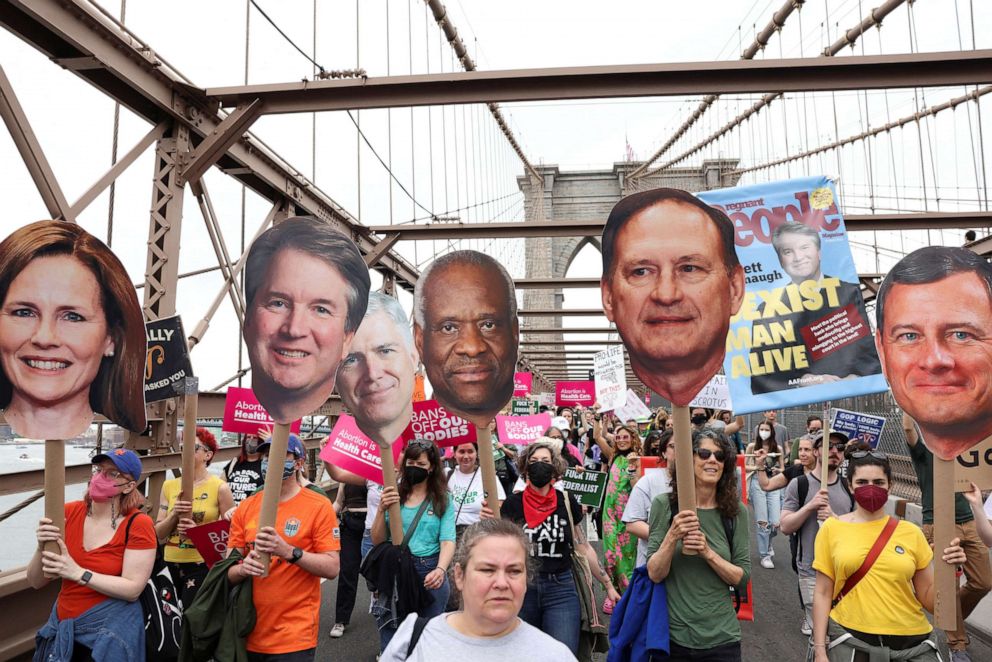
People carry images of Supreme Court Justices Amy Coney Barrett, Neil Gorsuch, Brett Kavanaugh, Clarence Thomas, Samuel Alito and John Roberts as abortion rights protesters participate in nationwide demonstrations following the leaked Supreme Court opinion suggesting the possibility of overturning the Roe v. Wade abortion rights decision, in New York City, May 14, 2022.
Caitlin Ochs/Reuters
Is the court out of touch with most of the country?
While Justice Samuel Alito wrote in the majority opinion in Dobbs that Roe "has remained bitterly divisive for the past half century," an ABC News/Washington Post poll completed in May shows that 58% of Americans believe abortions should be legal in all or most cases.
Striking down Roe then inherently undermined the will of the majority, Harry Litman, a former U.S. attorney and a constitutional law lecturer at the University of California, told ABC News.It is not the only issue on which the court and the public have split.
In a decades-long study comprised of three surveys, two researchers from Stanford University and the University of Texas looked at Americans' views on issues before the court and compared them to decisions issued by the court.
The study found a gap between the court and the public that has grown since 2020, with the court's position shifting "significantly to the right," study co-author Stephen Jessee, an associate professor of government at the University of Texas at Austin, told ABC News in an interview.
The study, published in June, found the justices moved to a position that is more conservative on all issues than an estimated 75% of the public.
"Our best estimate is that the court has almost exactly the position of the average Republican-identifying American," Jessee said.
"I wouldn't say our finding necessarily points to the court doing something wrong so much as it's just important to assess how the public's views compared to the performance of the court," he added.
According to Jessee, not every case that the Supreme Court decides favors the conservative viewpoint. Despite the politics of the presidents who appoint the justices, their ideologies don't always map neatly onto the spectrum of Democrats to Republicans. Indeed, a majority of Supreme Court rulings in the term that ended last summer -- many of them not on major social or political issues -- were unanimous or with only one dissent.
"There have been cases, for example in Bostock v. Clayton County, in which conservative justices have voted for things like protections for gay and transgender employees against employment discrimination," Jessee said.
It was a Republican-appointed justice who wrote the majority opinion in Roe just as it was the Trump-appointed Gorsuch and the Bush-appointed Roberts who provided crucial support for the majority in Bostock. Before that, Roberts narrowly upheld the Affordable Care Act, the signature domestic achievement of Democrat Barack Obama.
Roberts, the chief justice, has long taken pains to insist the court is not a partisan force and does its best to adhere to its interpretation of the Constitution. While he has been a key vote for some seismic decisions -- most notably the Citizens United ruling undoing campaign finance restrictions and Shelby County, which removed key provisions in the Voting Rights Act -- on other major cases he has counseled an incremental approach to avoid swings beyond what society might tolerate.
His view does not always win out, though, as was seen last week in the Dobbs decision.
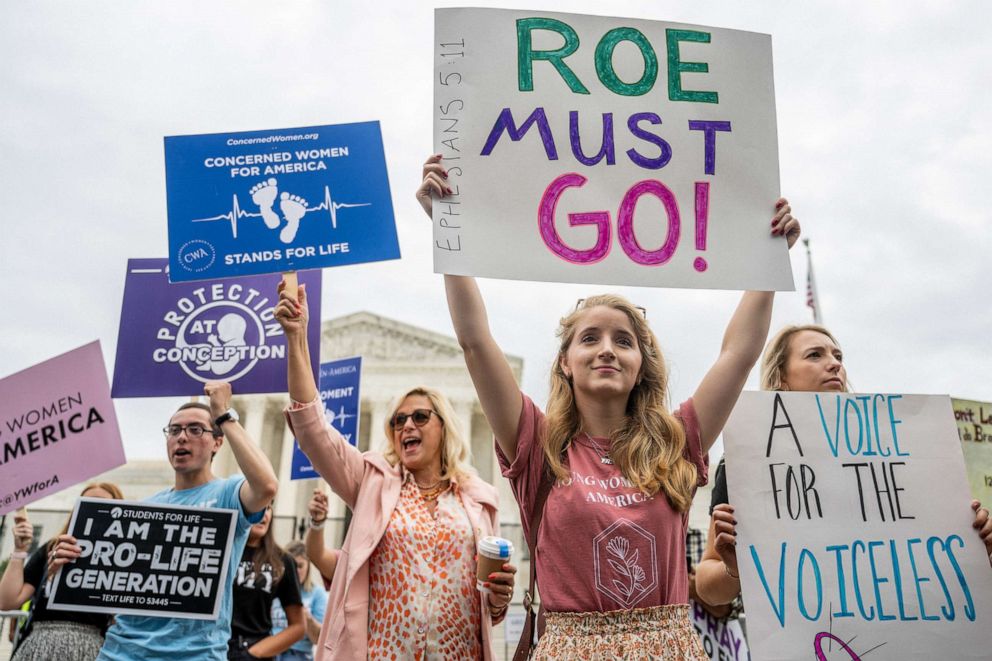
Anti-abortion demonstrators rally in front of the U.S. Supreme Court on June 21, 2022 in Washington as the country awaits a major case decision pertaining to abortion rights.
Brandon Bell/Getty Images
'Greatest function is protecting rights'
While the court's recent history shows it moving rightward, according to the Stanford University and the University of Texas study, it has of course used its same power to advance other goals in the past -- drawing fierce condemnation from different groups in America.
"The framers, for all their faults, designed the U.S. Supreme Court to be insulated from political whims of the day, as much as is humanly possible," said Carter, the constitutional law professor.
Litman, the lecturer and former federal prosecutor, agreed and said the court's "greatest function is protecting rights set out under the Constitution as against efforts by a majority, say the legislature, to abridge them."
He pointed to the civil rights era of the 20th century, when the Supreme Court found through its rulings that the Constitution extended equality under the law to Black Americans nationwide, including in the Jim Crow South -- leading to pitched battles there over school desegregation and more.
But as the court's membership shifted, so too has its approach to what rights the Constitution does and does not provide versus what states can and cannot regulate.
Litman said there were other cases that have provided Americans with protections for unenumerated rights, which are freedoms not explicitly written in the Constitution, that cannot be distinguished from Roe. Many of those decisions were fiercely criticized by conservatives who said they stretched the boundaries of the court's ability. The late Justice Antonin Scalia summarized this view in dissenting from the 2015 ruling that granted the right to same-sex marriage:
"This practice of constitutional revision by an unelected committee of nine, always accompanied (as it is today) by extravagant praise of liberty, robs the People of the most important liberty they asserted in the Declaration of Independence and won in the Revolution of 1776: the freedom to govern themselves."
Scalia was in the minority then. But three of the justices on the court have changed since, all of them replaced by President Trump and all three of whom went on to overrule Roe.
The opinion in the Dobbs case threatens other unenumerated rights, Litman said -- a possibility suggested by Justice Clarence Thomas' opinion last week concurring with the majority in which he wrote that the court should turn its attention to overruling the case on same-sex marriage and the guarantee to contraception, among others.
"What's really wrong with the [majority] opinion, for lawyers, is it sort of pretends that there's something special or different about abortion in legal doctrine, when there isn't," Litman said.
What is to come
Carter said overturning federal protections for abortion could pose a risk to the esteem of the court, which has broader implications.
"The Supreme Court has no way to enforce its own decisions," he said. "It's just its credibility and our society's acceptance, whether we agree or disagree with the ruling of the court, that that is the law of the land."
He also said the court's current position highlights the importance of elections and of people voting; Republicans were able to appoint three justices in four years because they had the number of seats in Congress and a president in power which allowed them to do so. By contrast, President Obama could not move forward with his final nominee, Merrick Garland, because of the Republican majority controlling the Senate.
Carter said the solution is not to "tear up" the court -- rather, those who disagree with its interpretation of the Constitution should organize, litigate or challenge its decisions.
Other suggested changes include changing how long justices remain on the court -- via term limits rather than a lifetime -- or appointing more justices to the court.
Jessee, who has been studying the ideology of the court's decisions, said there are worries that recent polling indicates trust and approval in the court have decreased.
"The court doesn't have the power of the purse, and they don't have an army," Jessee said, "and therefore they sort of rely on the respect and prestige of the court in order to have their decisions followed."
"When that disappears," Carter said, "then I think we are in real trouble."
"politic" - Google News
July 01, 2022 at 04:09PM
https://ift.tt/H4RIKNw
Supreme Court's dramatic rightward turn may undermine its political distance: Experts - ABC News
"politic" - Google News
https://ift.tt/6maWvQG
https://ift.tt/oQ73lUz



/cloudfront-us-east-1.images.arcpublishing.com/bostonglobe/VNG7YMZTRWJ5WBFTJ5NVETPCQI.jpg)


