Saturday, August 6, 2022

Young or old, age is factor in political elections - Spectrum News NY1
It’s a timeless debate in politics.
When should the old make way for the young? When is clout less valuable than vitality?
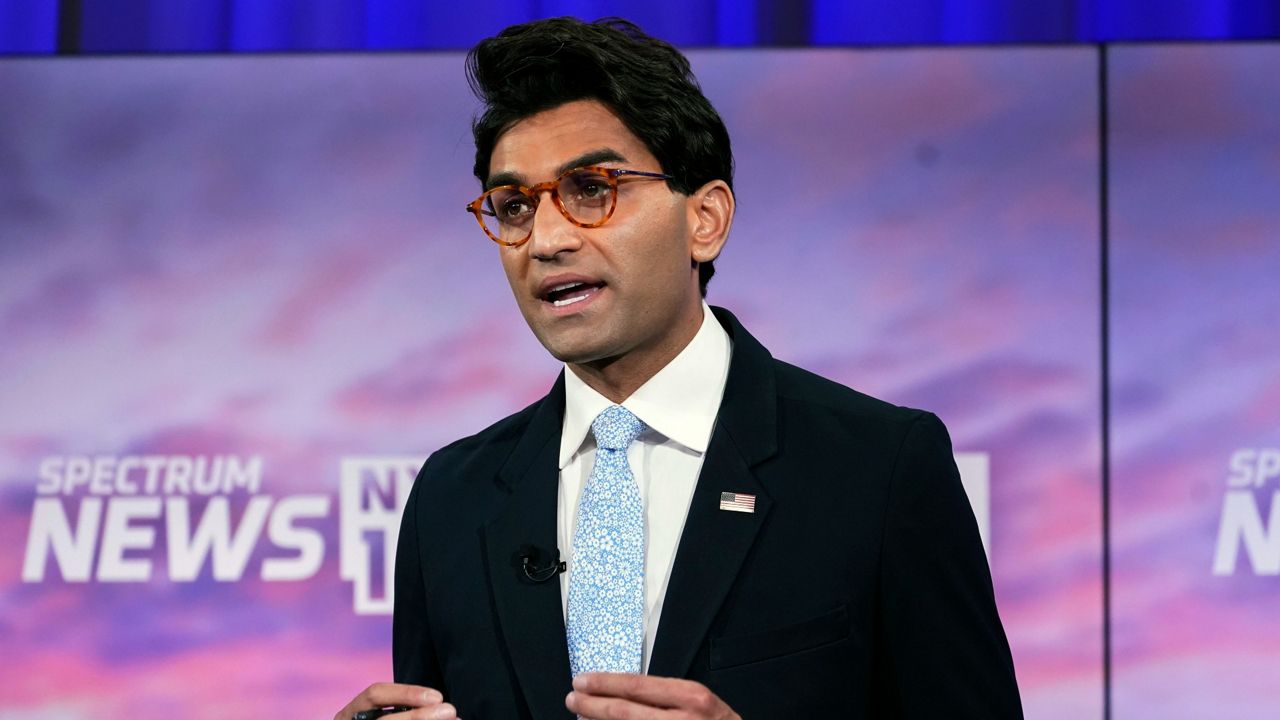
“It’s 2022. It’s time to turn the page on 1992,” Suraj Patel said Tuesday at the 12th Congressional District debate hosted by Spectrum News NY1 and WNYC-Gothamist.
What You Need To Know
- In 12th Congressional District primary, Maloney is 76, Nadler is 75 and Patel is 38
- In 10th Congressional District primary, Holtzman is 80 while Jones, Niou and Rivera are in their 30s
- But older politicians, including Holtzman and Senate Majority Leader Chuck Schumer, have proven they are spry and active
Patel was a fourth-grader when Reps. Carolyn Maloney and Jerry Nadler began their congressional careers.
Nadler is 75-years-old and Maloney is 76-years-old. Meanwhile Patel, at 38 years old, is half their age.
During the debate, Patel argued that experience hasn’t always translated to effectiveness.
Maloney and Nadler, who are ranking House members, reminded him of their hard-earned influence and record of results.
“What have you done? Achievements speak louder than words,” Maloney asked Patel during the debate Tuesday.
Several decades separate the youngest and oldest candidates in the 10th Congressional District primary as well.
Liz Holtzman, who left Washington, D.C. in 1981, would return to Congress as an 81-year-old freshman member if elected.
“If these weren’t really threatening times, if our democracy, if our country weren’t in real danger, I’d be out kayaking or on vacation,” she told NY1 in an interview. “I wouldn’t be coming back into this maelstrom.”
Her rivals in NY-10 include federal, state and city lawmakers in their 30s: Rep. Mondaire Jones, Assemblywoman Yuh-Line Niou and Councilwoman Carlina Rivera.
Like Maloney and Nadler, Holtzman made the case for experience.
She was the youngest woman ever to be elected to Congress in 1972.
As a House Judiciary Member, she voted to impeach former President Richard Nixon.
Holtzman also was Brooklyn district attorney and New York City comptroller.
“When people see me out there campaigning in the hot noonday sun, they figure that if I can withstand that, I’ve got the stamina to stand up in Congress,” she said.
But Holtzman is sprightly while Nadler visibly struggles.
Nadler misspoke in his opening debate remarks when touting how he, as Judiciary Committee chair, impeached former President Donald Trump.
“My — in leading this, I’ve impeached Bush twice,” Nadler said. After the debate, Patel attacked Maloney and Nadler as “ageist” for equivocating when asked if they believe President Biden, 79, should run for re-election.
“I’m going to tell you that the fact of the matter is that they think, maybe, they can pull young voters away from me by throwing their president under the bus,” Patel said Wednesday on MSNBC’s “Morning Joe.”
Maloney has sought to clarify her debate remarks about President Joe Biden.
She told CNN she would support him in 2024, but thought he won’t run.
The primary election is Aug. 23.
"politic" - Google News
August 06, 2022 at 06:41AM
https://ift.tt/2ua5fid
Young or old, age is factor in political elections - Spectrum News NY1
"politic" - Google News
https://ift.tt/jv9pnmG
https://ift.tt/h5SxZl4
Tuesday, August 2, 2022
America is heading toward its third great political realignment - The Hill

Across nearly four centuries, the genius of Anglo-American political institutions has been their general tendency toward evolutionary, rather than revolutionary, change. This inclination has been clearly reflected in the development of the most stable and successful political party systems in the world. Over time, political ascendency has favored those parties that stood for a steady broadening of the voting population and their inclusion in the processes of democratic governance through peaceful, though not always uncontroversial, means.
Even in those rare instances when “regime change” has required a resort to military force — England’s “Glorious Revolution” of 1688 or America’s Revolution of 1776 — these revolutions have been decidedly more limited in scope and far less bloodthirsty than the malign template of the French Revolution of 1789 and others that have emulated its “root and branch” approach to radical societal change.
In the United States there have been just two great political realignments, both of them occasioned by immense and catastrophic events that reached into every corner of the republic and fundamentally changed how people thought about politics and the very character of the Great American Democracy.
The first was the Civil War (1861-1865) — far and away the greatest bloodletting in our history — the result of which was the overthrow of the Democratic Party ascendency begun by Thomas Jefferson in 1800 that had endured for 60 years but eventually would be undone by its persistent toleration of slavery. The further result was the 70-year ascendency of the Republican Party begun by Abraham Lincoln in 1860.
The second great catastrophe leading to political realignment was the Great Depression, beginning in 1929, which inflicted more material misery on the American people than anything in our history — and even more ominously, seriously called into question the institution of capitalism that heretofore had been seen as the indispensable element in American growth and prosperity. As a result of this shattering event, millions of Americans who were adherents of the Republican Party ever since the Civil War changed their allegiance to the Democratic Party and its New Deal, led by Franklin Roosevelt in 1932. Most would generally maintain that allegiance for nearly 90 years.
It is evident that there is a great deal of party-switching going on today, mainly benefitting Republicans since the most striking group switching their allegiance are Hispanics and, to a much lesser but significant extent, African Americans who have been historically the most reliable part of the long-ruling Democratic coalition. Many Democrats comfort themselves by viewing these shifts as temporary and thinking of them in the context of the well-known pattern of voters less bonded to their usual party affiliation, who routinely punish the party of the White House incumbent whose policies they find disappointing.
This midterm retribution, however, in no way precluded these critical swing voting blocs — e.g., independents, suburban women — from bouncing back to their usual party affiliation in the presidential election two years later, as both Presidents Clinton and Obama, hugely punished in their first midterms but subsequently re-elected, can testify. In the eyes of these Democrats, thus reassured by history, all that is needed for their party to rebound is a fresh new face as their presidential standard-bearer in 2024.
I would suggest that this viewpoint profoundly misreads what is happening in our country today, and that a series of unprecedented events, ideological obsessions, mistaken policies, and economic and cultural impacts is irreversibly changing how longtime, devoted Democrats — notably from within minority communities but also from an alienated working-class generally — view today’s political parties.
This present trend in party-switching is not just about this one election; it represents a more permanent, new affiliation because the Democratic Party for which their parents and grandparents signed up long ago has ceased to exist, replaced by an affluent elite that openly mocks their values and wages war against their economic well-being. The best historical template for today’s switchers is African Americans during the Depression, who decisively and permanently switched from the party of Lincoln to the party of Roosevelt simply because Democrats spoke directly to their needs and beliefs and Republicans, who long took them for granted, did not.
Similarly, those voters now abandoning the Democratic Party won’t be coming home any time soon.
William Moloney is a Senior Fellow in Conservative Thought at Colorado Christian University’s Centennial Institute who studied at Oxford and the University of London and received his doctorate from Harvard University. He is a former Colorado Commissioner of Education.
"politic" - Google News
August 02, 2022 at 06:00PM
https://ift.tt/gHim5aC
America is heading toward its third great political realignment - The Hill
"politic" - Google News
https://ift.tt/A9xFZ3Q
https://ift.tt/j6981xC
America is heading toward its third great political realignment - The Hill
Across nearly four centuries, the genius of Anglo-American political institutions has been their general tendency toward evolutionary, rather than revolutionary, change. This inclination has been clearly reflected in the development of the most stable and successful political party systems in the world. Over time, political ascendency has favored those parties that stood for a steady broadening of the voting population and their inclusion in the processes of democratic governance through peaceful, though not always uncontroversial, means.
Even in those rare instances when “regime change” has required a resort to military force — England’s “Glorious Revolution” of 1688 or America’s Revolution of 1776 — these revolutions have been decidedly more limited in scope and far less bloodthirsty than the malign template of the French Revolution of 1789 and others that have emulated its “root and branch” approach to radical societal change.
In the United States there have been just two great political realignments, both of them occasioned by immense and catastrophic events that reached into every corner of the republic and fundamentally changed how people thought about politics and the very character of the Great American Democracy.
The first was the Civil War (1861-1865) — far and away the greatest bloodletting in our history — the result of which was the overthrow of the Democratic Party ascendency begun by Thomas Jefferson in 1800 that had endured for 60 years but eventually would be undone by its persistent toleration of slavery. The further result was the 70-year ascendency of the Republican Party begun by Abraham Lincoln in 1860.
The second great catastrophe leading to political realignment was the Great Depression, beginning in 1929, which inflicted more material misery on the American people than anything in our history — and even more ominously, seriously called into question the institution of capitalism that heretofore had been seen as the indispensable element in American growth and prosperity. As a result of this shattering event, millions of Americans who were adherents of the Republican Party ever since the Civil War changed their allegiance to the Democratic Party and its New Deal, led by Franklin Roosevelt in 1932. Most would generally maintain that allegiance for nearly 90 years.
It is evident that there is a great deal of party-switching going on today, mainly benefitting Republicans since the most striking group switching their allegiance are Hispanics and, to a much lesser but significant extent, African Americans who have been historically the most reliable part of the long-ruling Democratic coalition. Many Democrats comfort themselves by viewing these shifts as temporary and thinking of them in the context of the well-known pattern of voters less bonded to their usual party affiliation, who routinely punish the party of the White House incumbent whose policies they find disappointing.
This midterm retribution, however, in no way precluded these critical swing voting blocs — e.g., independents, suburban women — from bouncing back to their usual party affiliation in the presidential election two years later, as both Presidents Clinton and Obama, hugely punished in their first midterms but subsequently re-elected, can testify. In the eyes of these Democrats, thus reassured by history, all that is needed for their party to rebound is a fresh new face as their presidential standard-bearer in 2024.
I would suggest that this viewpoint profoundly misreads what is happening in our country today, and that a series of unprecedented events, ideological obsessions, mistaken policies, and economic and cultural impacts is irreversibly changing how longtime, devoted Democrats — notably from within minority communities but also from an alienated working-class generally — view today’s political parties.
This present trend in party-switching is not just about this one election; it represents a more permanent, new affiliation because the Democratic Party for which their parents and grandparents signed up long ago has ceased to exist, replaced by an affluent elite that openly mocks their values and wages war against their economic well-being. The best historical template for today’s switchers is African Americans during the Depression, who decisively and permanently switched from the party of Lincoln to the party of Roosevelt simply because Democrats spoke directly to their needs and beliefs and Republicans, who long took them for granted, did not.
Similarly, those voters now abandoning the Democratic Party won’t be coming home any time soon.
William Moloney is a Senior Fellow in Conservative Thought at Colorado Christian University’s Centennial Institute who studied at Oxford and the University of London and received his doctorate from Harvard University. He is a former Colorado Commissioner of Education.
"politic" - Google News
August 02, 2022 at 06:00PM
https://ift.tt/gHim5aC
America is heading toward its third great political realignment - The Hill
"politic" - Google News
https://ift.tt/A9xFZ3Q
https://ift.tt/j6981xC
Draghi's political downfall: How power imploded in Italy and what happens next - CNBC
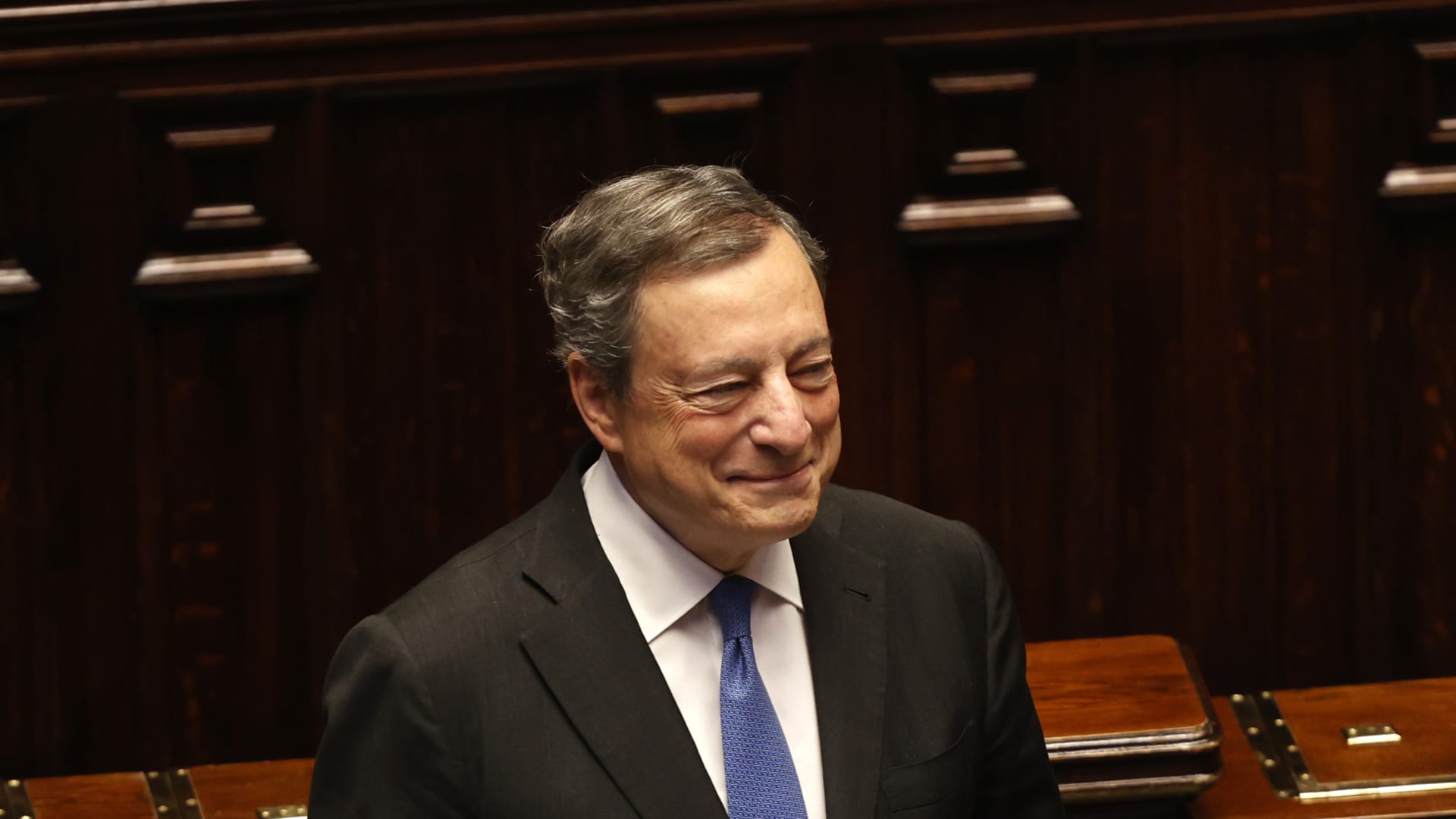
Mario Draghi is best known for saving the euro. But a coveted rescue of the Italian economy ended prematurely when internal politics came to the fore last month, making it harder and harder for him to govern.
In the space of about a week, Italy went from having a stable government to preparing for snap elections in September — which could see the far-right in charge of the next coalition in Rome. This prospect has investors questioning Italy's economic future and its broader role within European politics.
Draghi "was certainly a little bit tired of the politics within the government," an official working for the Italian government, who preferred to remain anonymous due to the political instability in the country and the sensitive nature of the comments, told CNBC.
Once a managing director at Goldman Sachs International, Draghi became Italian prime minister in February 2021 to lead a technocratic government, backed by four main parties across the political spectrum. His arrival in Rome was welcomed by investors and European officials, who were desperate to see a safe pair of hands leading the euro zone's third-largest economy.
The former European Central Bank chief delivered on several fronts, including putting together a reform plan to get more than 190 billion euros ($194.52 billion) from the EU. The disbursements are, however, linked to the completion of these reforms, so investors fear the next coalition might not follow through with Draghi's plans, and hence may not receive all of the cash from Brussels.
The prime minister also revived Covid-19 vaccination efforts and contributed to an economic rebound. But throughout his mandate, Draghi had to struggle with a slew of political sensitivities.
What happened?
The collapse of his government came about because of those fragilities at the heart of government. It started with the Five Star Movement (M5S), a left-leaning and populist party, boycotting a vote on a package aimed at helping Italians deal with the surging cost of living. The package included a controversial waste incinerator for Rome, which M5S vehemently rallied against.
The same anonymous CNBC source said M5S has a "great following in Rome, not so much in the rest of the country, but this law was a problem for this electorate." By not voting for the wide-ranging package and blocking it, the party was in essence against the government that they were part of, the official said.
Draghi offered his resignation after the stalemate on the vote.
A second Italian official, who preferred to remain anonymous due to the sensitive nature of the situation, said the move from M5S was "a significant decision."
Draghi had "trusted this was a national unity government," the official said. But with M5S abstaining from the vote on the government's bill, "Draghi felt [it] was becoming harder and harder to enact his program," the official added.
By late evening Wednesday July 15, Italy's President Sergio Mattarella had rejected Draghi's initial resignation and told him to build a new parliamentary consensus.
In the following days, hundreds of mayors had signed a letter asking him to stay. Union leaders and industrialists also come together to ask Draghi to remain in office. And there was an online petition signed by thousands of citizens who wanted him to stay.
If they said yes, [Draghi] had all the power he wanted.CNBC Source
The next week, Draghi returned to the Italian Parliament and asked lawmakers for a new mandate. "Are the parties and you parliamentarians ready to rebuild this pact?" he declared in the Senate on July 20. "Italy needs a government that can move swiftly and efficiently," he told lawmakers.
The first CNBC source said they were surprised that Draghi asked for a new mandate to try to build unity once again. "To be honest, his speech was really tough against M5S and the Lega [party] ... his aim was to put it clear: if we do another government, we have to continue without problems," the source said.
"If they said yes, [Draghi] had all the power he wanted; if they said no, he could resign without being blamed for leaving the country," the official said.
The second CNBC source stressed that Draghi was "very concerned" about being able to pass new laws in Parliament. Draghi was due to finish his mandate before next summer with parliamentary elections expected in June 2023.
What's next?
But Italy is now preparing for a new vote on September 25 with a lot at stake.
"If a right-wing coalition were to win in Italy's general election on 25 September, and subsequently abandon economic reforms, it could jeopardise not only Italy's access to EU fiscal support and the ECB's new anti-fragmentation tool, but more generally future EU integration and joint debt issuance," George Buckley, an economist at Nomura, said in a research note last week.
The upcoming election will matter not only to see where Italy's finances and fiscal strategy will be heading, but also whether Europe will continue to raise new funds together.
The recovery plan came about because of the impact that the coronavirus lockdowns had on the European economies. This was so significant that the 27 members of the EU decided to raise money jointly through the European Commission, the executive arm of the EU, for the first time. Italy, because it suffered the most from the pandemic, is receiving the largest chunk of the money borrowed.
However, if there are problems with the political situation of the biggest benefactor, then this could stifle more joint borrowing further down the line, including when tackling climate change or the impact from Russia's invasion of Ukraine.
"Italy's next government is unlikely to bring the country's future in the euro-zone into doubt, in a repeat of the turmoil that we saw after the 2018 election. But it will probably run looser fiscal policy and find it more difficult to pass reforms," Jack Allen-Reynolds, senior Europe economist at Capital Economics, said in a note last week.
"politic" - Google News
August 02, 2022 at 12:55PM
https://ift.tt/SuEge0c
Draghi's political downfall: How power imploded in Italy and what happens next - CNBC
"politic" - Google News
https://ift.tt/A9xFZ3Q
https://ift.tt/j6981xC
Monday, August 1, 2022
How cable news political leanings change over time | @theU - @theU
The political bias of cable news shows is surprisingly dynamic, according to new research investigating the average partisan leans of cable news channels over time.
Using a method to measure average political leanings, University of Utah political scientist Josh McCrain and colleagues found that even on channels that are well-known for a particular political bias, the strength of that bias can change from hour to hour and from show to show. They also found that the current polarization of cable news channels may be driven by the leanings of the primetime shows.
“This potentially tells us a lot about the cable news marketplace and how they compete for viewers,” McCrain says. “It’s not necessarily about quality of reporting or programming variety, but about the slant of their primetime programs.”
The research is published in Proceedings of the National Academy of Sciences.
TV is more than static
If asked about the political biases of news channels Fox News and MSNBC, many might readily say that Fox News leans conservative and MSNBC leans liberal, and that it has been so as long as they can remember. Political scientists and economists, in their studies of cable news, have typically assumed that the biases of news outlets are static.
“I think, largely, this is because it makes a lot of our work easier if we assume it’s static,” McCrain says. “If anything, I think researchers might have assumed it did not change much. We show it’s actually quite a bit more interesting than that static positioning, and it depends a lot on the time of day and the specific show.”
McCrain and his colleagues, Eunji Kim of Columbia University and Yphtach Lelkes of the University of Pennsylvania, set out to measure media bias in cable news shows over a decade, looking for ways to quantify how bias has changed over time.
Quantifying bias
How do you come up with a quantifiable measure of a channel’s political slant? McCrain and his colleagues took a novel approach, aided by a singular tool: the Stanford Cable News Analyzer, which contains a repository of data on what cable news is talking about and who shows up onscreen, dating back to 2010. Users can search for particular people or words and get a graph of the frequency of mentions over time along with clips that mention the search term. “We owe them a bunch of credit for their work,” McCrain says.
The researchers utilized the Stanford Cable News Analyzer’s facial recognition feature to quantify how much an individual’s face appears on screen. The idea, sometimes called “visibility bias,” is that if an outlet is more likely to feature political actors from the left than from the right, then the outlet is likely slanted more liberal. With the Stanford team’s cooperation, McCrain and his colleagues tabulated individuals’ screen time by channel by day, show and time of day.
Using another Stanford-created database, the Database on Ideology, Money in Politics, and Elections, the team matched those appearing on cable news with a score of their political ideology, derived from their political donation activity, which is public information.
Let’s take one example: Wayne LaPierre is the CEO of the National Rifle Association. “This is obviously a politically active individual, and someone who donates a lot to Republican candidates,” McCrain says. That donation activity yields a very conservative score for LaPierre.
Once you have all of this data, what can you do with it?
Surprisingly dynamic
McCrain and his colleagues used the political actors’ ideology scores to then look at which channels give screen time to which kind of political actors at different times of day, and then take an average of political bias scores to determine a channel’s leaning. LaPierre, for example, appeared frequently on Fox News shows over the decade of cable news data, influencing that channel’s political score, and more particularly on the Sean Hannity show, influencing that show’s score.
Looking at the results together, the researchers found that the most conservative shows were typically Fox News shows and the most liberal were MSNBC and CNN. Maybe not too surprising.

PHOTO CREDIT: Eunji Kim, Yphtach Lelkes, Josh McCrain
Program-level media bias. Shown is the distribution of ideology score for the top five most popular programs from CNN, Fox News, and MSNBC (2010
to 2021).
But over time there’s more variation.
Within a day, cable news shows typically air talk shows in the morning, hard news in the afternoon, and some of their most popular shows in primetime. The results showed that the political lean of all three major cable news channels were most similar in the afternoons, before becoming polarized again in primetime.
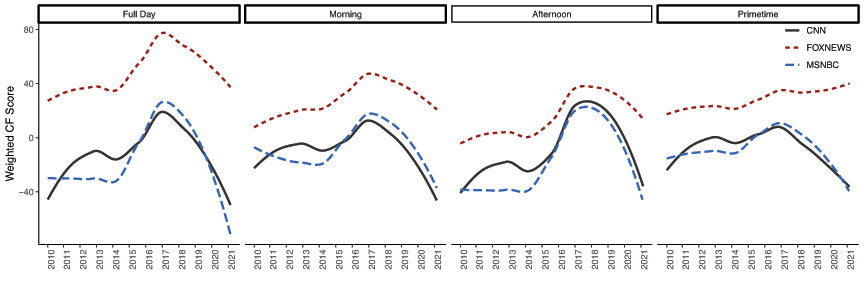
PHOTO CREDIT: Eunji Kim, Yphtach Lelkes, Josh McCrain
Within-day cable TV media bias by channel.
“We also find that shows tend to shift and evolve over time,” McCrain says. “For instance, The Rachel Maddow Show and The O’Reilly Factor looked similar in visibility bias during Obama’s first term. However, as 2016 approached, they began to diverge, with Maddow becoming one of the most liberal shows on MSNBC and O’Reilly one of the most conservative on Fox.”
Primetime
Post-2016, the political bias of the news channels polarizes sharply. McCrain and his colleagues write that the polarization is largely driven by the primetime shows.
“Primetime is where these channels make their money,” he says. “Viewership is highest, and they directly compete with each other for eyeballs.” So emphasizing certain political leanings, he adds, may show how the channel believes it can increase its revenue.
Questions about the relationship between political bias and viewership have important downstream implications for voters and democracy, McCrain says.
“Research shows that exposure to partisan media can shift election outcomes, and once people are exposed, they continue to seek it out. Our finding that media bias is dynamic and, potentially, a product of competition between channels, helps us better understand what generates partisan media bias and why it proliferates.”
Find the full study here.
"politic" - Google News
August 02, 2022 at 02:40AM
https://ift.tt/ExiZgIX
How cable news political leanings change over time | @theU - @theU
"politic" - Google News
https://ift.tt/oNOHxJn
https://ift.tt/FHaXj8U
Biden's surprise win will bring economic as well as political benefits - Financial Times

Joe Biden’s political prospects have just built back better. Last week’s passing of the Chips and Science Act by Congress breathed new life into the White House’s plans for industrial policy and support for US manufacturing.
Meanwhile, the famously intransigent West Virginia Democrat Joe Manchin, the king of coal country, performed a shocking turnabout on climate change. He agreed to back clean energy investment and healthcare subsidies to be paid for in large part by a 15 per cent minimum tax on big corporations.
Thus, in a week that was even more economically dismal than usual — with the Fed’s latest rate increase to battle inflation, dismal consumer confidence numbers and news that the US was now in a technical recession, Biden managed to score a big political win by doing something almost unheard of in Washington these days — orchestrating compromise. His win matters politically. The question now is what it might mean economically.
While the budget bill has yet to pass, and the Senate semiconductor support comes with far fewer strings attached for business than progressives would have liked (Senator Bernie Sanders has labelled it corporate “extortion”), there is a case to be made that simply getting to yes in Washington carries some economic benefits at present.
Chief executives have long complained that the uncertainty resulting from political gridlock, as well as a lack of adequate federal investment into things such as basic science research and workforce development, have curbed growth plans in the US.
The $280bn Chips and Science Act bill not only has strong bipartisan support but makes big investments into workforce training and basic science research, as well as supporting regional manufacturing hubs (something research shows has a disproportionately positive economic knock-on effect into local communities).
One can argue, as Sanders and progressives such as former Clinton-era labour secretary Robert Reich have, that companies like Intel don’t need lavish subsidies to stay in the US rather than moving more investment abroad. Many progressives believe that paying these now could set a dangerous precedent of giving taxpayer welfare to the richest corporations, which will result in them charging a future government ransom to stay in the US.
I’m not so sure. Silicon chips are unique, given that they are essential for pretty much everything else. The world needs more geographic diversity of supply in semiconductors. The fact that 92 per cent of high end chips are made in Taiwan, perhaps the second most politically contested country in the world after Ukraine, is worrisome for every nation, which is one reason Europe has its own chip regionalisation effort under way.
While it’s still possible for US companies such as Intel to move jobs and factories wherever they like, I suspect that stricter provisions around dual-use technologies coming down the legislative pike will make it harder to outsource strategic industries in the future. Regionalisation of supply chains, not unfettered globalisation, is the future.
The ramifications of the proposed budget bill, the name of which has been changed from Build Back Better to the Inflation Reduction Act, are more difficult to predict. The fact that the administration was able to push through a spending bill branded as a way to fight inflation is an impressive piece of political economy ju-jitsu (there is more than $300bn in deficit reduction for those worried about excessive demand, which helps a lot). But it’s still unclear whether the compromise will pass. Even if it does, its effect on short term inflation is very much up for grabs.
The upside of the bill is that it would enable the federal government to address rising healthcare costs. It would do so by helping poorer families to pay healthcare premiums, and also by capping out-of-pocket costs for drugs for those on Medicare. It will allow the US to do what most other rich countries do — negotiate with drug companies to reduce prices by using the power of the federal government (the largest buyer of prescription drugs in the world) to leverage scale to lower costs. That’s a no brainer that could save hundreds of billions of dollars in taxpayer money.
It also starts to address the outsized power of major lobbying industries such as Big Pharma. This, coupled with the fact that much of the bill would be funded by a 15 per cent minimum tax on big corporations goes a long way to fulfilling the administration’s promise to make the private sector pay its fair share in taxes.
Investment in clean energy is also welcome. I’m all for supporting investment in electric vehicles, wind farms, solar panels and lithium battery production. It is crucial to addressing climate change, which comes with its own huge economic costs. It’s the best way to encourage a “productive bubble” of widely shared private sector growth. Ultimately, it will lower the price of energy. But that process will take years.
No legislation is perfect. But last week represented an important first step toward bipartisan compromise on core bits of the Biden agenda that could have real economic impact. Restoring some sense of confidence that America can still govern itself comes with a reward beyond dollars.
"politic" - Google News
August 01, 2022 at 11:00AM
https://ift.tt/ixWh1zJ
Biden's surprise win will bring economic as well as political benefits - Financial Times
"politic" - Google News
https://ift.tt/LbgJx1a
https://ift.tt/k5mlUuz
Featured Post
Politics - The Boston Globe
unitedstatepolitics.blogspot.com Adblock test (Why?) "politic" - Google News February 01, 2024 at 03:47AM https://ift.tt...
/cloudfront-us-east-1.images.arcpublishing.com/bostonglobe/VNG7YMZTRWJ5WBFTJ5NVETPCQI.jpg)
Postingan Populer
-
unitedstatepolitics.blogspot.com What happens after the electoral college meets? Alright, so the (other) big vote happens tomorrow. Then w...
-
unitedstatepolitics.blogspot.com The president diverges from both Donald Trump and Barack Obama with a complex vision of coalition-building...
-
unitedstatepolitics.blogspot.com Adblock test (Why?) "politic" - Google News February 01, 2024 at 03:47AM https://ift.tt...


