Rechercher dans ce blog

Saturday, January 7, 2023

For GOP, Speaker Debacle Has Roots in Newt Gingrich’s Revolt - The New York Times

unitedstatepolitics.blogspot.com

Mr. Gingrich began the zero-sum politics that mutated into the brand of the Tea Party and Trump M.A.G.A. Republicans and that presaged the raucous speaker battle in the House.

WASHINGTON — Newt Gingrich was disdainful.

After watching days of House Republicans failing to elect a speaker, Mr. Gingrich, the most famous of all recent G.O.P. House speakers, vented about the hard-right holdouts, among them Representative Matt Gaetz of Florida.

“There’s no deal you can make with Gaetz,” Mr. Gingrich said in an interview Thursday night. “He’s essentially bringing ‘Lord of the Flies’ to the House of Representatives.”

In contrast, Mr. Gingrich said of his own speakership, which sought a revolt in the Republican Party and the way Washington does business, “We weren’t just grandstanders. We were purposeful.” He would be glad to show the current rebels how to do it, he said. “But anything that takes longer than waiting for their cappuccino, I doubt they’re interested in.”

History does not precisely remember it that way. It is true that Mr. Gingrich’s tenure from 1995 through 1998 produced several legislative accomplishments, including two balanced budgets signed into law by a Democratic president, Bill Clinton. But to both Democrats and Republicans, the jut-jawed intransigence of House Republicans opposing Representative Kevin McCarthy’s ultimately successful bid to be speaker did not materialize out of nowhere.

Instead, Mr. Gingrich’s triumph in 1994 in wresting the House from a Democratic majority for the first time since 1952 was the starting point for the zero-sum brand of politics that mutated into the Tea Party movement, the grievance-based populism of the Trump era, and what was garishly displayed on the House floor in a raucous four-day speaker battle that ended in the small hours of Saturday.

Those mutations have culminated in a tissue-thin Republican majority, auguring legislative episodes likely long on melodrama and short on happy endings, thanks to cameo actors such as Mr. Gaetz who have already demonstrated their zeal to seize the spotlight from the new speaker. Such actors appear to interpret their roles as opposing anything that the Biden administration might support, including sending military aid to Ukraine and avoiding a default on government obligations by raising the federal debt ceiling.

The bitterly partisan stalemates of the Gingrich era may well have metastasized into a state of governance by chaos.

“They’re employing the old Gingrich argument that you don’t get any benefit from cooperation or compromise, only from confrontation,” said Representative Steny Hoyer of Maryland, until recently the Democrats’ House majority leader. Mr. Hoyer, who was sworn into office in 1981, two years after Mr. Gingrich, recalled the Georgia congressman “playing to the anger and disaffection of people who Nixon called ‘the silent majority’ a few years earlier.”

“Those feelings predated Gingrich,” Mr. Hoyer said. “But he took extraordinary advantage of them, just as Trump did later and just as this crowd’s doing now.”

It was Mr. Gingrich, after all, who as a congressional candidate in 1978 told an audience, “One of the great problems we have in the Republican Party is that we don’t encourage you to be nasty.” A decade later, Mr. Gingrich coached his colleagues to cast the opposition as “the loony left,” saying, “When in doubt, Democrats lie.”

A decade after that, in 1998, Mr. Gingrich oversaw a multimillion-dollar ad blitz focusing on Mr. Clinton’s affair with a White House intern, Monica Lewinsky, while also telling supporters, “I will never again, as long as I am speaker, make a speech without commenting on this topic.”

Mr. Gingrich’s arrival in Washington in 1979 happened to coincide with the installation that same year of C-SPAN’s cameras inside the House chamber, enabling once-obscure members of Congress to reach a national audience with combative monologues that dragged on into the night. “Gingrich was the one who understood how to use the C-SPAN cameras,” said Mark Sanford, a Republican member of the 1994 class. “And I’d say that was one of the tools that over time helped coarsen the process and led to this increasing degree of militarism we’re seeing.”

Though Mr. Gingrich and his two lieutenants, Dick Armey, the House majority leader, and Tom DeLay, the majority whip, preached ruthless partisanship, in the end, Mr. Gingrich was forced out of power by his fellow Republicans in 1998 after agreeing to a budget deal with Mr. Clinton. The party lost the House majority in 2006, “though frankly, even before then, the Gingrich faction did not feel that they had won when George W. Bush won, because they weren’t interested in his ‘compassionate conservatism,’” Mr. Hoyer recalled.

The election of Barack Obama in 2008 thrust Mr. Gingrich back into relevancy. On the night of Mr. Obama’s inauguration, the former speaker gathered at a Washington steakhouse with a small group of desultory Republicans that also included a second-term congressman from California, Kevin McCarthy. It was Mr. McCarthy who, consulting his inner Gingrich, urged a hyperaggressive approach to Democratic control in Washington.

“We’ve got to challenge them on every single bill and challenge them on every single campaign,” he told the steakhouse group that night.

Mr. Gingrich left the dinner feeling much encouraged. “You will remember this day,” he said to the others.

The seeds of the Tea Party movement were sown by discontents among a threatened white majority, or what Mr. Trump later called “the forgotten men and women of this country.” Initially framed as a nonpartisan call for fiscal discipline, the Tea Party avatars returned the Republicans to power in the House after the 2010 midterm election and quickly reverted to Gingrichian partisanship.

“The Tea Party movement was more about fighting the Obama administration, Pelosi and Reid,” said a member of that class, Representative Jeff Duncan, Republican of South Carolina.

But, as both an echo of what Mr. Gingrich encountered in 1998 and a harbinger for the present G.O.P. intramural brawling, several restive ultraconservatives set their sights on their elected leaders. In 2015, they effectively forced the resignation of Speaker John Boehner. Three dozen of them, including Mr. Duncan, formed the House Freedom Caucus, a band of hell-no fiscal hard-liners that seemed to exist mainly to inconvenience their party leaders until 2017, when that leader happened to be President Donald J. Trump.

Mr. McCarthy, who was then the House majority leader, predicted that the Freedom Caucus would not be able to stand up to Mr. Trump.

“There’s not a place for them to survive in this world,” he told me.

He was wrong. In a matter of months, the Freedom Caucus repurposed itself as a populist fight club of Trump mini-me’s, albeit one that did not always appear to be strategically sound. “The one problem I’ve had with the Freedom Caucus was that they didn’t often define in advance what a win looks like,” Mr. Duncan said. “At some point, you’ve got to be willing to get to a yes.”

Among their new members in 2017 was Mr. Gaetz, a freshman from Florida. Mr. Duncan wryly noted that Mr. Gaetz’s supporting cast in the revolt against Mr. McCarthy included 11 members who are either freshmen or have served only one term.

“They don’t know how to operate in the majority, and they’re just listening to what others say about these rules changes,” Mr. Duncan said. “And then when Kevin’s given them 90 percent of what they’ve asked for, they’ve moved the goal posts.” Ultimately, Mr. Gaetz did give way, slightly, to Mr. McCarthy in the 14th vote and again in the 15th final vote early Saturday, when he voted “present” both times, rather than no.

Until the fight over the speakership, Mr. Gaetz’s biggest ally in the House has been Representative Marjorie Taylor Greene, an unflagging Trump loyalist who this past week helped cajole the former president into putting his support for Mr. McCarthy in writing. In an interview Friday afternoon before the House reconvened for two more rounds of voting, Ms. Greene said that she decided to back Mr. McCarthy’s bid for speaker several months ago, when he signaled his willingness to support hard-line fiscal stances, including not raising the debt ceiling unless certain conditions are met.

She was less enthusiastic about the conduct of Mr. Gaetz and another member of the Republican “Never Kevin” brigade, Representative Lauren Boebert of Colorado.

“Kevin’s said these things in conference,” Ms. Greene said. “But Matt never goes to conference, and if Lauren Boebert’s ever there, she’s just sitting there tweeting on her phone.”

As the G.O.P. dissidents huddled Friday with team McCarthy in search of a deal that would dilute the new speaker’s power, Ms. Greene observed that this was exactly the kind of back-room scheming that the group purported to abhor. “It’s pure ego,” she said of the Never Kevin brigade.

Mr. Gingrich, for his part, takes a relatively cheery long view of his party’s machinations. “I ran three times before I won on the third race,” he said. “We spent 16 years in the House trying for the majority before we finally won it.”

And for the current G.O.P., he said, “we’re in a period where everything’s going to be very hard.”

Adblock test (Why?)


"politic" - Google News
January 07, 2023 at 11:41PM
https://ift.tt/9pWB4N7

For GOP, Speaker Debacle Has Roots in Newt Gingrich’s Revolt - The New York Times
"politic" - Google News
https://ift.tt/sBHfC8Z
https://ift.tt/8RwtIFX

Thursday, January 5, 2023

First on CNN: Biden to honor 12 people with Presidential Citizens Medal on two-year anniversary of January 6 insurrection - CNN

unitedstatepolitics.blogspot.com
CNN  — 

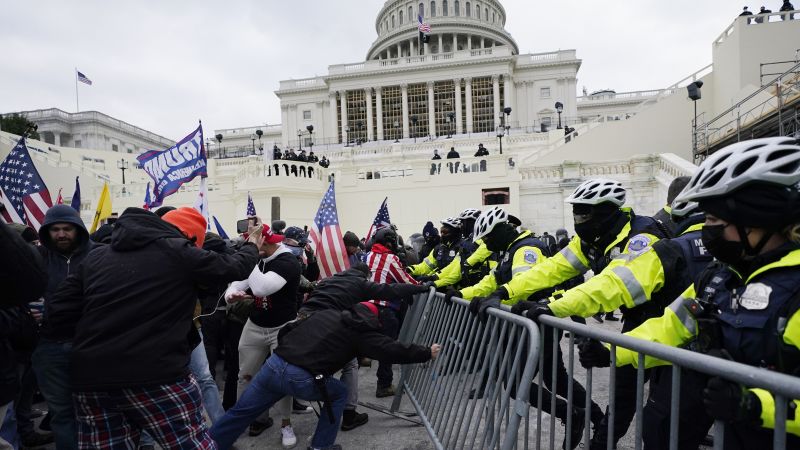
President Joe Biden on Friday plans to mark the two-year anniversary of the January 6, 2021, insurrection by awarding for the first time in his presidency the Presidential Citizens Medal to 12 people.

The individuals include law enforcement officers who were injured defending the Capitol, a Capitol Police officer who died the day after rioters stormed the building and election workers who rejected efforts by former President Donald Trump to overturn the results of the 2020 election.

Biden is set to deliver remarks and host a ceremony at the White House honoring the dozen individuals chosen for having made “exemplary contributions to our democracy” and shown “courage and selflessness” around the events of January 6, a White House official familiar with the details told CNN.

The Presidential Citizens Medal is one of the country’s highest civilian honors, given to American citizens deemed to have “performed exemplary deeds of service for their country or their fellow citizens.” Biden’s decision to distinguish Americans he sees as having protected the nation’s Capitol, its democratic institutions and elections system, is one of the major ways in which the president has sought to draw a stark contrast from his predecessor.

More than half of Friday’s 12 recipients of the Presidential Citizens Medal are current and former law enforcement officers.

They include Capitol Police Officer Eugene Goodman, credited for luring rioters away from the entrance to the Senate chambers as lawmakers were evacuating by using himself as “bait”; former DC police Officer Michael Fanone who was brutally assaulted by rioters and said he suffered a heart attack as a result of the experience (Fanone is now a CNN contributor); and Capitol Police Officer Caroline Edwards, who testified before the House January 6 committee that she hit her head during a clash with the insurrectionists and was knocked unconscious before she chose to run back into the chaos.

One person will receive the medal posthumously: Capitol Police Officer Brian Sicknick, who was determined to have suffered strokes and died the day after he had responded to the insurrection. Washington DC’s chief medical examiner said that “all that transpired” on that day had “played a role in his condition.” Sicknick’s remains were laid in honor at the Capitol Rotunda last year.

Other recipients of the Presidential Citizens Medal on Friday include election workers credited for having rejected efforts by Trump and his supporters to overturn the results of the 2020 election.

They include Shaye Moss and her mother Ruby Freeman, who both worked as election workers in Fulton County, Georgia. The two women, who are Black, gave emotional and poignant testimony to the House January 6 committee, describing how their lives were turned upside down after the former president and his allies publicly disparaged them as election fraud hustlers.

“There is nowhere I feel safe. Nowhere. Do you know how it feels to have the president of the United States target you?” Freeman told the House panel.

Moss told the committee that Trump’s attacks on her – and the storm of racist threats that followed – upended her life. “I don’t want anyone knowing my name,” she said. “It’s affected my life in a major way, in every way – all because of lies.”

Rusty Bowers, the Arizona House speaker who has spoken out about resisting an intense pressure campaign from Trump and his lawyer Rudy Giuliani to overturn the results of the 2020 election, and Al Schmidt, a former Republican city commissioner in Philadelphia publicly mocked by Trump as a “RINO” (Republican in name only) for rejecting claims of widespread election fraud in the city, will be honored.

Michigan Secretary of State Jocelyn Benson, Capitol Police Sergeant Aquilino Gonell, Capitol Police Officer Harry Dunn and Metropolitan Police Department Officer Daniel Hodges are also among the 12 set to receive the medal.

Marking the one-year anniversary of the insurrection last year, Biden delivered an impassioned address calling out Trump’s attacks on American democracy.

“For the first time in our history, a President had not just lost an election. He tried to prevent the peaceful transfer of power as a violent mob breached the Capitol,” Biden said in a speech from the Capitol. “But they failed. They failed. And on this day of remembrance, we must make sure that such an attack never, never happens again.”

While Biden has largely steered clear of weighing in on the details of the House January 6 committee and its work, as well as the Justice Department’s ongoing investigation into the day’s events, he has consistently spoken out more broadly about how the day marked an unacceptable attack on the country’s democratic pillars.

He also injected the theme of defending the country’s democracy into the midterm elections. The issue proved to be a more resonant one with voters than many had anticipated, leaving the White House feeling vindicated.

This week, as political drama and infighting engulfed House Republicans who failed to elect a House speaker over multiple rounds of voting, the president called the debacle an “embarrassing” episode for the country – and made clear that January 6, 2021, was on his mind.

“How do you think it looks to the rest of the world?” Biden told reporters on Wednesday. “We’re really getting through the whole issue relating to January 6. Things are settling out. And now, for the first time in 100 years, we can’t move?”

Adblock test (Why?)


"politic" - Google News
January 05, 2023 at 10:49PM
https://ift.tt/2REyJ9r

First on CNN: Biden to honor 12 people with Presidential Citizens Medal on two-year anniversary of January 6 insurrection - CNN
"politic" - Google News
https://ift.tt/JPlTUyw
https://ift.tt/WckLoMi

Wednesday, January 4, 2023

Twitter plans to resume taking some political ads - Axios

unitedstatepolitics.blogspot.com
Illustration of the Twitter bird with a hundred dollar bill in its beak.  

Illustration: AĂŻda Amer/Axios

Twitter said Tuesday it plans to expand the types of political and issue-oriented advertising allowed on the service.

Why it matters: The move could help increase revenue at cash-strapped Twitter, and the ad category may prove less controversial thanks to new regulations requiring online political advertisers to be clearer about who is paying for the message.

  • "We believe that cause-based advertising can facilitate public conversation around important topics," Twitter said in a post. "Today, we're relaxing our ads policy for cause-based ads in the U.S. We also plan to expand the political advertising we permit in the coming weeks."

Flashback: Twitter banned political advertising in the fall of 2019, cutting off what had been a fairly strong business for the company.

The big picture: Other online companies that once eschewed political advertising have also been growing more open to such ads, including Spotify and Hulu.

What they're saying: Jake Sticka, VP of client strategy for progressive political ad firm Rising Tide Interactive, praised the move. "Under Twitter’s previous policy, a company like ExxonMobil could advertise its work with very few limitations but climate advocacy groups were restricted from any running any advertising that held polluters to account."

Yes, but: Even as he praised the move, Sticka said he will be "cautious" in recommending clients return to Twitter: "While we are excited to have this tool back in the toolbox, the current unpredictability of Twitter’s direction makes it a less than brand-safe environment."

Adblock test (Why?)


"politic" - Google News
January 04, 2023 at 05:25PM
https://ift.tt/N64RASh

Twitter plans to resume taking some political ads - Axios
"politic" - Google News
https://ift.tt/ZwK0xlO
https://ift.tt/vBYPlKb

Tuesday, January 3, 2023

Beijing decries curbs on Chinese travellers, threatens to reciprocate - South China Morning Post

unitedstatepolitics.blogspot.com

[unable to retrieve full-text content]

Beijing decries curbs on Chinese travellers, threatens to reciprocate  South China Morning Post

"politic" - Google News
January 03, 2023 at 09:03PM
https://ift.tt/uvzOKUI

Beijing decries curbs on Chinese travellers, threatens to reciprocate - South China Morning Post
"politic" - Google News
https://ift.tt/JQuF1ES
https://ift.tt/sDnHilo

2023 brings more political pain for Sunak's government - Financial Times

unitedstatepolitics.blogspot.com

This article is an on-site version of our Inside Politics newsletter. Sign up here to get the newsletter sent straight to your inbox every weekday.

Good morning, and happy new year. Good news! Arsenal might win the league. Bad news! Almost everything else is bad, and also Arsenal probably won’t in fact, win the league. Some thoughts on the politics of the bleak outlook below.


Inside Politics is edited by Georgina Quach. Follow Stephen on Twitter @stephenkb and please send gossip, thoughts and feedback to insidepolitics@ft.com.


It’s a new year, and I’m feeling . . . grim

We start 2023 as we ended 2022: with a lot of alarming charts. The UK will face one of the deepest recessions and the weakest recoveries: that’s the grim consensus from the Financial Times’s annual economists’ survey (you can read the write-up here and the full responses here).

As is also customary, FT journalists have been asked to make some predictions about the coming year. They are all worth reading, but there are two in particular that are worth noting from a UK perspective.

The first is from Tony Barber, our European comment editor who writes the Saturday edition of the Europe Express newsletter. He predicts a “continued, grinding conflict” between Russia and Ukraine:

Conditions for a lasting ceasefire, let alone a formal peace settlement, are unlikely to be met in 2023. Freezing present positions would satisfy neither Russia nor Ukraine. Vladimir Putin’s Kremlin would not have broken Ukraine’s independence, or even fully control the four regions it “annexed” in September. President Volodymyr Zelenskyy cannot accept a ceasefire leaving Ukraine without the territory lost since Russia’s invasion in February, on top of occupied Donbas and Crimea, seized in 2014. Regaining that territory would require weaponry the west seems unwilling to supply. Russia is trying to regroup and is preparing its people for a long war. A continued, grinding conflict is most likely.

While FT energy editor David Sheppard predicts blackouts in Europe:

It could happen before April if the weather is cold enough, but next winter is the bigger challenge. Though gas storage sites are now close to full, refilling them in the spring will be tough. In 2022, Russian gas flows were largely intact until June; in 2023 they will be close to zero. Liquefied natural gas will struggle to cover the shortfall. Offsetting the risk is Europe’s backwards shift from gas to coal. France’s nuclear plants should have fewer maintenance issues. But the energy system has been straining for 18 months. The risk of something breaking is increasing.

Added to that, don’t forget that while Rishi Sunak and Jeremy Hunt might have removed much of Liz Truss’s “moron premium” as far as UK government borrowing costs are concerned, they haven’t been able to exorcise it from the UK more broadly, and the mortgage market in particular. (Chris Giles has written a good piece on how British homeowners are still paying the price of Truss’s regime, while, as Oliver Barnes explains, the picture is no better for renters.)

I’m going to go out on a limb here and say that if the UK faces a deeper and worse recession than its peers, if there are mounting pressures in UK housing, if there are blackouts, and if the war in Ukraine continues (even in the case of ceasefire, I don’t think there is any plausible account that leads to a return to prewar energy prices any time soon) then that is going to be painful for households and politically painful for the government, too.

That would be a problem even if people were inclined to give the government the benefit of the doubt for the situation it faces. The biggest political consequence of Liz Truss’s 49-day premiership, in my view, is that it has also increased the share of the blame that British voters assign to the Conservatives for various crises facing the UK, and decreased the amount they blame on global forces.

Taken together, my assumption is that this will be a year, when, yes, there will be the occasional eruption at Westminster over various issues that Labour might struggle to address. But given that it is still very far from an election, I don’t expect those to crystallise into polling difficulties for the Labour party. We might look back at some small row this year as a defeat foretold when the election eventually rolls around in the late winter of 2024. But this year? No, I think this year will be a very difficult one for the government.

Now try this

A happy bit of news to start 2023 with: the composer Max Richter is this week’s Composer of the Week on Radio 3.

Top stories today

Adblock test (Why?)


"politic" - Google News
January 03, 2023 at 04:35PM
https://ift.tt/eJ5DGSv

2023 brings more political pain for Sunak's government - Financial Times
"politic" - Google News
https://ift.tt/JQuF1ES
https://ift.tt/sDnHilo

Monday, January 2, 2023

Four paradoxes of health care reform: Conservatives can take moral and political high ground - Fox News

unitedstatepolitics.blogspot.com

NEWYou can now listen to Fox News articles!

Polls show that Americans trust Democrats over Republicans on health care more than any other issue. However, they also show that conservative health care solutions, such as price transparency and increasing choice and competition to lower prices, are popular. 

This dynamic has led to a conventional wisdom among the center-right health care reform community – that Americans will come around to trusting conservatives if we talk more about our market and state and local-based policies to make care and coverage more affordable. 

We agree that conservatives should not shy away from discussing health care, but opinion research our two organizations conducted this summer suggests that a message too focused on market fundamentalism and saving money will backfire. 

What Americans want from health care coverage is peace of mind.

What Americans want from health care coverage is peace of mind. (iStock)

First, while Americans support specific free-market health care reform ideas, it will alienate voters if we talk about health care as if it should be a typical commercial market. This is because health care is life or death – the stakes are too high for people to accept normal market dynamics. 

HEALTH CARE IS A MORAL ISSUE FIRST, ECONOMIC SECOND. HERE'S WHAT CONSERVATIVES MUST DO

For instance, in health care, there is little concept of "luxury." If a new treatment comes along that is more effective, it immediately becomes the standard of care. The idea that wealthy Americans can get higher quality care than the middle class or poor is anathema to what Americans want from a health care system. 

Second, Americans already believe that health insurance is too complicated, and the basic tradeoff they are asked to make when selecting a plan, between paying higher premiums or exposing themselves to more financial risk, feels like being forced to gamble with their and their family’s health.  

Ultimately, what Americans want from health care coverage is peace of mind. The idea of more options and customization of health insurance could be seen as adding to their stress and confusion as well as exacerbating health care inequality if it is explained purely in terms of saving money rather than ensuring everyone gets the care they need.  

Third, this desire for peace of mind in health care helps explain why in our research, most Americans said they preferred laws and regulations to be set at the national level to provide consistency and standards across the country. This is something we need to keep in mind while promoting state and local-based health care solutions.  

Fourth, even though Americans give our health care system low marks on most measures (quality of care being an exception), they rate their individual care and coverage highly. As a result, there is little support for rapid, large-scale reform of health care. 

President Barack Obama and Vice President Joe Biden during the health care bill ceremony in the East Room of the White House, March 23, 2010.

President Barack Obama and Vice President Joe Biden during the health care bill ceremony in the East Room of the White House, March 23, 2010. (AP Photo/J. Scott Applewhite, File)

So, what are conservatives supposed to do? The answer is not to abandon our principles and embrace the left’s big government socialist approach to health care. Nor is it to be timid and only propose marginal tweaks to the system. 

Instead, conservatives should embrace the goal of ensuring that every American – no matter their income – receives high-quality health care at a price they can afford and harness market forces to achieve it. 

Fortunately, much of our agenda can be explained favorably on those terms. For instance, ObamaCare and Medicaid plans are notorious for long wait times for appointments and narrow provider networks that often leave out the best doctors. Loosening ObamaCare’s onerous coverage rules would allow plans to specialize, partner with centers for excellence, and give more Americans coverage for the high-quality care they need. Making room for association health plans, cost-sharing, and direct contracting options would also give more Americans the ability to get high-quality care at a price they can afford. 

CLICK HERE TO GET THE OPINION NEWSLETTER

The same goes with the reform of certificate of need laws that limit the number of health care providers in an area. We conservatives tend to talk about reforming these laws to promote competition to lower prices. We should also emphasize that it is the poorest Americans who suffer the most from fewer providers, and reform would give more people access to care. 

Conservatives can address the American people’s desire for consistency and standards in health care with clear national quality benchmarks but allow state and local interpretation and enforcement to avoid one size fits all rules. Section 1332 innovation waivers and the deference the Trump administration gave to states in responding to COVID-19 provide possible models. 

Conservatives should also embrace a strategy that we at the America First Policy Institute have adopted, "radical incrementalism" – small but important changes that, over time, add up to large-scale change. 

CLICK HERE TO GET THE FOX NEWS APP

Price transparency in health care is a perfect example. It is an issue with over 90% favorability that could dramatically change the convoluted third-party payer system with all its middlemen driving up costs and adding confusion. However, it will do so organically and over time by patients and doctors making independent decisions, not through the designs of central planners in Washington. 

The big government approach to health care is replete with failures that heighten health inequality and lead to more confusion and frustration. Conservative health care solutions that put patients and doctors back in charge are the cure to the mess big government has created. It’s time for we conservatives to take the moral and political high ground in health care by emphasizing how our solutions don’t just save money, but more importantly, save lives.

CLICK HERE TO READ MORE FROM NEWT GINGRICH

CLICK HERE TO READ MORE FROM BOBBY JINDAL

Bobby Jindal was the governor of Louisiana from 2008-2016 and a candidate for the 2016 Republican presidential nomination. He chairs the Center for a Healthy America at the America First Policy Institute.

Adblock test (Why?)


"politic" - Google News
January 02, 2023 at 02:00PM
https://ift.tt/Idx5PQZ

Four paradoxes of health care reform: Conservatives can take moral and political high ground - Fox News
"politic" - Google News
https://ift.tt/v0Gk6zf
https://ift.tt/DViac3J

Sunday, January 1, 2023

Former Slough leader reflects on politics at 100 - BBC

unitedstatepolitics.blogspot.com
Richard StokesLDRS

A former council leader who is turning 100 said his birthday wish is that more young people would get involved in local politics.

Richard Stokes led Slough Borough Council in a five party coalition from 2004, retiring as a councillor at the age of 89.

Mr Stokes joins the list of centenarians on Monday,

He started his political career as a Labour councillor in 1983 but defected to the Liberal Party in 1987.

He became leader of the council between 2004 and 2008 when five parties, including the Liberals, Liberal Democrats, Conservatives, and Independents, formed a coalition to oust Labour.

'Gone downhill'

Reflecting back he said: "We finished in the top ten of local authorities in Britain for good management.

"We built over £10m worth of cash reserves and we had the lowest council tax rate in the South East, we were commended for efficient management."

The dominant Labour party returned in 2008 and Mr Stokes retired. He said the council had gone "downhill" since then.

Slough Borough Council effectively declared bankruptcy in July 2021 after discovering a £760m borrowing debt following historic accounting errors.

Mr Stokes put the financial woes down to "bad business" and councillors not questioning or challenging proposals or decisions.

He also criticised its decision to buy office blocks in the town and a cinema outside Slough "when the day of cinemas are over".

Odeon cinema in Basingstoke
Google

Mr Stokes, who said he still has a "lingering interest" in politics, said the biggest change in Slough was the "decline" of the High Street.

For his 100th birthday wish, he said he wants more young people to get involved with local politics and has called for a debating society for youths to get involved in.

Presentational grey line

Follow BBC South on Facebook, Twitter, or Instagram. Send your story ideas to south.newsonline@bbc.co.uk.

Related Internet Links

The BBC is not responsible for the content of external sites.

Adblock test (Why?)


"politic" - Google News
January 01, 2023 at 04:46PM
https://ift.tt/EDAUr4H

Former Slough leader reflects on politics at 100 - BBC
"politic" - Google News
https://ift.tt/wh0mEFK
https://ift.tt/W29p8mN

Search

Featured Post

Politics - The Boston Globe

unitedstatepolitics.blogspot.com Adblock test (Why?) "politic" - Google News February 01, 2024 at 03:47AM https://ift.tt...

Postingan Populer