Thursday, July 26, 2018

Emails: Lawyer Who Met Trump Jr. Tied to Russian Officials
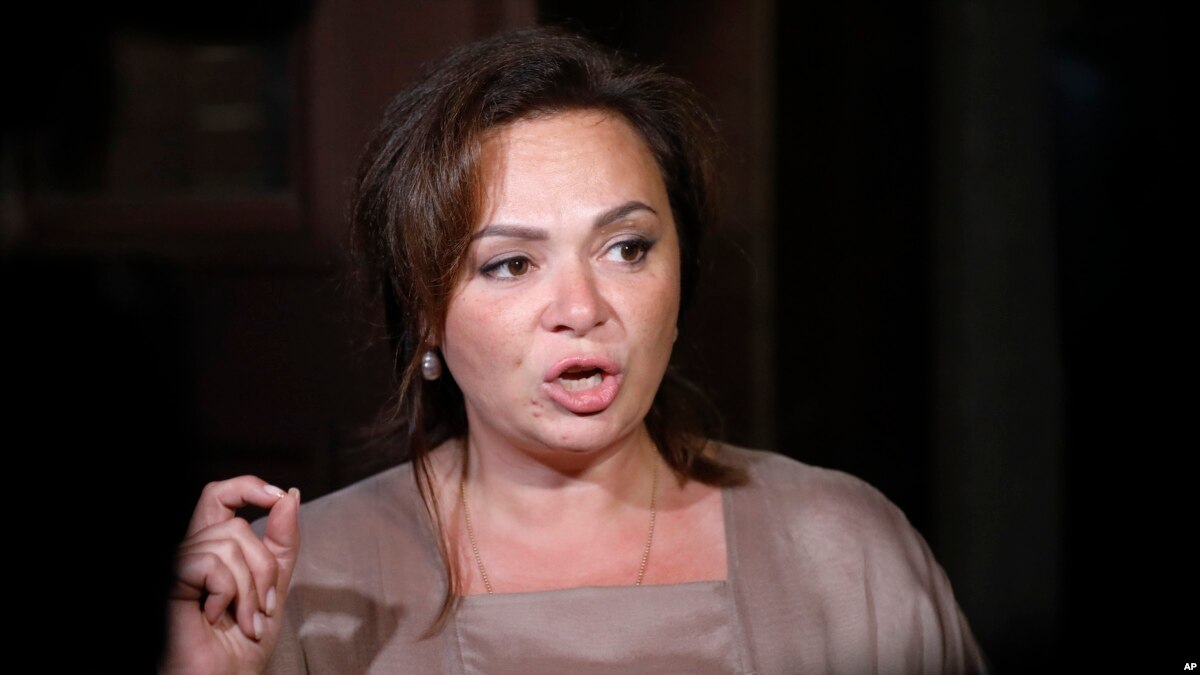
The Moscow lawyer said to have promised Donald Trump's presidential campaign dirt on his Democratic opponent worked more closely with senior Russian government officials than she previously let on, according to documents reviewed by The Associated Press.
Scores of emails, transcripts and legal documents paint a portrait of Natalia Veselnitskaya as a well-connected attorney who served as a ghostwriter for top Russian government lawyers and received assistance from senior Interior Ministry personnel in a case involving a key client.
The data were obtained through Russian opposition figure Mikhail Khodorkovsky's London-based investigative unit, the Dossier Center, that is compiling profiles of Russians it accuses of benefiting from corruption. The data were later shared with journalists at the AP, the Swiss newspaper Tages-Anzeiger, Greek news website Inside Story and others.
The AP was unable to reach Veselnitskaya for comment. Messages from a reporter sent to her phone were marked as "read'' but were not returned. A list of questions sent via email went unanswered.
Veselnitskaya has been under scrutiny since it emerged last year that Trump's eldest son, Donald Jr., met with her in June 2016 after being told by an intermediary that she represented the Russian government and was offering Moscow's help defeating rival presidential candidate Hillary Clinton.
'Independent' operator
Veselnitskaya has denied acting on behalf of Russian officialdom when she met with the Trump team, telling Congress that she operates "independently of any government bodies.''
But recent reporting has cast doubt on her story. In an April interview with NBC News, Veselnitskaya acknowledged acting as an "informant'' for the Russian government after being confronted with an earlier batch of emails obtained through the Dossier Center.
The new documents reviewed by AP suggest her ties to Russian authorities are close — and they pull the curtain back on her campaign to overturn the sanctions imposed by the U.S. on Russian officials.
The source of the material is murky. Veselnitskaya has previously said that her emails were hacked. Khodorkovsky told AP he couldn't know where the messages came from, saying his group maintained a series of anonymous digital drop boxes.
The AP worked to authenticate the 200-odd documents, in some cases by verifying the digital signatures carried in email headers.
In three other cases, individuals named in various email chains confirmed that the messages were genuine. Other correspondence was partially verified by confirming the nonpublic phone numbers or email addresses they held, including some belonging to senior Russian officials and U.S. lobbyists.
US House Passes Defense Bill Targeting Chinese Investments
The U.S. House of Representatives on Thursday passed a sprawling $716 billion defense authorization bill that also aims to rein in China's investments in the United States and prohibits the U.S. government from using technology from major Chinese telecommunications firms.
The John S. McCain National Defense Authorization Act, which must also be approved by the Senate, passed the House by a vote of 359-54. While the measure puts controls on U.S. government contracts with ZTE Corp and Huawei Technologies Co Ltd because of national security concerns, the restrictions are far weaker than initially drafted.
It also strengthens the Committee on Foreign Investment in the United States (CFIUS), which reviews proposed foreign investments to weigh whether they present national security concerns.
The White House praised the House passage of the legislation and for including a pay raise for military troops.
"It also takes positive steps that are consistent with the Administration's commitment to maintaining a strong and resilient manufacturing and defense industrial base," Sarah Sanders, the White House press secretary, said in a statement.
The sprawling piece of legislation — which is necessary to approve ongoing military operations — has historically enjoyed strong bipartisan support.
The strength of sanctions against ZTE Corp have waned. Earlier in July, U.S. lawmakers cut measures from a defense bill that would have reinstated sanctions on ZTE Corp, abandoning an attempt to punish the company for illegally shipping U.S. products to Iran and North Korea.
Lawmakers from both parties have been at odds with Republican President Donald Trump over his decision last week to lift his earlier ban on U.S. companies selling to ZTE, allowing China's second-largest telecommunications equipment maker to resume business.
An amendment backed by two Republicans and two Democrats would have reinstated the sanctions but was stripped out of the must-pass defense policy bill, lawmakers said on Friday.
Lawmakers are also using the military authorization bill as a vehicle to pass new rules governing investment by foreign-owned entities in the United States.
The remit of CFIUS, an interagency group led by the Treasury Department that assesses mergers and stock buys by foreign investors and companies to ensure that the purchases do not harm national security, was broadened.
Nothing in the bill will change CFIUS' basis decision-making process — the deals that were ordered scrapped by CFIUS previously will still be scrapped and the deals that were allowed will still be allowed, according to most CFIUS practitioners.
That said, the legislation will expand the number of minority investments reviewed by CFIUS and allows for abbreviated reviews of less controversial deals. It also provides for more secure funding for the agency, which has seen its workload balloon in recent years.
"It expands CFIUS' jurisdiction. It creates mandatory filing obligations for certain types of transactions. And it greatly increases the resources available to CFIUS," Stephen Heifetz, a CFIUS expert with the law firm Wilson Sonsini Goodrich & Rosati, said in a telephone interview.
Separately, the legislation would authorize spending $7.6 billion for 77 F-35 Joint Strike Fighter jets, made by Lockheed Martin Corp.
But it would prohibit delivery of the advanced aircraft to fellow NATO member Turkey. U.S. officials have warned Ankara that a Russian missile defense system that Turkey plans to buy cannot be integrated into the NATO air and missile defense system.
Pompeo Declines to Reveal What Trump and Putin Discussed

U.S. Secretary of State Mike Pompeo came under pressure from Republican and Democratic lawmakers to defend U.S. President Donald Trump's foreign policy and disclose what happened during Trump's one-on-one meeting with Russian President Vladimir Putin. Meanwhile, the White House announced the Trump-Putin summit would be next year, and Pompeo issued a Crimea Declaration, saying the U.S. would never accept Russia's annexation of the peninsula. VOA's Diplomatic Correspondent Cindy Saine reports.
Read More Pompeo Declines to Reveal What Trump and Putin Discussed : https://ift.tt/2AcUrK3Featured Post
Politics - The Boston Globe
unitedstatepolitics.blogspot.com Adblock test (Why?) "politic" - Google News February 01, 2024 at 03:47AM https://ift.tt...
/cloudfront-us-east-1.images.arcpublishing.com/bostonglobe/VNG7YMZTRWJ5WBFTJ5NVETPCQI.jpg)
Postingan Populer
-
unitedstatepolitics.blogspot.com Adblock test (Why?) "politic" - Google News February 01, 2024 at 03:47AM https://ift.tt...
-
unitedstatepolitics.blogspot.com The president diverges from both Donald Trump and Barack Obama with a complex vision of coalition-building...
-
unitedstatepolitics.blogspot.com The public radio program and podcast Our Body Politic is pausing production. The program is “at a cross...


