Rechercher dans ce blog

Wednesday, September 30, 2020

Why Coinbase will struggle to ban politics from the workplace - The Verge

unitedstatepolitics.blogspot.com

Programming note: There’s a presidential debate tonight! Here’s how to watch it online. And here’s Politico’s handy “pre-bunk” of 10 lies you’re likely to hear at the debate.

If there is a manager in your life, there is a good chance that they are miserable right now.

They are miserable for the reasons everyone is miserable: the pandemic; quarantine; the challenges of working from home while raising children; the steady erosion of American democracy. But unlike us working stiffs, managers are miserable for another reason: their employees are miserable, too — and worse, they expect the managers to do something about it.

In July I wrote about how a surge of employee activism inside tech companies was beginning to remake the relationship between managers and their workforces. The turbulent past four years have roiled once-harmonious businesses of all sorts, from venture-backed e-commerce companies to giants like Google. Increasingly, workers want their employers to take political stands, as I wrote about last week after listening to a summer’s worth of internal meetings at Facebook. And because these companies sell themselves as “mission-driven” to their idealistic employees, many managers feel pressure to live up to that by engaging with current affairs.

This is particularly true because the US government has become staggeringly unresponsive to its citizenry — unable to provide for their basic safety and economic security during a historic crisis. Meanwhile, corporations — particularly big US tech corporations — tend to be very responsive to their workforces, courting their feedback regularly and using it to improve the operations of the company. And so the worse that the government performs, the more that workers ask of their employers.

Other managers, though, are taking a look at all of these dynamics and saying the hell with it. Take it away, Coinbase CEO Brian Armstrong (emphasis his):

It has become common for Silicon Valley companies to engage in a wide variety of social activism, even those unrelated to what the company does, and there are certainly employees who really want this in the company they work for. So why have we decided to take a different approach?

The reason is that while I think these efforts are well intentioned, they have the potential to destroy a lot of value at most companies, both by being a distraction, and by creating internal division. We’ve seen what internal strife at companies like Google and Facebook can do to productivity, and there are many smaller companies who have had their own challenges here. I believe most employees don’t want to work in these divisive environments. They want to work on a winning team that is united and making progress toward an important mission. They want to be respected at work, have a welcoming environment where they can contribute, and have growth opportunities. They want the workplace to be a refuge from the division that is increasingly present in the world.

As a result, Armstrong said, Coinbase would not take positions on broader societal issues, advocate for political causes or candidates, or commit more than a minimal amount of time or resources to nonprofit work. “We are an intense culture and we are an apolitical culture,” he wrote.

Armstrong’s post resonated with some prominent members of the managerial class, who showered it with more than 5,000 Medium claps. “Yet again, Brian Armstrong leads the way,” tweeted Y Combinator founder Paul Graham. “I predict most successful companies will follow Coinbase’s lead. If only because those who don’t are less likely to succeed.”

As more people read Armstrong’s post, my timelines began to light up with takes. The tweets, which more often come from rank-and-file workers, expressed skepticism that an organization whose mission is “to use cryptocurrency to bring economic freedom to people all over the world” could also manage to be apolitical. Meanwhile, my direct messages lit up with takes from managers, who argued that a less political company is the kind that most people want to work at. If you’re an underrepresented minority and find yourself regularly confronted with internal posts that you regard as hostile, you’ll probably want to work elsewhere.

And sure, a person who is regularly posting hostile or borderline-hostile messages internally might deserve to be fired. But certain beliefs are protected — you can’t be fired for your views on religion, for example. And so, like basically everything we cover here at The Interface, the question of what employees should be allowed to say — and what they should be allowed to demand from their employers — becomes a question of content moderation.

Given how difficult content moderation is, it’s no surprise that some companies are trying to limit discussion of these issues at all. Coinbase made headlines for it this week, but earlier this month it was Facebook in a similar spot. Here’s Salvador Rodriguez at CNBC:

Under the new set of principles, Zuckerberg said, Facebook will ensure all employees feel supported at work, especially the company’s Black community, by strengthening the company’s harassment policy with more protections for underrepresented employees.

The company will also be more specific about which parts of Workplace can be used to discuss social and political issues. This change will be so that employees do not have to confront social issues during their day-to-day work.

If the past year has seen a surge of employee activism in the workplace, it seems, the next will see managers attempt to swing the pendulum back in the other direction. In addition to the moves announced this week, for example, Coinbase also removed two Slack channels that employees were once able to use to ask questions. (Like Facebook, the company now asks employees to submit questions in advance, with Armstrong and other executives answering only the questions with the most votes.)

Talking with current and former Coinbase employees over the past day, I found mixed reviews of Armstrong’s post. (The company itself declined to comment when I asked.)

“Most people disagree with the stance and don’t see a clear-cut separation of the company’s mission and societal issues,” one employee told me. “Others may agree with the spirit of what Brian’s suggesting, knowing how he personally thinks about mainstream issues, but don’t agree with the tone or the approach.”

Whatever you think about Armstrong’s move, I suspect that on some level we will ultimately look back on it as an act of wishful thinking. Armstrong is not alone in wishing that the polarized politics of 2020 would recede into the background long enough to let us concentrate on work. But nothing now unfolding in the world around us suggests that anything of the sort is about to happen. On the contrary, the next several weeks promise to inject politics into everyday life in frequent and possibly unsettling new ways.

It may be that your friendly neighborhood cryptocurrency exchange has nothing of consequence to add to these events. But it seems more than a little odd to declare that to be so in advance, and by fiat. Politics are not vampires — they do not need to be invited in to enter your home.

One last point: it was reported last night on Twitter by Erica Joy, and confirmed by my own sources, that Coinbase engineers walked out on the job in June after Armstrong declined to issue a public statement affirming that Black lives matter. (He later did so in a Twitter thread.) Inside the company, it is widely believed that Armstrong’s post this week is his response to the walkout — an effort to remind employees who is in charge.

And if that’s the case, it’s worth saying that much of what we have been discussing this summer has not been “politics” so much it has been human rights. Breonna Taylor was shot dead by police in the middle of the night; Armstrong’s post referred to the killing only as “recent events regarding Breonna Taylor,” before the coldness of the language was mocked on Twitter and he deleted any reference to her.

There are many issues on which I can easily accept that a cryptocurrency exchange, or really any company, has no opinions. But during an election year in which democracy itself is at stake, and state-backed violence against protesters continues unchecked, racial justice can’t be one of them. By lashing out at employees who dared to challenge him, the CEO’s worldview became crystal clear. Coinbase won’t be apolitical so much as it will be as political as he wants it to be, and those politics will be whatever Brian Armstrong says they are.

The Ratio

Today in news that could affect public perception of the big tech platforms.

Trending up: Facebook estimates that 100,000 new poll workers have signed up in response to the company’s election efforts. In North Carolina alone, 11,000 people signed up from Saturday to Monday morning, with 60,000 people clicking the link on Facebook. (Facebook)

Trending up: TikTok launched an in-app guide to the 2020 US election as part of its ongoing efforts to protect the platform from misinformation. It’s meant to help users register to vote and get information about federal, state, and local candidates. (Makena Kelly / The Verge)

Trending down: Amazon has deceived the public about rising injury rates among its warehouse workers, according to internal documents. The crisis is especially acute at robotic facilities and during Prime week and the holiday peak. (Will Evans / Reveal)

Governing

⭐ The Committee on Foreign Investment in the United States (CFIUS) is stepping up its scrutiny of Chinese investments in US tech start-ups. The committee has been sending a flurry of inquiries about past deals, making startups more cautious about accepting foreign investments. Here’s Jeanne Whalen at The Washington Post:

Michael Borrus, the founding general partner of XSeed Capital, said CFIUS scrutiny is causing investors and companies to think twice about deals.

“We’ve had Chinese VCs or Chinese families who have been interested in putting money in” to some companies where XSeed Capital is a shareholder, Borrus said. “In the current environment, we’ve decided it’s too complicated.” [...]

CFIUS is particularly focused on companies and apps that collect sensitive personal information on users, such as location or financial data, and on companies involved in technology seen as critical for national security, such as certain types of battery technology and biotechnology, lawyers said, requesting anonymity to discuss sensitive matters. The committee is mostly inquiring about Chinese investment, but on a few occasions has asked about Russian investors.

President Rodrigo Duterte of the Philippines lashed out at Facebook for taking down fake accounts that supported his policies. The president, who rose to power in part by harnessing Facebook’s platform to get his messages to millions, is now making vague threats to shut it down in the Philippines. This is why Facebook was not excited about India banning TikTok, incidentally. (Jason Gutierrez and Paul Mozur / The New York Times)

QAnon leaders are asking followers to drop the “QAnon” label from their conspiracy theories and simply refer to their fight against a fictitious cabal of powerful baby-eating politicians. The move comes as tech companies crack down on QAnon content. (Ben Collins / NBC)

Baseless rumors about Joe Biden planning to use a hidden earpiece during tonight’s debate are spreading among right-wing influencers on Facebook and Twitter. “If Joe Biden isn’t hiding anything, why won’t he consent to a third party checking for an earpiece before tonight’s debate?” asked conservative activist Charlie Kirk. These lies have a history in US presidential debates dating back at least 20 years. (Kevin Roose / The New York Times)

Project Veritas, an organization run by right-wing activist James O’Keefe, has a new investigation on “ballot harvesting” that’s going viral on Facebook, YouTube, and Twitter. The video contains significant misinformation. (Popular Information)

There have been at least 10 major foreign interference claims related to the 2020 election in the month of September. The Digital Forensic Research Lab launched a tracker to assess the credibility and impact of each claim. (Digital Forensic Research Lab)

President Trump’s assault against Twitter may represent the most egregious violation of the First Amendment by a president since Nixon went to war against the Washington Post almost half a century ago, say these authors. The president has repeatedly accused the platform of censorship. (Lee C. Bollinger and Donald E. Graham / The Washington Post)

Google is set to win EU antitrust approval for its $2.1 billion purchase of Fitbit. The news comes after the search giant said it would restrict the use of Fitbit data for Google ads and would also tighten the monitoring of that process. (Foo Yun Chee / Reuters)

Industry

⭐ Amazon unveiled a new biometric technology called Amazon One that allows shoppers to pay at stores by placing their palm over a scanning device. To register to use the technology, a customer will scan their palm and insert their payment card at a terminal. After that, they can just pay with their hand. Jason Del Rey at Recode has the story:

The technology will be available at the entrance of two of the company’s Amazon Go cashierless convenience stores in Seattle, Washington, starting Tuesday, and will roll out to the rest of the chain’s 20-plus stores in the future, Amazon Vice President Dilip Kumar told Recode in an interview Monday. Recode reported in December that Amazon had filed a patent application for such a hand-payment technology.

The technology could also show up in Whole Foods stores, with Amazon hinting in a press release that it will introduce palm payments in the coming months at its other stores beyond its Amazon Go locations. Kumar wouldn’t comment on a potential Whole Foods implementation, though the New York Post reported a year ago that such a plan was in the works.

Facebook is promoting Alex Schultz, one of its longest-tenured product and growth executives, to take over as chief marketing officer. Schultz is taking over the CMO job from Antonio Luciom who departed last month. (Kurt Wagner and Sarah Frier / Bloomberg)

Zynga is shutting down its original FarmVille web game on Facebook at the end of the year. In July, Facebook said it would no longer support Flash games as of December 31st. (Kim Lyons / The Verge)

Media companies have largely backed off their attempts to compete with Facebook and Google’s digital advertising dominance. In 2017, many invested in pricey ad tech deals to lure advertisers away from the tech giants. (Sara Fischer / Axios)

Colleges are hiring students as COVID-19 safety influencers. They’re tasked with sharing coronavirus content written by the university on their personal accounts. (Ezra Marcus / The New York Times)

Emma Chamberlain has mastered the art of being relatable on YouTube, despite her increasing wealth and fame. She also just launched a new line of fair-trade coffee. (Rebecca Jennings / Vox)

And finally...

Talk to us

Send us tips, comments, questions, and political opinions appropriate to your workplace: casey@theverge.com and zoe@theverge.com.

Let's block ads! (Why?)


"politic" - Google News
September 30, 2020 at 05:00PM
https://ift.tt/33fUDEU

Why Coinbase will struggle to ban politics from the workplace - The Verge
"politic" - Google News
https://ift.tt/3c2OaPk
https://ift.tt/2Wls1p6

Social media's impact on politics in spotlight in 'Hacking Democracy' - Sequim Gazette

unitedstatepolitics.blogspot.com

Humanities Washington speaker Travis Ridout offers “Hacking Democracy: What Social Media is Doing to US Politics,” an online presentation, at 3 p.m. Saturday, Oct. 3.

Registration is required to receive the Zoom login; register at www.nols.org or by contacting a North Olympic Library System branch.

With Hacking Democracy,” Ridout — a political scientist — explores the pros and cons of social media in political campaigns.

“While social media use gives citizens access to a wealth of information, it also exposes them to messages that are carefully tailored and targeted in a highly sophisticated manner,” Ridout’s Humanities Washington presentation notes. “More ominously, social media can be used to psychologically manipulate voters in unprecedented ways, beyond the fact-checking and scrutiny of the news media spotlight. How real is this latter possibility as we head toward the 2020 presidential campaign? Learn how politicians — and foreign spies — are using social media and personal data to their advantage.”

Ridout is the Thomas S. Foley Distinguished Professor of Government and Public Policy at Washington State University. His research on political campaigns has appeared in the American Journal of Political Science, British Journal of Political Science and in the Journal of Politics.

Ridout’s most recent book is political advertising in the United States.

One of Humanities Washington’s oldest and most popular programs, Speakers Bureau is designed to “spark conversation and critical thinking using story as a catalyst, nurturing thoughtful and engaged communities across the state.” For more about Speakers Bureau, visit https://ift.tt/155VmI0.

Travis Ridout

Travis Ridout

Let's block ads! (Why?)


"politic" - Google News
September 30, 2020 at 03:30PM
https://ift.tt/3ihwjq8

Social media's impact on politics in spotlight in 'Hacking Democracy' - Sequim Gazette
"politic" - Google News
https://ift.tt/3c2OaPk
https://ift.tt/2Wls1p6

Stocks slip after first Trump-Biden debate - Yahoo Tech

unitedstatepolitics.blogspot.com

TipRanks

2 “Strong Buy” Space Stocks That Are Ready for Takeoff

Space, the final frontier. Throughout history, the expanse that exists beyond Earth has captivated people all over the world, with space exploration continuing to take giant leaps forward since Apollo 11 first landed on the moon.Now, outer space has peaked Wall Street’s interest. Given the high levels of private funding and advances in technology, the pros argue there could be major implications should space become more accessible and less expensive to reach. To this end, new markets such as satellite broadband, high-speed product delivery, reusable rockets and human space travel are emerging.Speaking to the potential opportunity, according to a recent KPMG report, by 2030, the global space industry could reach $600 billion, with it currently worth $350 billion. Bearing this in mind, we used TipRanks’ database to zero in on two space stocks reaching for the stars, so says the Street. Boasting the analyst community’s full support, both tickers have received a “Strong Buy” consensus rating. Virgin Galactic Holdings (SPCE)By offering high-speed point-to-point travel, Virgin Galactic wants to commercialize space travel and revolutionize commercial flight. Given the significant backlog of demand for commercial spaceflight, several members of the Street have high hopes for this space stock.Representing Cowen, analyst Oliver Chen sees SPCE as “uniquely positioned to benefit from the growing consumer interest toward luxury experiences, especially among high-net-worth individuals.” He added, “We believe a substantial growth opportunity lies ahead with the commercial spaceflight business, which already has ~600 reservations, and the development of high-speed point-to-point travel.”Looking at the market opportunity, Chen estimates that this part of the business could push SPCE’s top-line to $1 billion-plus by 2030, growing at a 60%-plus CAGR (2021-2030), with an EBITDA margin of 46%. According to the analyst, there’s a total addressable market (TAM) for commercial spaceflight (suborbital) of roughly 2.4 million individuals with a net worth of $5 million-plus globally.On top of this, SPCE could use its technology to develop additional revenue streams such as high-speed P2P commercial air travel. The development of hypersonic aircrafts would make 85% of the global network pairs accessible in a one-day trip. In addition, the analyst thinks the high-speed P2P opportunity could yield a TAM of $985 billion by 2050, and SPCE's market share could clock in at 20%. “P2P is in very early innings but we believe the company has the resources, capital, and experience to pursue this business line,” Chen noted.Given that the company’s leadership team brings expertise from NASA and Disney to the table, Chen argues SPCE is capable of capitalizing on the opportunity, with solid execution potentially solidifying its status as an experiential luxury brand.The positioning of its commercial space flight offering as a luxury airline experience, which is what consumers are more used to, is likely to give SPCE the first-mover advantage over others like Blue Origin. “Given the high fixed cost of operating a space tourism operation, first-mover advantage looks critical to success; and VG appears better positioned than BO to get it,” Chen mentioned.What else could give SPCE the first-mover advantage? Chen points to SPCE’s 10-plus years of technology developed with $1 billion of investment made to-date and the vertically integrated aerospace development capabilities. What’s more, SPCE has “created competitive moats in a high-barrier-to-entry industry and benefits from strong consumer demand, which should support a premium pricing structure.”Based on all of the above, Chen puts an Outperform (i.e. Buy) rating and $22 price target on the stock. (To watch Chen’s track record, click here)Are other analysts in agreement? They are. Only Buy ratings, 7 to be exact, have been issued in the last three months. Therefore, the message is clear: SPCE is a Strong Buy. With a $25.43 average price target, shares could rise 22% in the next year. (See Virgin Galactic stock analysis on TipRanks)Aerojet Rocketdyne Holdings (AJRD)Serving customers that include the U.S. Department of Defense (DoD), NASA and other agencies and companies, Aerojet Rocketdyne develops and manufactures advanced propulsion and energetics systems. Given its recent contract awards, multiple analysts believe this company’s long-term growth prospects are strong.5-star analyst Ken Herbert, of Canaccord Genuity, recently met with AJRD’s new CFO, coming away from the discussion with his bullish thesis very much intact. The company expects the space business, which makes up 40% of sales, to be flat to up slightly, due to the recent SLS RS-25 engine order, with the core defense business (60% of sales) set to see steady growth.“While near-term margin upside is limited, we believe the revenue visibility, strong balance sheet and incremental opportunities in both space and defense contribute to a scarcity value for AJRD not reflected in the stock,” Herbert commented.That said, new programs are an essential piece of the puzzle here. Earlier in September, AJRD announced that it will build two elements of the new ground based strategic deterrent (GBSD) nuclear missiles for Northrop Grumman, which received a $13.3 billion, 8.5-year EMD contract to initiate early production of the “Minuteman IV” platform. AJRD is responsible for manufacturing a large solid rocket motor for the missile’s upper stage and the post-boost propulsion system needed to guide the nuclear warheads to their targets through apogee (the highest point of their parabolic flight arc). Weighing in on the deal, Herbert commented, “The program is expected to be substantial to both Aerojet and Northrop, with 400 active and 242 spare ICBMs expected to occupy the existing launch sites in the American West. It has been estimated that the GBSD program will be worth $63 billion during its first 20 years of life, which is likely to be extended given the longevity of the current Minuteman III deterrent.”Adding to the good news, AJRD’s backlog has increased to a record high of $6.8 billion as of Q2 2020, a 48% gain from the prior-year quarter. According to Herbert, a key driver of this growth has been the $1.8 billion NASA contract to construct 18 new RS-25 engines to support at least five additional Artemis lunar missions beyond the three currently planned. “As such, visibility into Aerojet’s business with NASA continues to look promising through 2030. Aerojet has also continued to see backlog growth on THAAD, hypersonics, Standard Missile and GMLRS,” the analyst stated. If that wasn’t enough, Herbert believes missile defense and classified hypersonics programs are likely to see solid backlog growth in the near-term.On top of this, in August, the U.S. Air Force awarded two contracts for the National Security Space Launch (NSSL) program to ULA (a Boeing and Lockheed joint venture) and SpaceX. The implication? “Aerojet Rocketdyne is seen as a winner of the contact outcome, which ensured that the company will continue to provide content on a majority of U.S. military and intelligence launches. AJRD will see its upper stage engine content double on the new ULA Vulcan rocket under this contract, which utilizes a new Centaur upper stage (the Centaur V) powered by two RL10 engines, as opposed to one RL10 on the legacy Atlas V rocket,” Herbert explained.Everything that AJRD has going for it convinced Herbert to reiterate his Buy rating. Along with the call, he maintained a $54 price target, suggesting 34% upside potential. (To watch Herbert’s track record, click here)All in all, other analysts are on the same page. AJRD’s Strong Buy consensus rating breaks down into 3 Buys and no Holds or Sells. Meanwhile, the $56 average price target brings the upside potential to 39%. (See AJRD stock analysis on TipRanks)To find good ideas for stocks trading at attractive valuations, visit TipRanks’ Best Stocks to Buy, a newly launched tool that unites all of TipRanks’ equity insights.Disclaimer: The opinions expressed in this article are solely those of the featured analysts. The content is intended to be used for informational purposes only. It is very important to do your own analysis before making any investment.

Let's block ads! (Why?)


"Market" - Google News
September 30, 2020 at 02:52PM
https://ift.tt/3jk3M4E

Stocks slip after first Trump-Biden debate - Yahoo Tech
"Market" - Google News
https://ift.tt/2Yge9gs
https://ift.tt/2Wls1p6

Personal Emergency Response System Market Will Showcase Neutral Impact During 2020-2024 | Growing Geriatric Population to Boost the Market Growth | Technavio - Galveston County Daily News

unitedstatepolitics.blogspot.com

LONDON--(BUSINESS WIRE)--Sep 30, 2020--

Technavio has been monitoring the personal emergency response system market and it is poised to grow by USD 2.47 bn during 2020-2024, progressing at a CAGR of over 6% during the forecast period. The report offers an up-to-date analysis regarding the current market scenario, latest trends and drivers, and the overall market environment.

This press release features multimedia. View the full release here: https://www.businesswire.com/news/home/20200930005402/en/

Technavio has announced its latest market research report titled Global Personal Emergency Response System Market 2020-2024 (Graphic: Business Wire)

Although the COVID-19 pandemic continues to transform the growth of various industries, the immediate impact of the outbreak is varied. While a few industries will register a drop in demand, numerous others will continue to remain unscathed and show promising growth opportunities. Technavio’s in-depth research has all your needs covered as our research reports include all foreseeable market scenarios, including pre- & post-COVID-19 analysis. We offer $1000 worth of FREE customization

The market is fragmented, and the degree of fragmentation will accelerate during the forecast period. ADT Inc., AlertOne Services LLC, Bay Alarm Co., Best Buy Co. Inc., Careline UK Monitoring Ltd., Koninklijke Philips NV, MobileHelp LLC, Nortek Security & Control LLC, Tunstall Healthcare Group Ltd., and Valued Relationships Inc. are some of the major market participants. To make the most of the opportunities, market vendors should focus more on the growth prospects in the fast-growing segments, while maintaining their positions in the slow-growing segments.

Buy 1 Technavio report and get the second for 50% off. Buy 2 Technavio reports and get the third for free.

View market snapshot before purchasing

Growing geriatric population has been instrumental in driving the growth of the market.

Technavio's custom research reports offer detailed insights on the impact of COVID-19 at an industry level, a regional level, and subsequent supply chain operations. This customized report will also help clients keep up with new product launches in direct & indirect COVID-19 related markets, upcoming vaccines and pipeline analysis, and significant developments in vendor operations and government regulations.Download a Free Sample Report on COVID-19 Impacts

Personal Emergency Response System Market 2020-2024: Segmentation

Personal Emergency Response System Market is segmented as below:

  • Type
    • Mobile
    • Landline
    • Standalone
  • Geography
    • North America
    • Europe
    • Asia
    • ROW

Personal Emergency Response System Market 2020-2024: Scope

Technavio presents a detailed picture of the market by the way of study, synthesis, and summation of data from multiple sources. The personal emergency response system market report covers the following areas:

  • Personal Emergency Response System Market Size
  • Personal Emergency Response System Market Trends
  • Personal Emergency Response System Market Industry Analysis

This study identifies increasing prevalence of chronic diseases as one of the prime reasons driving the personal emergency response system market growth during the next few years.

Technavio suggests three forecast scenarios (optimistic, probable, and pessimistic) considering the impact of COVID-19. Technavio’s in-depth research has direct and indirect COVID-19 impacted market research reports.

Register for a free trial today and gain instant access to 17,000+ market research reports.

Technavio's SUBSCRIPTION platform

Personal Emergency Response System Market 2020-2024: Key Highlights

  • CAGR of the market during the forecast period 2020-2024
  • Detailed information on factors that will assist personal emergency response system market growth during the next five years
  • Estimation of the personal emergency response system market size and its contribution to the parent market
  • Predictions on upcoming trends and changes in consumer behavior
  • The growth of the personal emergency response system market
  • Analysis of the market’s competitive landscape and detailed information on vendors
  • Comprehensive details of factors that will challenge the growth of personal emergency response system market, vendors

Table of Contents:

Executive Summary

Market Landscape

  • Market ecosystem
  • Value chain analysis

Market Sizing

  • Market definition
  • Market segment analysis
  • Market size 2019
  • Market outlook: Forecast for 2019 - 2024

Five Forces Analysis

  • Five force summary
  • Bargaining power of buyers
  • Bargaining power of suppliers
  • Threat of new entrants
  • Threat of substitutes
  • Threat of rivalry
  • Market condition

Market Segmentation by Type

  • Market segments
  • Comparison by Type
  • Mobile - Market size and forecast 2019-2024
  • Landline - Market size and forecast 2019-2024
  • Standalone - Market size and forecast 2019-2024
  • Market opportunity by Type

Customer Landscape

Geographic Landscape

  • Geographic segmentation
  • Geographic comparison
  • North America - Market size and forecast 2019-2024
  • Europe - Market size and forecast 2019-2024
  • Asia - Market size and forecast 2019-2024
  • ROW - Market size and forecast 2019-2024
  • Key leading countries
  • Market opportunity by geography
  • Volume drivers – Demand led growth
  • Growing
  • Market challenges
  • Market trends

Vendor Landscape

  • Vendor landscape
  • Landscape disruption

Vendor Analysis

  • Vendors covered
  • Market positioning of vendors
  • ADT Inc.
  • AlertOne Services LLC
  • Bay Alarm Co.
  • Best Buy Co. Inc.
  • Careline UK Monitoring Ltd.
  • Koninklijke Philips NV
  • MobileHelp LLC
  • Nortek Security & Control LLC
  • Tunstall Healthcare Group Ltd.
  • Valued Relationships Inc.

Appendix

  • Scope of the report
  • Currency conversion rates for US$
  • Research methodology
  • List of abbreviations

About Us

Technavio is a leading global technology research and advisory company. Their research and analysis focus on emerging market trends and provides actionable insights to help businesses identify market opportunities and develop effective strategies to optimize their market positions. With over 500 specialized analysts, Technavio’s report library consists of more than 17,000 reports and counting, covering 800 technologies, spanning across 50 countries. Their client base consists of enterprises of all sizes, including more than 100 Fortune 500 companies. This growing client base relies on Technavio’s comprehensive coverage, extensive research, and actionable market insights to identify opportunities in existing and potential markets and assess their competitive positions within changing market scenarios.

View source version on businesswire.com:https://www.businesswire.com/news/home/20200930005402/en/

CONTACT: Technavio Research

Jesse Maida

Media & Marketing Executive

US: +1 844 364 1100

UK: +44 203 893 3200

Email:media@technavio.com

Website:www.technavio.com/

KEYWORD:

INDUSTRY KEYWORD: NURSING HARDWARE HEALTH MEDICAL DEVICES HOSPITALS TECHNOLOGY MOBILE/WIRELESS SECURITY

SOURCE: Technavio Research

Copyright Business Wire 2020.

PUB: 09/30/2020 06:17 AM/DISC: 09/30/2020 06:17 AM

http://www.businesswire.com/news/home/20200930005402/en

Let's block ads! (Why?)


"Market" - Google News
September 30, 2020 at 05:17PM
https://ift.tt/3kZL96v

Personal Emergency Response System Market Will Showcase Neutral Impact During 2020-2024 | Growing Geriatric Population to Boost the Market Growth | Technavio - Galveston County Daily News
"Market" - Google News
https://ift.tt/2Yge9gs
https://ift.tt/2Wls1p6

Sultan's Market Opens In Logan Square – Block Club Chicago - Block Club Chicago

unitedstatepolitics.blogspot.com

LOGAN SQUARE — Logan Square neighbors now don’t have to travel all the way to Wicker Park or Lincoln Park to get their Sultan’s Market fix.

The owners of the wildly popular Middle Eastern spot have opened a third location at 2204 N. California Ave., directly across from the California Blue Line station, the owners announced Tuesday on Facebook.

Sultan’s Market, beloved by both locals and tourists alike, moved into the building currently home to Masada, the Middle Eastern restaurant owned by the same family.

Owner Shadi Ramli didn’t immediately return messages seeking comment Tuesday, but wrote in a comment on the Facebook post Masada is now acting as Sultan Market’s event space.

The Logan Square location joins existing Sultan’s Market locations in Wicker Park at 2057 W. North Ave. and in Lincoln Park at 2521 N. Clark St.

Ramli and his mother, who established Sultan’s Market, emigrated from Jordan in the 1980s.

This is a developing story.

Subscribe to Block Club Chicago. Every dime we make funds reporting from Chicago’s neighborhoods.

Already subscribe? Click here to support Block Club with a tax-deductible donation.

Let's block ads! (Why?)


"Market" - Google News
September 29, 2020 at 10:59PM
https://ift.tt/2Go29nW

Sultan's Market Opens In Logan Square – Block Club Chicago - Block Club Chicago
"Market" - Google News
https://ift.tt/2Yge9gs
https://ift.tt/2Wls1p6

Stock Market Today: Dow, S&P Live Updates for Sep. 30, 2020 - Bloomberg

unitedstatepolitics.blogspot.com
First Presidential Debate Between Donald Trump And Democratic Candidate Joe Biden

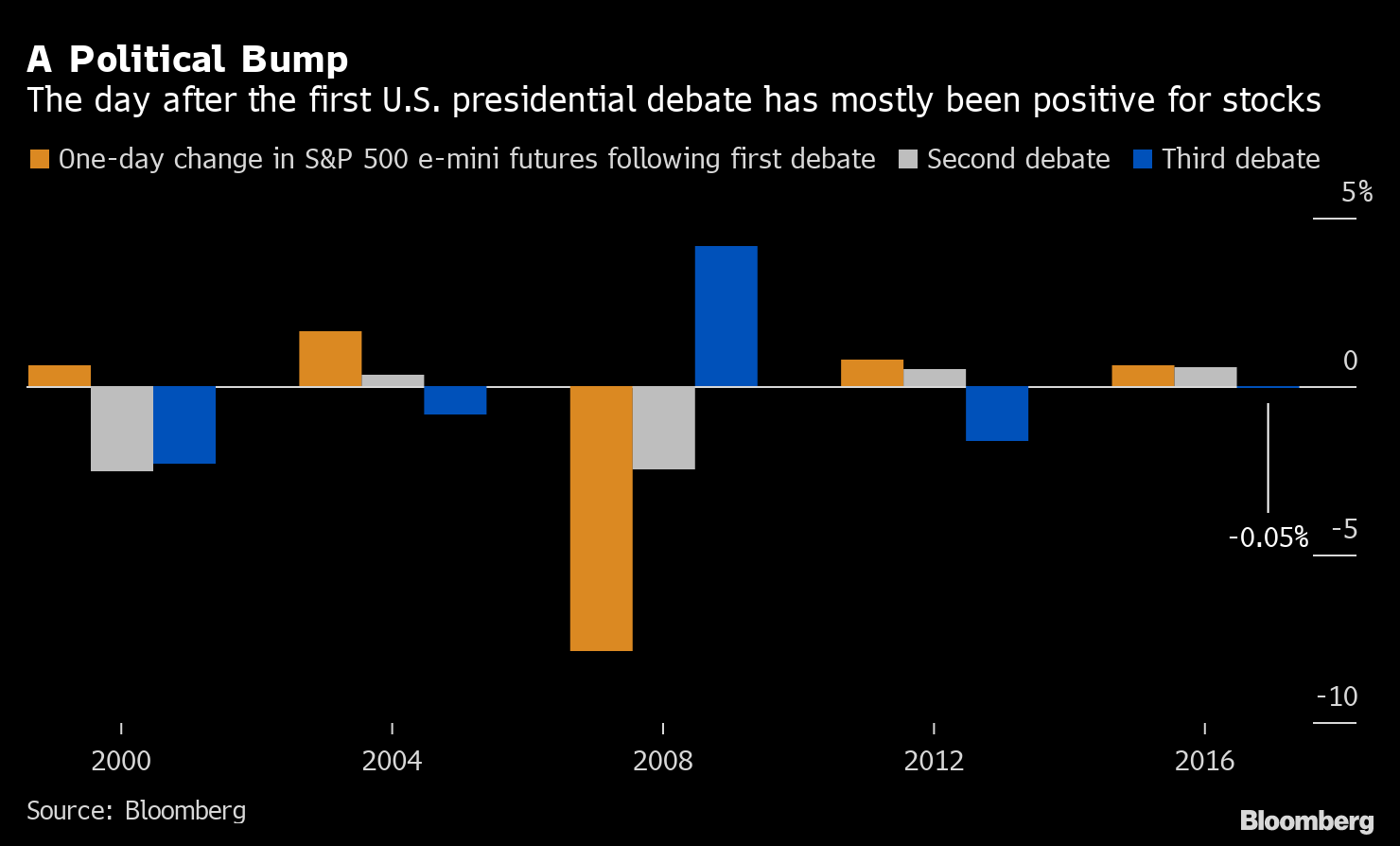
U.S. equity-index futures dropped and European shares fluctuated after an acrimonious American presidential debate highlighted the risk of a contested vote in November. A gauge of the dollar held steady.

S&P 500 futures fell as much as 1.3% in the hours after the chaotic sparring between Donald Trump and Democratic hopeful Joe Biden during which the president suggested vote-by-mail could be rife with fraud. The Stoxx Europe 600 opened lower and then recovered as insurance and utility shares advanced.

“What we’ve seen from the debate is the reinforcement that if Biden wins, Trump is not going to accept that,” said Chris Weston, head of research at Pepperstone Group Ltd. in Melbourne. “People positioned for an ugly contest afterwards have been validated.”

Traders were also recalibrating positions on the final day of this quarter. Walt Disney Co. shares fell in late trading after it said 28,000 workers will be let go in its slumping U.S. resort business, marking one of the deepest workforce reductions of the Covid-19 era.

A Political Bump

The day after the first U.S. presidential debate has mostly been positive for stocks

Source: Bloomberg

Global investors are keeping an eye on news about coronavirus vaccines and on talks in Washington for a new stimulus package that’s set to reach a critical juncture this week. House Speaker Nancy Pelosi and Treasury Secretary Steven Mnuchin spoke Tuesday morning for 50 minutes and are set to speak again Wednesday.

Earlier in Asia, China Evergrande Group’s bonds and stocks climbed after the developer took a major step toward avoiding a cash crunch. China markets are shut from Thursday for a week of holidays. South Korea is closed Wednesday. Equity gauges in Japan and Australia declined by at least 2%.

Frank Luntz, founder of Luntz Global, talks about the first presidential debate between President Donald Trump and Democratic nominee Joe Biden.

Source: Bloomberg

Here are some key events coming up:

  • A large line up of ECB officials, including Christine Lagarde, are speaking Wednesday at the ECB and its Watchers Conference.
  • The EIA crude oil inventory report comes out Wednesday.
  • The September U.S. employment report on Friday will be the last before the November election.

These are the main moves in markets:

Stocks

  • The Stoxx Europe 600 Index advanced 0.1% as of 8:38 a.m. London time.
  • Futures on the S&P 500 Index fell 0.5%.
  • Nasdaq 100 Index futures fell 0.7%.
  • The MSCI Asia Pacific Index dipped 0.5%.

Currencies

  • The Bloomberg Dollar Spot Index was little changed.
  • Sterling weakened 0.2% to 0.9152 per euro.
  • The Japanese yen was little changed at 105.62 per dollar.
  • The Mexican peso strengthened 0.4% to 22.3736 per dollar.

Bonds

  • The yield on 10-year Treasuries climbed one basis point to 0.65%.
  • Germany’s 10-year yield climbed one basis point to -0.54%.
  • Britain’s 10-year yield increased one basis point to 0.194%.
  • New Zealand’s 10-year yield climbed five basis points to 0.519%.

Commodities

  • West Texas Intermediate crude fell 0.4% to $39.12 a barrel.
  • Gold weakened 0.6% to $1,887.47 an ounce.
  • Silver weakened 1.2% to $23.89 per ounce.
  • Iron ore surged 3.2% to $120.53 per metric ton.

— With assistance by Eric Lam, Gregor Stuart Hunter, and Adam Haigh

    Let's block ads! (Why?)


    "Market" - Google News
    September 30, 2020 at 04:41AM
    https://ift.tt/2S7CWAU

    Stock Market Today: Dow, S&P Live Updates for Sep. 30, 2020 - Bloomberg
    "Market" - Google News
    https://ift.tt/2Yge9gs
    https://ift.tt/2Wls1p6

    How almost losing my restaurants pushed me to care about politics By Lien Ta - KCRW

    unitedstatepolitics.blogspot.com

    Before COVID-19, I was the furthest thing from political. When it came to voting, I was apathetic. While I was smart enough to know that my vote mattered, it was still hard to feel like it did.

    I just didn't know enough about it. I was work-obsessed, overtaken by the burden of keeping two restaurants alive, I couldn't find time to prioritize the massive undertaking of educating myself on politics. Voting for the President was something that I did in earnest, but casually. The activity came around far less frequently than most things I was committed to.

    It's safe to say I wasn't familiar with my local government either — until it seemed like I needed them.

    Then 2020 happened. 

    I own two small restaurants called Here's Looking At You and All Day Baby. Both were mandated to close effective March 16, 2020 in response to the novel coronavirus. Suddenly, I was responsible for stripping away 100 jobs. Suddenly, I was at risk of losing everything.

    Within 24 hours, restaurant peers all over the city began to unite in the form of a mass email and a call to discuss our chances of survival. I remember replying to the group, cc'ing additional chefs and restaurateurs, asking the group to write their respective councilperson that night. There was an LA City Council meeting scheduled the following morning to vote on a motion to apply a moratorium on evictions and utilities shut-off for failure to pay due to lack of business. I searched for and listed direct email addresses of a few known council people, a sample draft email encouraging support of the motion, and I tried to convince my peers that their councilperson needed to wake up to a lot of emails from all of us in order to do right by us. And all the while I was uncertain myself if my letter, or any of our letters, would make a difference.

    Later a longer letter, drafted by members of what would become a Los Angeles coalition of restaurants, would be sent to Governor Gavin Newsom, a former restaurateur himself, explaining what could help us withstand the pandemic. The biggest item was and still is: the call for abatement of rent.

    Would the Governor read the letter, I wondered? I wasn't even sure how the letter would actually arrive in his hands.


    Photo courtesy of Lien Ta

    Photo courtesy of Lien Ta

    A week would pass before I would muster up the courage (and time) to write a personal letter to Mayor Eric Garcetti. I remember its length, comparable to this essay. I remember being frank about the status of the restaurants' two bank accounts. I shared that I needed $50,000 in order to cover payroll that week, and I had $30,000 in sales tax due that day. I thanked him for following suit with the State's allowance to enable restaurants to sell cocktails to-go (the City needed to sign off, too, in order for it to become "law"). 

    The Mayor used to dine at Here's Looking At You for family dinners, date nights and business meetings. And that's what I told his security personnel in the driveway of his home, when I strolled up to the house and asked if they would please give my letter to the Mayor. In the letter, I discussed the need for his Executive Order for rent abatement. (I had learned that a Mayor's Executive Order was his power move, and it would save us so much bureaucratic time.) I let him know that we needed true relief aid, not in the form of a micro loan. And I told him this: "The root of what 'restaurant' means is to 'restore.' We want to get back to restoring others. But first, we need the city, the state and the nation to step up and help to restore us."

    He wrote me back. That night. We're Instagram friends, lol. I had successfully reached him, and he was listening to me. But of course, I wondered: What are you going to DO?


    Photo courtesy of Lien Ta

    I invested more time in writing letters to my two councilmen (I only ever received responses from one). I would listen in on eight-hour-long calls in hopes of leaving public comment on issues that would severely help or handicap our businesses. I wondered how did these elected officials come up with these ideas in the first place? Someone was feeding them these ideas, that's how. You have to appreciate that they were trying to help. But perhaps they needed better stories.

    In April, I was desperately trying to navigate the PPP loan process. In May, I rushed to spend all the money within eight weeks like I was supposed to. I followed the virus closely, and it bewildered all of us when Governor Newsom allowed for indoor dining to resume on a seeming whim. It was, evidently, based on what the Los Angeles County Health Department said we were ready for. I learned that the County would supersede the City on certain levels. A lot of dining rooms reopened, despite the fact that the Health Department wouldn't deliver new regulations for restaurants until six hours after the news release. The information was never emailed to any of us. But restaurants were later blamed for not being "up to code" and for spreading the virus further.

    I elected to never reopen our two dining rooms, a collective decision that my staff and I came to. We resumed takeout and middling sales. A month later, the Governor would backtrack and close indoor dining rooms again. I knew that the order would inevitably affect even our outdoor-dining efforts, so I cancelled a planned oyster event at Here's Looking At You, and frantically tried to return a bunch of oysters to Morro Bay. A week later, HLAY would close its doors indefinitely.

    Photo courtesy of Lien Ta

    During that seesaw journey, a Senate Bill called SB939 surfaced, which was pitched by a Senator in Northern California.

    This bill would help commercial tenants walk away from their leases without penalty. Of course, most of us were trying to save our businesses and not give up. The bill wasn't perfect, but the intention of the bill was to force landlords to engage in renegotiations with tenants desperate for a COVID-19 edit to their rent obligations.

    I encouraged my restaurant peers to write their Senators to support this bill. Knowing my fellow restaurateurs were busy trying to save their businesses, I supplied a sample letter. I would learn that the bill would need to surpass a few hurdles: First, the Senate Judiciary Committee (it did!), then the Appropriations Committee. It would later get killed en route to the Suspense File when property owners came guns a-blazing.

    I full-tilt pivoted my advocacy energy to the RESTAURANTS Act. With the leadership of Eddie Navarrette of the Independent Hospitality Coalition, I joined dozens of Zoom meetings alongside other restaurateurs. We needed to rally support for the $120 billion stabilization fund for small restaurants. It needed votes, but elected officials needed to be made aware of the bill in the first place. And they needed to hear our personal stories.

    I'm in California, so it made sense to start there. In a short time, I met with Senator Connie Leyva, Senator Maria Elena Durazo, House Representative Maxine Waters' team, and attempted to reach all of our local officials, too. Councilman Mitch O'Farrell of District 13 (where All Day Baby is located) listened intently. I met Councilwoman Monica Rodriguez of District 7 in a more unique way, and she would visit me at All Day Baby the following day and purchased every single pie we had left. When Councilman Herb Wesson of District 10 committed to a Zoom date with us, I spent the better part of a day off finding fellow restaurateurs in CD10 (where Here's Looking At You is located) to join me. Daniel Patterson of Alta Adams was in. Genet Agonafer of Meals By Genet was in. Bricia Lopez of Guelaguetza was in. My friend Jeff Jun of Jun Won was too busy closing his restaurant that week to join us, but the owner of Park's BBQ was willing.


    Photo courtesy of Lien Ta

    Unrelated to all of the above work, I was asked to be a part of the Democratic National Convention in a small way: A video in which Mayor Eric Garcetti would interview me as a small business owner impacted by the pandemic.The video, which would feature other U.S. elected officials alongside other struggling small business owners, would air on the same night as the speeches of Barack Obama, Hillary Clinton, and Vice Presidential nominee Kamala Harris. And the entire point of it was to express support for Presidential candidate Joe Biden.

    Of course, I still wonder if Joe himself heard what I said during his convention. And more importantly, is he, or anyone else with that kind of a job, going to do something about it?

    In a recent LA Times article, I read this quote from Assemblywoman Buffy Wicks of Oakland, who now famously was forced to bring her newborn baby to work in order to vote. She said: “I love being a legislator. You can hear about something on the radio that you care about and say, ‘I can do a bill.’ You can have a significant meaning in people’s lives.”

    Hearing that, I'm encouraged to keep sharing our stories. We've got to capture their attention. We've got to inspire them to care about us. It is, literally, their job to listen to us. And to do something to help.


    Photo courtesy of Lien Ta

    Let's block ads! (Why?)


    "politic" - Google News
    September 30, 2020 at 06:56AM
    https://ift.tt/36jPUni

    How almost losing my restaurants pushed me to care about politics By Lien Ta - KCRW
    "politic" - Google News
    https://ift.tt/3c2OaPk
    https://ift.tt/2Wls1p6

    Search

    Featured Post

    Politics - The Boston Globe

    unitedstatepolitics.blogspot.com Adblock test (Why?) "politic" - Google News February 01, 2024 at 03:47AM https://ift.tt...

    Postingan Populer