Rechercher dans ce blog

Tuesday, February 22, 2022

The true price of anti-pipeline politics - Fox Business

unitedstatepolitics.blogspot.com

The United States is on the verge of an energy crisis of its own making. 

The price of oil recently hit a seven-year high on the back of rising geopolitical tensions in Europe and the Middle East. With tensions rising between Ukraine and Russia, and no end in sight to existing supply chain disruptions, industry analysts expect prices to soar to over $100 a barrel before the end of the year. 

If they are correct, inflation and economic uncertainty will be driven even higher than they are today, as will the dollar value of our energy imports from strategic adversaries. Unfortunately for the United States, this is a crisis of its own making.

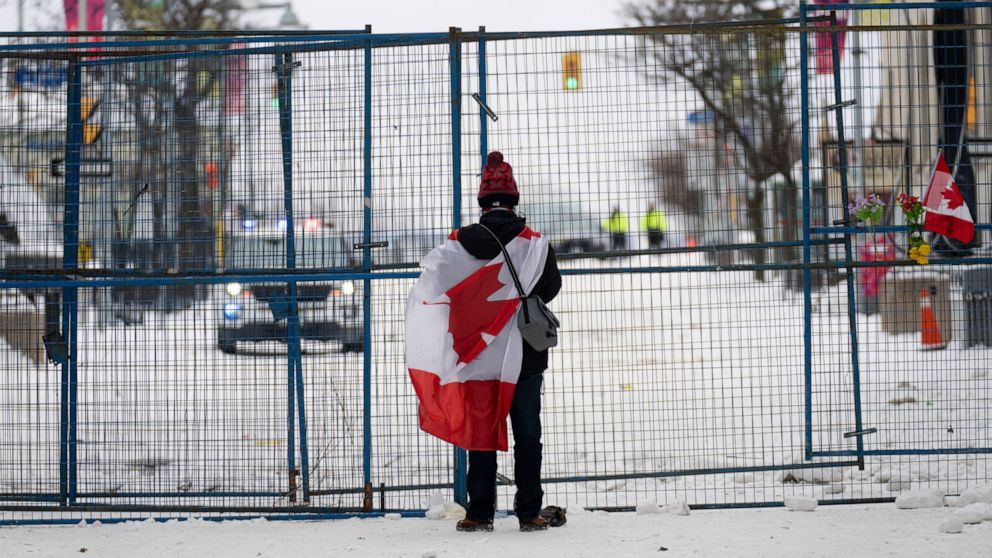
CANADA TRUCKERS WANT FREEDOM, NOT A GLOBAL WORLD WHERE ELITES CONTROL THEIR LIVES

While all the blame for foreign instability or the lasting effects of the pandemic is not on the Biden administration, our country’s current predicament would be far more manageable if its policy toolkit wasn’t constrained by artificial controversy surrounding the critical infrastructure of our national energy system, especially pipelines.

Energy infrastructure is simultaneously one of the most divisive and least understood topics in American politics. For that reason, a brief overview is warranted. 

Oil and gas pipelines serve the same function as the body’s circulatory system, carrying the compounds that heat our homes and fuel our economy across the country. Although alternative transportation methods exist, in most situations pipelines are the safest and most efficient means of moving energy from Point A to Point B.

Given that energy infrastructure is essential to controlling prices and mitigating supply challenges, it is crucial that its construction is protected from interference.

For a pipeline to be built, the U.S. Army Corps of Engineers, a nonpartisan organization tasked with evaluating public works, must first determine that 1) it can be constructed and operated safely without significant environmental impact and 2) no superior alternative exists. If a comprehensive review of the project by the Corps cannot verify that these and other requirements are met, then construction is not allowed to proceed.

Despite the existence of an effective, rigorous regulatory system, pipelines continue to be vilified by a small but vocal group of activists as environmental monstrosities built without regard for local communities and their surrounding ecosystems. This narrative and its consequences are encapsulated by the fight over the Dakota Access Pipeline (DAPL), critical oil infrastructure that has operated safely for years, has overwhelming public support, and is already the most studied and regulated pipeline in US history.

Legal opposition to DAPL has centered on two arguments: that the environmental review process conducted by U.S. Army Corps of Engineers professionals was flawed, and that community engagement leading up to construction was insufficient. Because these claims are inherently subjective, politics and fringe opinions rooted in distortions of reality can penetrate the regulatory process. As a result, the Corps must now produce an additional statement on the environmental impact of DAPL, despite its years-long safe operations record.

DAPL’s operator is confident that the final environmental impact statement will reinforce the Corps’ earlier assessments. However, its opponents’ success in threatening the pipeline for the better part of a decade, leveraging sympathetic and non-expert judges, has created a dangerous precedent. 

GET FOX BUSINESS ON THE GO BY CLICKING HERE

Without confidence that our judicial system will uphold the integrity of the regulatory process and dismiss spurious legal challenges, energy companies are now far less likely to invest in similar projects. Besides creating local jobs, generating tax revenue, bolstering the national economy, and ensuring the reliable delivery of energy to consumer markets, pipelines like DAPL reduce our dependence on foreign oil as well as our vulnerability to supply shortages like the current one. 

All of these benefits and more are at risk of being lost unless something is changed.

Given that energy infrastructure is essential to controlling prices and mitigating supply challenges, it is crucial that its construction is protected from interference. To that end, the Supreme Court should reverse the lower court decision requiring additional environmental review of DAPL and bring six years of undue controversy to a close.

CLICK HERE TO READ MORE ON FOX BUSINESS

At the onset of the pandemic, pipeline opponents celebrated the crash in global demand for oil and gas as a death knell for America’s energy industry. Now, with prices soaring, it is undeniable that demand will remain high for the foreseeable future. 

Instead of allowing activists to hijack America’s judicial system in a misguided attempt to force a premature transition to renewables, President Biden should use this moment to revert to an "all-of-the-above" energy strategy like the one endorsed by his Democratic predecessor that affirms the importance of oil, natural gas and their essential infrastructure. At a minimum, current regulatory processes should be insulated against activist litigation. Otherwise, $100 a barrel may soon seem like a bargain. And with all the challenges before us, let’s not add to that list unnecessarily.

Tom Magness is a strategic adviser to the Grow America’s Infrastructure Now (GAIN). He formerly served as a commander in the U.S. Army Corps of Engineers.

Adblock test (Why?)


"politic" - Google News
February 23, 2022 at 03:10AM
https://ift.tt/IiuXF2M

The true price of anti-pipeline politics - Fox Business
"politic" - Google News
https://ift.tt/uTJstGV
https://ift.tt/18YdyjK

Is Political Language Too Contested? - The New Republic

unitedstatepolitics.blogspot.com

Democratic politics are bounded by what people allow themselves to imagine. Pundits often make this point by citing the Overton window: a concept developed in the 1990s by two libertarian Josephs, Overton and Lehman, to describe the realm of the thinkable for mainstream voters considering policies and platforms. But it sometimes happens that our civic imaginations expand and contract not in terms of policy choices (more or less regulation, spending here or cuts there) but at the level of language itself. Sometimes, we start recasting the most elemental vocabularies that we use to live together, the building blocks of our shared political reality.

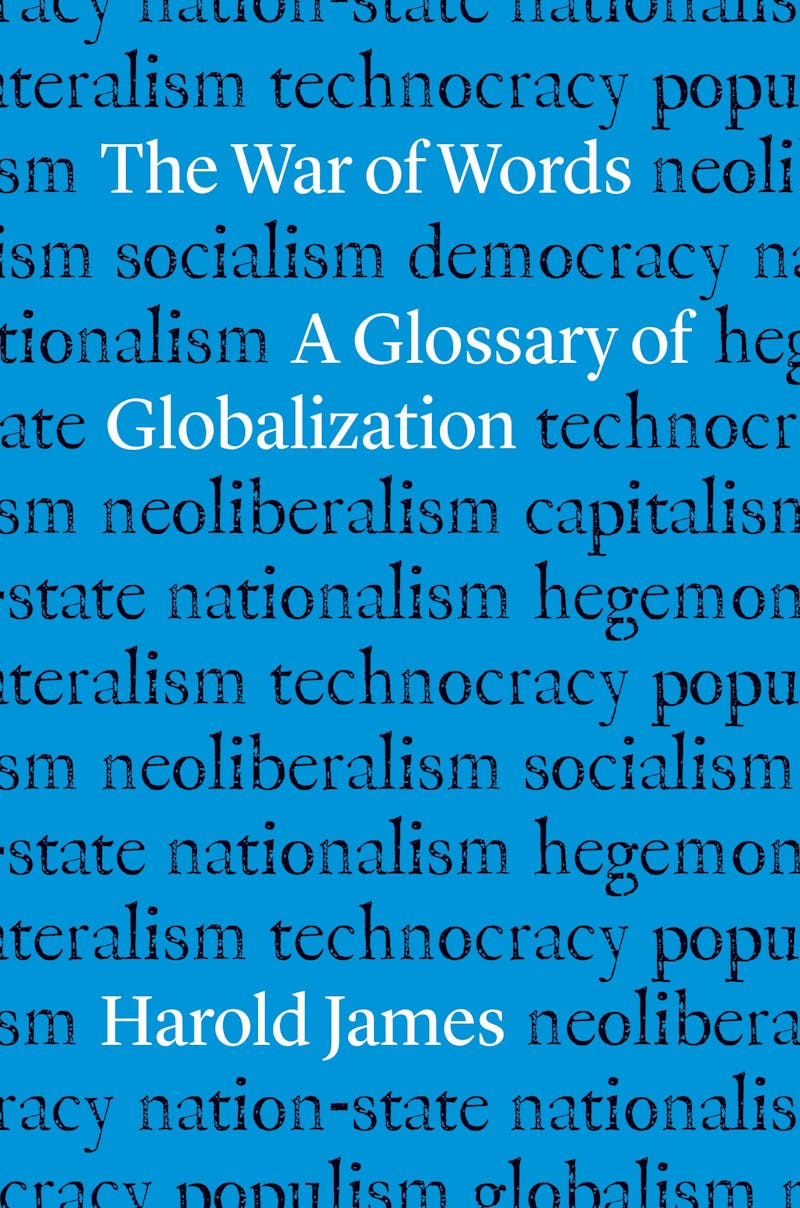
The War of Words: A Glossary of Globalization
by Harold James
Yale University Press, 368 pp., $30.00

Redefine the terms, remake the world. Is heroism for soldiers and the police, or is it for teachers and nurses, too? Is safety a physical state or a psychological one? Is patriotism defined by loyalty or dissent? Must truth be validated by facts, or is it simply whatever Trump says it is? Who are “the people,” and who speaks for them? Deciding what words mean is always a political act as much as an intellectual one, subtle yet consequential.

In a pluralistic society in which people hold different values (that is to say, a human one), core political and social concepts will always be contested. The Welsh socialist critic and historian Raymond Williams knew this to be true when he published Keywords, his great encyclopedic 1976 work on the sociocultural vocabulary of modern life. What’s more, he loved the complexity. Keywords celebrated the creative “shaping and reshaping” of terms over time and scoffed at the notion that they might be reducible to a single meaning. “No single group is ‘wrong’ by any linguistic criterion,” Williams said, “though a temporarily dominant group may try to enforce its own uses as ‘correct.’” In this intensely democratic sense, political language was for people “to use, to find our own ways in, to change as we find it necessary to change it.”

The Princeton economic historian Harold James takes a rather different view in his latest book, The War of Words: A Glossary of Globalization. What Williams saw as generative democratic work, James treats as intellectual sloppiness and confused thinking. Primarily focused on how we (struggle to) debate questions of political economy and globalization, The War of Words argues that we are talking past each other because we cannot agree on the meaning of terms. Words that once had clear definitions, like capitalism or socialism, have been wrecked by misuse or replaced by “postmodern” versions. “We are drowning,” he laments, “in clashing ideas formulated in incoherently used words.” The solution is for experts like James to restore accuracy and linguistic order, clarifying what terms actually mean and helping people use them as intended. This is meant to extinguish the ferocious, muddled arguments that James despairingly calls “the war of words”—though readers are more likely to look at those disagreements and call them politics.

What James is really doing is staking a set of claims about what words mean, how ideas work in the world, and what our politics ought to look like. It’s this underlying vision of political discourse that makes The War of Words such an illuminating read, for it tells us something crucial about liberal feelings during an era of civic fracture. More seismograph than glossary, its pages record irritation as old ideas are challenged and revalued, despair as debates get rowdier and less polite, frustration with disorder, confusion as the inherited consensus thins and frays. One closes The War of Words feeling a bit alarmed. After all, James is a learned and liberally minded historian who has produced, in pursuit of clarity and linguistic order, a book on political language that is rather anti-historical and, at least temperamentally, a tad anti-liberal. How could this happen? And what does it tell us?


Exasperation is this book’s defining spirit, and the lifestyle guru Marie Kondo, somewhat curiously, is its explicit patron saint. Surveying the political landscape, James asserts that there is precious little “clear thinking” to be had on the subject of globalization—and that “imprecise vocabulary” is now “an obstacle to productive debate” and “the application of rigorous logic.” What’s needed, he proposes, is an enterprise of “intellectual decluttering” that can sweep away this accretion of mismeaning and, by turning to the past, restore first principles and best definitions. “Getting back to what really matters will require revisiting an earlier era,” he adds, “to learn what was at stake before the conceptual lexicon became so cluttered.” Original meaning sparks joy. 

Let’s start with technocracy, which isn’t what it used to be. What the term signifies today is rule by experts, typically appointed rather than elected, usually economists but perhaps also behavioral scientists or lawyers or consultants. It suggests incrementalism and status quo thinking, a preference for nudging or tweaking rather than making structural change or reimagining the world. It is not used aspirationally. To many, it seems anti-democratic.

Technocracy meant something rather different when it was invented after World War I. Then, it was revolutionary. An American engineer named William H. Smyth coined the term in 1919, defining it as “the rule of the people made effective through the agency of their servants, the scientists and engineers.” It sought to disrupt the groupthink of ruling back-slapping elites by elevating energetic and professional outsiders, bringing modern scientific knowledge to bear on problems of public interest, and breaking down the walls between departments and disciplines. In other words, technocracy was a project to make peacetime administration look more like wartime mobilization, to make change at scale. According to James, this initial heroic sense remains the term’s proper definition.

James gives a variety of prominent concepts in political economy the same treatment in The War of Words. Multilateralism, a hotly contested term in 2003 as the United States invaded Iraq, was born during postwar trade negotiations in the 1940s as a way to distinguish new structures of inclusive global bargaining from cliquey coalitions once thrown together by great powers. The word capitalism, James stresses, was specifically used in the middle of the nineteenth century to criticize excessive financial accumulation, not a full economic system. Globalism, a term now used by the conspiratorial and white supremacist right, was first a description of Hitlerian-Germanic dreams to conquer the world—and then foreign policy shorthand for international engagement and responsibility. Other ideas James singles out for clarification include crisis, debt, populism, socialism, and neoliberalism.

Of all the concepts spotlighted in The War of Words, democracy is surely the richest and most genuinely contested. When we speak about it, do we mean liberal democracy or its illiberal cousin? Workplace democracy or constitutional democracy? Market democracy or social democracy? Does it live in the practice of elections and voting, in the language of law and rights, or in daily habits? Is it a substantive achievement or a procedural one? Democracy would appear to be an ideal candidate for the Jamesian approach, making it all the stranger that he has so little to say about it. Democracy, he explains briskly, but without much reference to any specific time or place, has a “strong normative definition,” by which he seems to mean that it is aspirationally about rule of, by, and for the people. All political ideas are normative, of course, and so this is not an especially distinguishing characteristic. Rather than breaking the concept down into constituent parts or analyzing its competing components (in the manner of, say, Astra Taylor), James instead dashes off 10 vague and clichéd “lessons” from Weimar Germany about democratic failure—a poor man’s Timothy Snyder, and not all that relevant to the decluttering work at hand.

How, exactly, are citizens bamboozled and mistaken about the terms James has selected? The book takes for granted that we’re all irritated by the delirious state of current political discussion, but doesn’t do much to explain how, more specifically, people are locked into conceptual impasses around notions like hegemony or geopolitics, let alone socialism or capitalism. What James does propose is that some of our best terms have swollen in their metaphorical meaning and moralistic charge. He writes regretfully about how words that once referred neutrally to “concrete political or social phenomena” are now “easy labels, usually of condemnation,” rife with “quasi-metaphorical meanings” that smuggle ethical judgment into intellectual or policy discussions. The title of his own book is, naturally, a metaphor, and The War of Words relies on a range of others to make its case: describing political discourse as a marketplace, words in terms of currency, and language as a kind of blockchain technology. The irony here is well and truly lost. 

There is perhaps a useful distinction to be drawn, which James doesn’t, between technical terms that need fixed definitions and universal legibility in order to function, and political ideas for which that kind of thing is genetically hopeless. The most interesting words here fall in this latter category. Ideas like capitalism and socialism relate to the things we most value, and therefore tend not to have single or universal semantic meanings. In fact, terms like democracy or freedom or Europe or liberalism (strangely omitted from this book) are politically resonant exactly because of the chameleon quality that so badly annoys James, because they can be used to channel so many varied desires, because they can do so much work in the world. In their slipperiness lies their charm.

For words like these ones, Raymond Williams recognized in the 1970s, “it is not only an impossible but also an irrelevant procedure” to fix meanings so authoritatively. Rather, it is “the range that matters.” Political words resist being flash-frozen by elites because they “embody different experiences and readings of experience,” claimed Williams, a fact that remains true in spite of “the clarifying exercises of scholars or committees.”


The words in this “glossary of globalization” have not grown misunderstood or confused. It’s just that their social meaning and cultural significance have changed over time. Debt, for instance, has come to seem less like a freely chosen burden and more like a cruel and inescapable consequence of yawning inequality. It is still a moral concept. People are not, I think, confused about the concept of owing money (to payday lenders or prisons, banks or student loan administrators). But it’s true that the word’s valence has changed: Now, to many, it evokes neither personal duty nor recklessness but rather injustice and indenture. Socialism, despite the best efforts of many leftover Cold Warriors, now suggests to many not totalitarian state control or Stalinist repression but simply a society in which nobody is bankrupted by their own bodies or finds themselves “too poor to live.” Globalization is no longer just a promise of more and easier; it is an experience for many that has brought dislocation and vulnerability and the feeling of having lost. 

All of this represents a kind of linguistic Fall for James: a painful, damaging decline from a state of conceptual clarity and grace. Change is treated throughout The War of Words as deviation from truth rather than a neutral historical force. It is a kind of reverse Whiggism that traces not progress but degeneration and intellectual stagnation. It’s almost as though James is insulted by history’s foundational premise, that the world shifts over time. As he writes, “questions of unfairness have haunted every political debate of the past millennia. None of the issues … are fundamentally new—can there be new answers?”

This is altogether a rather bizarre position for a contemporary historian to adopt. To think that ideas and language are best preserved in amber and that such a thing is even possible, to see time as a kind of adversary. Masters of the historian’s craft tend to contextualize, to explore how and why the world made sense to people in a given time and place, to dissect processes of historical change and peer closely at the interlocking gears. James, it must be said, is an accomplished historian of European business and finance, known for his books on firms and banks. All the more surprising that there are only trace amounts of historical sensibility to be found here. James is more interested in universals. The accurate meaning of words doesn’t vary over time. Capitalism was not invented but is timeless, the result of an “instinct deeply embedded in the human psyche” that’s “practically universal.” Maybe most startling, however, is what James has to say about narrative, the bread and butter of historical interpretation. “The human mind is hardwired to be receptive to stories,” James writes, before proposing that this is really a kind of cognitive bias, a “narrative addiction” that we can’t help but greedily indulge at the expense of thinking clearly or fixing things. “Narratives,” he concludes, somewhat oddly for a historian who has crafted many of his own, typically “stand in the way of concrete and effective solutions. The most compelling and comprehensive ones … lock us in a mental prison.”

The War of Words is a reminder that swimming in the past to make an argument is not the same thing as doing history. The Jamesian approach to political language is historical in the way that legal originalism is historical: It describes events that took place long ago and offers dates and makes claims about what happened in centuries past, but it seeks to arrest change and fix meaning rather than understand variation over time as legitimate and interesting. Like originalism, too, defined by Antonin Scalia as a mode of inquiry focused on “the meaning that … words were understood to bear at the time they were promulgated,” James’s way is not scientifically objective so much as quietly and determinedly political. His approach to political language values most of all “the debates that took place when the concepts were born.” Everything that happened afterward is just in the way. 


It’s hard not to feel that this “sacral approach to words” (Williams again, anticipating The War of Words by half a century) shares more with authoritative scriptural exegesis than it does with democratic practice. And many of its assumptions—that the meaning of words should not fluctuate or that there are single correct answers to what are essentially political questions—collide with James’s own professed liberalism. He accurately writes that “liberal politics requires debating and contesting” and that “everyone should be free to develop, express, examine, revise, contradict, refute and confound ideas.” Yet when James gazes out from Princeton upon exactly the kind of freewheeling contestation he ought to revere, he sees debate and disagreement as illegitimate conflict: a war of words rather than a civilized public sphere, in which “weaponized” ideas are used disgracefully as “munition” to blame and shame others. 

Most unsettling, however, is the way that James frames our disordered political-economic thinking in terms of deviance, illness, and contagion. Alternate or new meanings of words (say, for instance, neoliberalism or socialism) don’t enrich or expand our vocabularies but instead “pervert” them. These errors “infect the political debate” and become what James bewilderingly and hysterically calls “demon words.” His highest and best hope is that the messiness of our public thinking can be expunged via a process of “intellectual hygiene,” which implies, to be sure, not decluttering so much as cleansing. Presumably, a purified and exorcised body politic awaits. A more sterile one, too.

What becomes clear when reading The War of Words is that James, understandably, has a horse in this race. He seems to hanker for a less political world, smooth and technocratic. Toward the end of the book, he sketches this aspirational near-future. Instead of wasting time with disagreement and discord, James imagines, we shall embrace new technologies that let us “know more, learn more, and do more.” We should “harness those possibilities by creating new connections” and cold-shouldering all the ideologues. Techno-optimistic to the extreme, the whole thing is at turns jejune (automation is exciting and great; facial-recognition scans and algorithms could make policing less racist); sadly funny (he praises the fintech startup Robinhood for democratizing finance; last year, the platform was fined $70 million after it misled its users); and a little terrifying (Starbucks cards could become a global currency; a nonstop flow of data about one’s coffee or sugar consumption habits could go straight to doctors and affect your health insurance premiums). Above all, James is a chipper evangelist for blockchain and cryptocurrency. 

These bland predictions and technocratic schemes make sense, I think, as the outcome of the Jamesian approach to political language. What he thinks we need is a new vocabulary that “promotes understanding, not confusion; community, not division.” Really what he is asking for is a new consensus, established on his preferred terms. This vision of language and political action is one in which progress is measured, as the nineteenth-century liberal John Stuart Mill wrote, by “the number of doctrines which are no longer disputed or doubted” plus the “gravity of truths which have reached the point of being uncontested.” As James quotes these words, he concedes that they’re unrealistic. But it’s difficult not to wonder if he is disappointed; to detect, perhaps, a slight twinge of regret.


Cast your eye across the starry firmament of Anglo-American intellectual and literary life, and it’s possible to make out a constellation of liberal centrist figures, from Steven Pinker and J.K. Rowling to Adam Gopnik and Mark Lilla and Yascha Mounk and the signatories of that Harper’s letter, who seem to have met this consensus-rattling period by tipping, at least temperamentally, to the right. Some are put off by the polite requests of trans people to use their preferred pronouns, others have been singed by wokeness or “cancel culture,” others continue to fret about the left’s incivilities. When, one day, a great book is written about twenty-first-century liberal pique and the emotional experience of late-American centrism, The War of Words will be an invaluable primary source. For beneath its certainty and the scholarly confidence of its definitions, this is, at its heart, a nervous book, a restorationist project intended to shore up a consensus that is slipping away. That enterprise is bound to be a quixotic one. Experts don’t do these things single-handedly anymore. 

“Some people, when they see a word, think the first thing to do is to define it.” Raymond Williams again, for the last time. Very often, he recognized, definitions are imposed from above as a form of possession, excluding “those meanings which were inconvenient” to a powerful class or group “but which some benighted person had been so foolish as to use.” But Williams, who spent 15 years teaching evening adult education classes to workers in Sussex before assuming a post at Cambridge, knew better. The business of deciding what words mean and where the consensus ends is work that belongs, dauntingly, to all of us.  

Adblock test (Why?)


"politic" - Google News
February 22, 2022 at 06:01PM
https://ift.tt/XZAGbKW

Is Political Language Too Contested? - The New Republic
"politic" - Google News
https://ift.tt/hMJupOa
https://ift.tt/JO2qVAn

Monday, February 21, 2022

Analysis | Democrats are engaged in a 'new politics of evasion' that could cost them in 2024, new study says - The Washington Post

unitedstatepolitics.blogspot.com

Three decades ago, Democratic policy analysts William A. Galston and Elaine Kamarck published a bracing critique of their party, warning against a “politics of evasion” that they said ignored electoral reality and hindered changes needed to reverse the results of three losing presidential races in which the party had won a combined total of just 173 electoral votes.

Now the authors are back, with a fresh analysis of their party. This time it comes in the wake of President Biden’s victory over former president Donald Trump in 2020, but it is an even starker warning about the future than the one they issued in 1989 after Michael Dukakis’s landslide electoral college loss to George H. W. Bush.

“A Democratic loss in the 2024 presidential election may well have catastrophic consequences for the country,” they write, arguing that the Trump-led Republican Party presents the most serious threat to American democracy in modern times. The Democrats’ first duty, they argue, should be to protect democracy by winning in 2024; everything else should be subordinated to that objective.

But they argue that the Democrats are not positioned to achieve that objective, that, instead, the party is “in the grip of myths that block progress toward victory” and that too many Democrats are engaged in a “new politics of evasion, the refusal to confront the unyielding arithmetic of electoral success.”

“Too many Democrats have evaded this truth and its implications for the party’s agenda and strategy,” the authors add. “They have been led astray by three persistent myths: that ‘people of color’ think and act in the same way; that economics always trumps culture; and that a progressive majority is emerging.”

Galston and Kamarck served in the Clinton administration, and Kamarck is a long-standing member of the Democratic National Committee. Both are scholars at the Brookings Institution, and their new study is published on the website of the Progressive Policy Institute, where they are contributing authors.

Their analysis is a centrist critique of a party that they fear has moved too far to the left and in the process increasingly has lost touch with the swing voters who still have the power to decide elections. Its publication comes a week after voters in San Francisco recalled three members of the local school board in a battle that underscored the limits of left-wing politics even in such a liberal city and an outcome that set off alarms inside the party.

Galston and Kamarck argue that in an age of close elections (five of the past six were decided by five points or fewer), mobilizing base voters is not enough to assure success. “Even though deepening partisanship has reduced the number of swing voters, the narrow margins of our recent national elections have made these voters more important than ever,” they write. “This reality will dominate national politics until one party breaks the deadlock of the past three decades and creates a decisive national majority.”

The authors are especially pointed in their analysis of Democrats’ vulnerabilities on cultural issues. They argue that too many Democrats continue to believe that economic issues “are the ‘real’ issues and that cultural issues are mostly diversions invented by their adversaries for political purposes.” But for many voters, cultural and religious issues are more important than economic issues, and for those voters, those issues “reflect their deepest convictions and shape their identity.”

Trump’s appeals on cultural issues, and his anti-immigrant and nationalist posture moved voters in states with a higher-than-average percentage of White working-class voters, especially Ohio and Iowa, to the point that they are now difficult for Democrats to win presidentially. “And it has made the upper Midwest fiercely competitive, a face-off that is likely to persist until the battle lines between the parties are redrawn,” the study says.

Democrats, they argue, must balance appeals to their base voters with a message that also appeals to enough working-class voters to win elections. In 2020, Biden was able to do that, but Galston and Kamarck argue that Democrats “must not blind Democrats to the fact that these voters often have found Republicans’ cultural claims more persuasive than the Democrats’ economic arguments.”

Galston and Kamarck have joined what is a rising debate within the Democratic Party about the road ahead, and while they offer recommendations from their centrist perspective, others see economic issues as still the core of the party’s message and agenda.

One of those is the pollster Stan Greenberg, who did groundbreaking analysis of White working-class voters in Michigan’s Macomb County in the 1980s and served as Bill Clinton’s pollster in the 1992 campaign. Greenberg is every bit as apocalyptic about the threat posed by Trump and the GOP. He argues in an analysis published in the American Prospect that Democrats are in trouble with working-class voters of all kinds. “Today, the Democrats’ working-class problem isn’t limited to white workers,” he writes. “The party is also losing support from working-class Blacks and Hispanics.”

He says that this trajectory away from the Democrats can be reversed, but adds, “There is no room for error. There is no room for fools. There is no time for strategists who look down on or rule out voters who fail a purist civics test. There is also no room for sensibilities that keep us from clearly understanding our options.”

But he diverges from Galston and Kamarck in his prescription for dealing with the problem. His answer is for Democrats to embrace a more populist economic message, focusing on the power of big corporations and a Democratic agenda designed to change that status quo. That, he says, will produce dividends with working-class voters no matter their ethnicity or color.

“If Democrats are to stop hemorrhaging their working-class support and achieve the kinds of gains that they did in 2018, they have to embrace a message of change,” he writes.

In their analysis of voters of color, Galston and Kamarck give special attention to Hispanics, a diverse community all its own and one that has shown signs of drifting away from the Democratic Party. Hispanic support for Democratic nominees dropped from 71 percent in 2012 to 66 percent in 2016 to 59 percent in 2020.

“Democrats,” they write, “must consider the possibility that Hispanics will turn out to be the Italians of the 21st century — family oriented, religious, patriotic, striving to succeed in their adopted country and supportive of public policies that expand economic opportunity without dictating results.” They note that ultimately, “Italians became Republicans. Democrats must rethink their approach if they hope to retain majority support among Hispanics.”

They also use the case of Hispanic voters to make a larger point. “The phrase ‘people of color’ assembles highly diverse groups under a single banner. The belief that they will march together depends on assumptions that are questionable at best.”

The authors also try to debunk the idea that there is an emerging progressive majority in the country, citing data that suggests voters are closer to Biden’s center-left positions than to the liberal views of Sen. Bernie Sanders (I-Vt.) or Rep. Alexandria Ocasio-Cortez (D-N.Y.). Nowhere, they argue, is this idea stronger than “in the sphere of culture.”

The authors note that Republicans have made “unprincipled but effective use of Democrats’ vulnerabilities on social and cultural issues, especially those with racial overtones” since the 1960s. But they also say they believe that Democrats live in a “bubble defined by education, income and geography” and Republicans often have exploited progressive “overreach” on issues such as crime, immigration and education as wedges that put the party at odds with many swing voters.

“This pattern will not end until the Democrats break out of the mindset that dominates deep blue areas,” become familiar with the other parts of the country and develop policies that “a majority of Americans can embrace,” they say. While today’s cultural issues are different from those of three decades ago, Democrats will “remain on the defensive” until they embrace and articulate policies that can attract majority support and pursue those policies at a pace with which that majority is comfortable.

Greenberg makes a related but different point about presumptions of a Democratic-dominated future. President Barack Obama, he writes, “embodied the forces making America a multiracial nation, and many Democrats — and Republicans — came to assume that those trends would ultimately make the Democrats politically and culturally ascendant. But it didn’t turn out that way, and it may not.”

In 2020, both Biden and Trump produced a surge of voters. Biden won in large part because he was able to capture more of the swing voters than Hillary Clinton did in 2016. But Galston and Kamarck note that in his second year as president, Biden has lost ground with the very voters who made the difference. “The erosion of support for Biden has been greatest among not-strong Democrats and independents leaning Democratic, groups in which conservative[s] and moderates outnumber liberals.”

Thirty-three years ago, Bill Clinton digested the critique offered by Galston and Kamarck and the implications of the research by Greenberg to retool the Democratic Party’s message and eventually to capture the White House. Today, Democrats face a different America and a different set of problems, with the stakes for 2024 demonstrably greater.

Adblock test (Why?)


"politic" - Google News
February 21, 2022 at 08:02PM
https://ift.tt/WTfDOxg

Analysis | Democrats are engaged in a 'new politics of evasion' that could cost them in 2024, new study says - The Washington Post
"politic" - Google News
https://ift.tt/gax8PpU
https://ift.tt/jMU9YPd

Factbox: Key players in Turkey's political opposition - Reuters

unitedstatepolitics.blogspot.com

Turkey's main opposition Republican People's Party (CHP) leader Kemal Kilicdaroglu meets with the other opposition party leaders Temel Karamollaoglu of Saadet Party, Meral Aksener of IYI (Good) Party, Ahmet Davutoglu of Gelecek (Future) Party, Ali Babacan of Democracy and Progress Party (DEVA) and Gultekin Uysal of Democratic Party in Ankara, Turkey February 12, 2022. Alp Eren Kaya/Republican People's Party (CHP) /Handout via REUTERS

Register now for FREE unlimited access to Reuters.com

ANKARA, Feb 21 (Reuters) - Kemal Kilicdaroglu, leader of Turkey's main opposition party, said he saw no purpose for Ankara's Russian missile defence purchases which triggered U.S. sanctions and would overhaul the Central Bank if victorious in elections due by June 2023. L8N2UR2B2

His party is one of six in an alliance aiming to oust President Tayyip Erdogan and his ruling AK Party (AKP). Here are descriptions of some of the key opposition figures in Turkish politics:

CHP LEADER KEMAL KILICDAROGLU

Register now for FREE unlimited access to Reuters.com

Main opposition Republican People's Party (CHP) head Kemal Kilicdaroglu, 72, has led the centre-left, secularist party since 2010. Under his leadership the CHP has failed to close the gap with Erdogan's AKP in parliamentary elections. With support holding between 22-26% in general elections, critics have questioned his ability to push the CHP to the top nationally. Kilicdaroglu was a civil servant who ran the social security institution before entering politics and he is a favourite target of Erdogan's criticism in speeches. His profile rose in 2017 when he led an opposition march from Ankara to Istanbul to protest the jailing of one of his party's lawmakers.

IYI PARTY LEADER MERAL AKSENER

Former interior minister Meral Aksener, 65, has risen to greater prominence in recent years as a potential challenger to Erdogan. She was expelled from the nationalist MHP party in 2016 after mounting an unsuccessful bid to oust its long-standing leader Devlet Bahceli. In 2017, she formed the moderately nationalist IYI (Good) Party, which formed an alliance with the CHP in 2018 elections and has 36 lawmakers in the 600-seat parliament. She appeals to right-wing and nationalist voters disenchanted with the MHP over its alliance with the AKP. She has pressed for a return to the parliamentary system which was replaced in 2018 with a presidential one under Erdogan.

ISTANBUL MAYOR EKREM IMAMOGLU

After five years as CHP mayor of an Istanbul district, former businessman Ekrem Imamoglu, 51, rose to prominence in March 2019 when he defeated the AKP mayoral candidate in municipal elections. His status as a major new player in Turkish politics was reinforced after authorities annulled that vote and he won a re-run election more decisively, dealing a major blow to Erdogan's dominance. Backed by an opposition alliance, Imamoglu has succeeded in appealing to more conservative voters beyond the party's secularist grassroots. He has clashed at times with Erdogan over issues such as handling of the coronavirus pandemic and the president's plans for a huge canal cutting through the west of Istanbul. He is seen as a potential presidential candidate even as he runs Turkey's largest city in a term scheduled to run until 2024.

ANKARA MAYOR MANSUR YAVAS

Nationalist politician and lawyer Mansur Yavas, 66, defeated the AKP candidate in 2019 municipal elections in the Turkish capital as the CHP candidate backed by an opposition alliance. Previously he served for 10 years as the nationalist MHP mayor of an Ankara district until 2009. He left the MHP in 2013 and joined the CHP the same year before narrowly losing the Ankara municipal election in 2014. Opinion polls have indicated strong support for Yavas as a potential challenger to Erdogan at the national level after he won praise for his performance as Ankara mayor during the coronavirus pandemic.

DEVA PARTY LEADER ALI BABACAN

Babacan, 54, is an ex-deputy prime minister and former close ally of Erdogan who resigned from the AKP in 2019 due to "deep differences" about its direction. He formed the Deva (Remedy) Party and called for reforms to strengthen the rule of law and democracy. He served as economy and foreign minister before holding the post of deputy prime minister from 2009 to 2015. He was well regarded by foreign investors during his time in charge of the economy.

FUTURE PARTY LEADER AHMET DAVUTOGLU

Davutoglu, 62, served as prime minister between 2014 and 2016 but first came to prominence as foreign minister between 2009 and 2014. He broke with Erdogan's AKP in 2019 and established the Gelecek (Future) Party. In the first decade of AKP rule he championed a less confrontational foreign policy with the mantra "zero problems with neighbours", but his Middle East strategy was derailed in the turmoil of the Arab uprisings. He has since criticised what he described as a lurch towards authoritarianism under the executive presidency.

Register now for FREE unlimited access to Reuters.com

Reporting by Daren Butler; Editing by Jonathan Spicer and Alistair Bell

Our Standards: The Thomson Reuters Trust Principles.

Adblock test (Why?)


"politic" - Google News
February 21, 2022 at 12:11PM
https://ift.tt/JIEMof2

Factbox: Key players in Turkey's political opposition - Reuters
"politic" - Google News
https://ift.tt/gax8PpU
https://ift.tt/jMU9YPd

Sunday, February 20, 2022

Canada's protests settle down, but could echo in politics - ABC News

unitedstatepolitics.blogspot.com

TORONTO -- The streets around the Canadian Parliament are quiet now. The Ottawa protesters who vowed never to give up are largely gone, chased away by police in riot gear. The relentless blare of truckers’ horns has gone silent.

But the trucker protest, which grew until it closed a handful of Canada-U.S. border posts and shut down key parts of the capital city for weeks, could echo for years in Canadian politics and perhaps south of the border.

The protest, which was first aimed at a COVID-19 vaccine mandate for cross-border truckers but also encompassed fury over the range of COVID-19 restrictions and hatred of Prime Minister Justin Trudeau, reflected the spread of disinformation in Canada and simmering populist and right-wing anger.

“I think we’ve started something here,” said Mark Suitor, a 33-year-old protester from Hamilton, Ontario, speaking as police retook control of the streets around Parliament. Protesters had essentially occupied those streets for more than three weeks, embarrassing Trudeau and energizing Canada’s far right. Suitor believes the protests will divide the country, something he welcomes.

“This is going to be a very big division in our country,” he said. “I don’t believe this is the end.”

While most analysts doubt the protests will mark a historic watershed in Canadian politics, it has shaken both of Canada’s two major parties.

“The protest has given both the Liberals and the Conservatives a black eye,” said Nelson Wiseman, a political science professor at the University of Toronto. Trudeau’s Liberals look bad for allowing protesters to foments weeks of chaos in the capital city, he said, while the Conservatives look bad for championing protesters, many of them from the farthest fringes of the right.

The conservatives “have to be careful not to alienate more moderate voters, who are generally not sympathetic to the protesters or right-wing populism more generally,” said Daniel Béland, a political science professor at McGill University in Montreal.

The self-styled Freedom Convoy shook Canada’s reputation for civility, inspired convoys in France, New Zealand and the Netherlands and interrupted trade, causing economic damage on both sides of the border. Hundreds of trucks eventually occupied the streets around Parliament, a display that was part protest and part carnival.

Authorities moved quickly to reopen the border posts, but police in Ottawa did little but issue warnings until the past couple days, even as hundreds and sometimes thousands of protesters clogged the streets of the city and besieged Parliament Hill.

Truckers ignored warnings that they were risking arrest and could have their rigs seized and bank accounts frozen under the new emergency powers invoked by Trudeau. The truckers, parked on the streets in and around Parliament, blared their horns in defiance of a court injunction against honking, issued after residents said the constant noise was making the neighborhood unlivable.

“It’s high time that these illegal and dangerous activities stop,” Trudeau declared in Parliament a few days ago, speaking just a few hundred meters from the protests.

On Friday, authorities launched the largest police operation in Canadian history, arresting a string of Ottawa protesters and increasing that pressure on Saturday until the streets in front of Parliament were clear. Eventually, police arrested at least 191 people and towed away 79 vehicles. Many protesters retreated as the pressure increased.

The Ottawa protests — the movement’s last major stronghold — appeared to be largely over by Sunday. Fencing and police checkpoints remained.

"The number of unlawful protesters has dramatically declined in the last 24 hours," Ottawa interim Police Chief Steve Bell said.

Authorities also said 206 bank accounts had been frozen under the power granted by federal emergencies act.

Public Safety Minister Marco Mendicino said progress has been made but the end of the blockades might not be over. He said that targeted measures in the emergencies act allowed police to designate a wide swath of Ottawa's downtown core to become a no-go zone and that tool alone has been extremely effective.

“For the first time in three weeks the streets are calm, they are quiet and they are clear. That all followed the invocation of the emergencies act,” Mendicino said in an interview with The Associated Press. “We will not use it for a single minute longer than we have to.”

Mendicino said the financial accounts of those who refused to leave will remain frozen while the act is in force but added that it is up to police to decide whose accounts get frozen. The powers are already in effect but Parliament is expected to ratify the action Monday.

As it did in the United States, COVID-19 quickly became a political issue in Canada.

Coronavirus health restrictions became a political cudgel for Canada’s far right, which accused Trudeau of authoritarianism. But while the restrictions clearly benefitted the far-right People’s Party of Canada, things are more complicated in the Conservative Party.

Only recently have some Conservative leaders fully embraced the pushback against vaccine mandates and coronavirus restrictions.

Even so, the protests may open the door to the sort of populism that former President Donald Trump used to vault himself into the White House.

Pierre Poilievre, who is running to become the next leader of the Conservative party, has cheered on the protesters, gambling that voters will back him. But it remains unclear whether that will get him to the top of the party, or whether it would help or hurt him if there is a showdown between him and Trudeau or the next Liberal party leader.

“Poilievre is clearly playing by the populist playbook right now,” said Béland. “If he becomes Conservative leader, the party might effectively shift towards Trump-style populism. However, it’s unclear whether enough Canadians support this vision to make it appealing beyond the party’s base.”

The protests have been cheered on in the U.S. by Fox News personalities and conservatives like Trump. Millions of dollars in donations have flowed across the border to the protesters.

About 44 percent of the nearly $10 million in contributions to support the protesters originated from U.S. donors, according to an Associated Press analysis of leaked donor files. Prominent Republican politicians have praised the protesters.

But experts say the U.S. support of the Canadian protesters is really aimed at energizing conservative politics in the U.S., where midterm elections are looming. k.

Meanwhile, though the situation in Ottawa appeared to be ending, there were new signs the protests had not died out entirely.

The Canadian border agency warned late Saturday afternoon that operations at a key truck crossing from western Canada into the United States had been slowed by protesters, advising travelers to find a different route.

Adblock test (Why?)


"politic" - Google News
February 21, 2022 at 07:33AM
https://ift.tt/CihM3vJ

Canada's protests settle down, but could echo in politics - ABC News
"politic" - Google News
https://ift.tt/vq0bK4p
https://ift.tt/EZva2mt

Saturday, February 19, 2022

How the Fight Over Abortion Rights Has Changed the Politics of South Texas - The New York Times

unitedstatepolitics.blogspot.com

In the Laredo region, long a Democratic stronghold, that single issue appears to be driving the decision for many voters, the majority of whom are Catholic.

LAREDO, Texas — Like the majority of her neighbors in the heavily Latino community of Laredo, Angelica Garza has voted for Democrats for most of her adult life. Her longtime congressman, Henry Cuellar, with his moderate views and opposition to abortion, made it an easy choice, she said.

But as up-and-coming Democratic candidates in her patch of South Texas have leaned ever more liberal, Ms. Garza, a dedicated Catholic, cast a ballot for Donald Trump in 2016, primarily because of his anti-abortion views.

In choosing Mr. Trump that year and again in 2020, Ms. Garza joined a parade of Latino voters who are changing the political fabric of South Texas. In the Laredo region, where about nine out of 10 residents are Catholic, many registered voters appear to be driven largely by the single issue of abortion.

“I’m willing to vote for any candidate that supports life,” said Ms. Garza, 75. “That’s the most important issue for me, even if it means not voting for a Democrat.”

With a pivotal primary election just a little more than a week away, Ms. Garza is ready to to turn away from Democrats. Pointing at a wall covered in folkloric angel figurines at the art store she owns in Laredo, she explained why: “They are babies, angels, and I don’t think anyone has the right to end their life. We have to support life.”

Christopher Lee for The New York Times

Voters like Ms. Garza are worrying Democratic leaders, whose once tight grip and influence on the Texas-Mexico border region has loosened in recent electoral cycles. Republicans have claimed significant victories across South Texas, flipping Zapata County, south of Laredo on the bank of the Rio Grande, and a state district in San Antonio. They also made gains in the Rio Grande Valley, where the border counties delivered so many votes for Mr. Trump in 2020 that they helped negate the impact of white voters in urban and suburban areas of the state who voted for Joe Biden.

Much is at stake in Laredo, the most populous city of the 28th Congressional District, where Latinos are a majority, and which stretches from the eastern tip of San Antonio and includes a western chunk of the Rio Grande Valley. Since the district was drawn nearly three decades ago, the seat has been held by Democrats. Mr. Cuellar has represented the district since 2005. His moderate and sometimes conservative views — he was the only Congressional Democrat to vote against a U.S. House bill that would have nullified the state’s near-total ban on abortion that went into effect last September — have frequently endeared him to social conservatives and Republicans.

But he now finds himself locked in a tight fight against a much more liberal candidate backed by the progressive wing of the party that includes Senator Bernie Sanders and Representative Alexandria Ocasio-Cortez. Mr. Cuellar, whose home was raided last month by the F.B.I. as part of an investigation that neither he nor the government has disclosed, beat his opponent, Jessica Cisneros, by four percentage points in 2020.

Should he lose the primary on March 1 to Ms. Cisneros, a 28-year-old immigration lawyer who supports abortion rights, the path to flip the House of Representatives could very well run through South Texas, as Republicans have vowed an all-in campaign focused on religious and other conservative values.

Young Voters Weigh a Texas District’s Future

Edgar Sandoval
Edgar Sandoval�� Reporting from Laredo, Texas

Young Voters Weigh a Texas District’s Future

Edgar Sandoval
Edgar Sandoval�� Reporting from Laredo, Texas
Christopher Lee for The New York Times

In Laredo, Texas, a vibrant border city, only about half of all registered voters cast a ballot in 2020. With a pivotal primary approaching on March 1, voting advocates set out to recruit a new generation of voters.

Here are the ones I met →

    Item 1 of 7

    Across Laredo, a city home to one of the busiest land ports of entry in North America and where Catholic Masses are embedded in everyday life, anti-abortion messages abound. The polarizing issue appears firmly settled in this stretch of the state, as evidenced by sermons at the 34 Catholic parishes, the graphic billboards at intersections and the fact that the last abortion clinic in the area closed nearly 20 years ago.

    Christopher Lee

    “My priest doesn’t tell people how to vote, but he reminds us to vote with our Catholic conscience,” said Betty Flores, the city’s mayor from 1998 to 2006. Ms. Flores, a longtime friend of the Bush family, also identifies as a Democrat — an “old Blue Dog” Democrat, she said, referring to her moderate views. While she sees herself in the anti-abortion column, she said she does not believe in enacting policies that govern over women’s bodies.

    Even Sylvia Bruni, the leader of the Democratic Party in Webb County, which includes Laredo, said she has made peace with the duality of her anti-abortion views and the broader Democratic mandate that seeks to expand health care to women, including the termination of pregnancies.

    “I speak for myself,” said Ms. Bruni, a Catholic, “but as anti-abortion as I am personally, I don’t think I have the right to tell others what to do.”

    Mr. Cuellar has retained the seat since 2005 largely because of his moderate views. In voting last September against the Women’s Health Protection Act, the measure that sought to protect abortion rights, he cited his Catholic upbringing.

    The measure, which passed, appears to be doomed in the Senate. But Mr. Cuellar’s vote was a symbolic nod to his socially conservative constituency, whose members drive every day past banners with images of fetuses that read, “God says ‘All Lives Matter,’” or of a downcast Virgin Mary praying for those considering abortions.

    Christopher Lee for The New York Times
    Christopher Lee for The New York Times
    Christopher Lee for The New York Times

    With the Texas law banning most abortions after about six weeks of pregnancy, and with the Supreme Court possibly on the verge of upholding a Mississippi law that bans most abortions after 15 weeks, many South Texas voters will do whatever it takes to preserve those gains, said Eddie Lucio Jr., a state senator often compared with Mr. Cuellar because of his moderate views.

    “There is no such thing as an abortion-rights Catholic,” said Mr. Lucio. “There is a silent majority that don’t say anything. But when they go vote, they go vote for the anti-abortion candidate.”

    Outside Laredo, Texans remain deeply divided on the issue. According to a recent poll by the Texas Politics Project at the University of Texas at Austin, about 46 percent of the 1,200 respondents believe that current abortion laws should either be more strict or left as they are; 43 percent said they should be less strict.

    On a recent afternoon at St. Vincent de Paul Catholic Church in Laredo, Jose Brizuela, 73, a retired businessman, said he had always voted for Democrats, including Mr. Cuellar, driven by their agenda to offer aid to the poor. But if the next Democratic nominee supports abortion rights, he said, “I’m ready to vote for the Republican.”

    Christopher Lee for The New York Times

    With Mr. Cuellar’s seat in jeopardy, Republicans are prepared to mount their first real challenge in the district in decades. If the news of the investigation involving Mr. Cuellar were to keep many of his supporters home, Republican leaders say Ms. Cisneros’s progressive values, especially when it comes to abortion, may be a bridge too far for the larger faith-based general electorate. In the primary, seven Republicans are vying for the nomination.

    “There used to be a mentality that, ‘Oh, we only vote this way,’” said Luis De La Garza, chairman of the Webb County Republican Party. “We are showing them that it is OK to vote for something they actually believe in. I think voters are starting to see that we have the same religious and family values.”

    And indeed, Republicans have made gains in the 28th District. In November 2020, the G.O.P. garnered 39 percent of the vote, up from 31 percent in 2016.

    Also in 2020, the Democratic presidential ticket received 487 fewer votes than it did four years earlier. The Republican presidential ticket, in contrast, received nearly 13,000 more votes in 2020 than in 2016, according to data compiled by the Democratic Party.

    Christopher Lee for The New York Times
    Christopher Lee for The New York Times
    Christopher Lee for The New York Times

    Last November, Republicans flipped a once solidly Democratic district in San Antonio by 286 ballots in a special election runoff. Voters also turned out in droves for Republicans in Hidalgo and Zapata Counties, both traditionally Democratic strongholds along the Rio Grande. In 2020, Joe Biden won Hidalgo County, home to McAllen, by 17 percentage points, a narrower victory when compared with Hillary Clinton’s 40-point win four years earlier. And in nearby Zapata County, Mr. Trump won by five points.

    The state, while increasingly diverse and more progressive, has not translated into more votes for Democrats. In Webb County, only half of the registered voters cast ballots in 2020.

    Still, progressive Democrats are working overtime to energize younger, first-time voters — both to defeat Mr. Cuellar in the primary and the Republican candidate in November. During a recent visit to San Antonio to campaign for Ms. Cisneros, Ms. Ocasio-Cortez, the progressive congresswoman from New York, called the 28th District a “battleground.”

    In the last few months, Democrats have intensified their outreach efforts, said Ms. Bruni, and have added more than 2,300 voters.

    Christopher Lee for The New York Times

    “We were solidly Democrat, but we’re more conservative than traditional liberal enclaves,” said Sergio Mora, a former chairman of the Democratic Party. “We are more socially conservative. We could lose the seat.”

    Sarah Smith, 40, is among the voters who see the district turning red based on the abortion issue alone. Ms. Smith, who favors smaller government — she calls herself a 19th century liberal — and has both Mexican and British ancestry, said she supported Democratic priorities like prison reform but added that maintaining the abortion ban was her priority.

    “Maybe it’s time for this area to become Republican,” she said. “Whatever it takes to preserve life.”

    Susan C. Beachy contributed research.

    Adblock test (Why?)


    "politic" - Google News
    February 20, 2022 at 01:04AM
    https://ift.tt/jehQd1Y

    How the Fight Over Abortion Rights Has Changed the Politics of South Texas - The New York Times
    "politic" - Google News
    https://ift.tt/emG6TUC
    https://ift.tt/vjCX0sE

    Search

    Featured Post

    Politics - The Boston Globe

    unitedstatepolitics.blogspot.com Adblock test (Why?) "politic" - Google News February 01, 2024 at 03:47AM https://ift.tt...

    Postingan Populer