Rechercher dans ce blog

Thursday, March 24, 2022

Politics Podcast: What Went Down At Ketanji Brown Jackson’s Hearings - FiveThirtyEight

unitedstatepolitics.blogspot.com
FiveThirtyEight
 

Judge Ketanji Brown Jackson’s Supreme Court confirmation hearings wrapped up on Thursday, and all indications point to Jackson being confirmed, largely along partisan lines. She would be the first Black woman and first public defender to serve on the court. Since her confirmation is expected, the hearings — similar to past ones — were more about politics. In this installment of the FiveThirtyEight Politics podcast, Galen Druke and Amelia Thomson-DeVeaux discuss the messages that senators sent and whether we were able to glean anything about what kind of justice Jackson would be.

You can listen to the episode by clicking the “play” button in the audio player above or by downloading it in iTunes, the ESPN App or your favorite podcast platform. If you are new to podcasts, learn how to listen.

The FiveThirtyEight Politics podcast is recorded Mondays and Thursdays. Help new listeners discover the show by leaving us a rating and review on iTunes. Have a comment, question or suggestion for “good polling vs. bad polling”? Get in touch by email, on Twitter or in the comments.

Adblock test (Why?)


"politic" - Google News
March 25, 2022 at 01:21AM
https://ift.tt/hGlKVPu

Politics Podcast: What Went Down At Ketanji Brown Jackson’s Hearings - FiveThirtyEight
"politic" - Google News
https://ift.tt/ERVKS9b
https://ift.tt/1ZiISBp

How a 73-Year-Old Man Ended Up in a NJ Political Scandal - The New York Times

unitedstatepolitics.blogspot.com

George Bratsenis pleaded guilty to his role in a murder-for-hire plot that could grow into the state’s next big public corruption scandal.

George Bratsenis shuffled into a New Jersey courtroom in shackles last month, an old-school hoodlum with thick glasses, white hair and a forearm tattoo.

Court is a familiar setting for Mr. Bratsenis, 73. So is prison. His Tarantino-esque odyssey spans at least three states and Canada and includes the killing of a drug courier known as the Turk, ties to organized crime and a bizarre failed jailbreak bid.

This court appearance was the result of his having been implicated in a murder-for-hire case involving a veteran campaign consultant that many in New Jersey’s political class think could grow into the state’s next big public corruption scandal.

The consultant, Sean Caddle, had admitted to arranging the killing of an associate who was found fatally stabbed in his burning Jersey City apartment in May 2014, and he had named Mr. Bratsenis as his hired hit man.

The February hearing ended abruptly without explanation, but on Thursday, Mr. Bratsenis pleaded guilty to taking part in the murder in exchange for thousands of dollars in cash from Mr. Caddle. He is scheduled to be sentenced on Aug. 2. Prosecutors are prepared to recommend a prison term of 10 to 25 years, his plea agreement says.

Appearing via video from a federal jail in Brooklyn, Mr. Bratsenis, wearing a gray T-shirt, answered, “Yes, Your Honor,” calmly and repeatedly as Judge John M. Vazquez of Federal District Court in Newark asked him whether he understood the implications of his plea. The only new detail to emerge involved the disclosure that Mr. Bratsenis agreed to plead guilty in the case last August.

“You all have a nice day,” he said as the hearing ended. “Take it easy.”

Richard J. McCormack/The Jersey Journal

It is a new chapter for Mr. Bratsenis, whose criminal heyday lasted roughly from 1974 to 1985. In that time — according to interviews, court documents, other public records and newspaper articles — he racked up 10 convictions, many for felonies like burglary, armed robbery and, once, conspiracy to commit murder. He took orders from Gambino crime family associates and was an enforcer for a notorious former police lieutenant in Connecticut.

“He’s a very bad guy,” said Alan H. Nevas, who, as the U.S. attorney in Connecticut in the 1980s, won convictions against Mr. Bratsenis for bank robbery and in the murder conspiracy.

Mr. Bratsenis did not reply to an interview request sent to him at the Brooklyn jail, where he is awaiting sentencing in a separate bank robbery case. His lawyer declined to comment.

Born in Stamford, Conn., Mr. Bratsenis grew up with five sisters. (The one to whom he says he is closest did not answer a phone message.) In a court filing, he describes a childhood of walks to the park and Little League games.

He says in the same document that he began drinking as a teenager before moving to LSD, cocaine and heroin. He graduated from high school in 1966 — “enjoys girls, water skiing, baseball, hunting and cars,” his yearbook says — and then joined the Marines. He was honorably discharged, has been married and divorced twice — the first marriage lasted about a year — and has four children.

“I don’t want anything to do with him or his family,” his second wife, Patricia, said in a telephone interview. “I wish him nothing but yuck.”

Mr. Bratsenis’s criminal career began when he returned home from serving his country. His father had an exterminating business, but George chose a different path.

An early arrest came in October 1973, when he and three other men broke into a seafood restaurant in Westport, Conn. Several months later, he was arrested 800 miles away in Nova Scotia, Canada, on charges of robbing a bowling alley at gunpoint. He pleaded guilty to armed robbery and got 90 days in jail.

Back in Stamford, the Gambino and Genovese crime families were battling over control of the illegal rackets. Mr. Bratsenis and his cronies “would link up with organized crime associates and do their bidding — robberies, burglaries, selling drugs,” said Capt. Richard Conklin of the Stamford police.

“Subcontractors,” Michael Docimo, a retired Stamford officer, called them: “They’d do anything for hire.”

Mr. Bratsenis was “kind of a loose cannon” with a “certain meanness,” Captain Conklin said. At 6 foot 2 inches and over 200 pounds, he was also physically intimidating — a quality he used, Mr. Docimo said, as “muscle” for Larry Hogan, a retired Stamford police lieutenant and longtime target of law enforcement scrutiny over his suspected ties to the drug trade and organized crime. (Mr. Hogan was convicted in 1982 of trying to buy heroin from undercover federal agents. The verdict was reversed on appeal.)

Mr. Bratsenis’s primary partner was Louis Sclafani (he called himself Trigger Lou). From 1979 to 1983, court records show, they went on a whirlwind of crime: bank jobs in Connecticut; grand theft arrests in Florida; jewelry store heists and gun and drug convictions across New Jersey.

In 1980, the bullet-riddled body of David Avnayim, a.k.a. the Turk, was found in a car trunk near Mr. Hogan’s home. Four years later, Mr. Bratsenis, Mr. Sclafani and Mr. Hogan were charged in the killing. Mr. Hogan died before trial. Mr. Sclafani cooperated. Mr. Bratsenis pleaded guilty to a murder conspiracy charge.

David Golub, a lawyer who represented Mr. Hogan, said in an interview that he had read about the murder that Mr. Bratsenis was now implicated in.

“Is this about George Bratsenis rearing his ugly head?” Mr. Golub said when he answered the phone, adding: “If he’s out of jail more than a day, it’s a fluke.”

Mr. Bratsenis’s spree ended in 1983 when he was arrested and charged in one of the jewelry store robberies in New Jersey. Before his trial there, he was convicted of robbing two Stamford banks. (Mr. Sclafani cooperated again.) He got 30 years in federal prison for the robberies and 10 to 20 years, to be served concurrently, for the Turk’s murder.

Next came the New Jersey trial for the jewelry store thefts. Prosecutors said they followed a typical pattern: Mr. Bratsenis and his associates would scout places to rob. Then they would set fires elsewhere to distract the authorities.

The trial was a spectacle. Mr. Sclafani, testifying again as a federally protected witness, was brought to court under the watch of rooftop snipers guarding against a targeted killing.

Then there was Mr. Bratsenis’s escape plot.

While he was in prison awaiting trial, one of his sisters smuggled him a balloon filled with a nausea-inducing drug that he kept in his rectum for weeks. He planned to make himself ill by ingesting the drug the day the trial started, prompting a trip to a hospital. There, armed men would help him flee.

The scheme crumbled thanks to a jailhouse informer and an undercover agent who recorded Mr. Bratsenis’s sister discussing it. The trial proceeded, and he was convicted.

“Now, I’ve always said this in passing sentence, that it’s difficult to say whether an individual will commit another offense,” the judge said in ordering him to spend a minimum of 25 years in state prison. “But based on this defendant’s previous history, his attitude, there’s no question.”

Prescient words. Mr. Bratsenis wound up serving 25 years altogether — nine in federal prison and 16 in state custody — before being paroled in 2010.

Then, on Sept. 29, 2014, he was arrested in Trumbull, Conn., and charged in a bank robbery there. A second man, Bomani Africa, was also charged. Mr. Africa pleaded guilty and acknowledged that he and Mr. Bratsenis had stolen a car that they used in their getaway and then set ablaze.

The case got little notice until January, when Mr. Caddle, the campaign consultant, pleaded guilty to arranging the murder of Michael Galdieri, 52, and hiring Mr. Bratsenis. Mr. Africa pleaded guilty to taking part and said Mr. Bratsenis had recruited him.

Bryan Anselm for The New York Times

Prosecutors say — and Mr. Africa, 61, has acknowledged — that he and Mr. Bratsenis met in a New Jersey prison where they were on the same cell block for several years and made plans to commit crimes together after being released.

Mr. Bratsenis’s link to Mr. Caddle is fuzzier. Mr. Caddle’s brother, James Caddle Jr., is one possibility. He, too, spent several years in the same prison as Mr. Bratsenis. He is dead, and it is not clear whether they met.

Another source of intrigue is the admission by Mr. Caddle, who controlled a web of dark money nonprofits and super PACs, that he has been cooperating with the F.B.I. in what his lawyer called an “important investigation.” It is unclear where his cooperation could lead.

The details of Mr. Galdieri’s murder prompted the son of a prominent New Jersey couple whose September 2014 deaths remain unsolved to seek an investigation into a possible connection between the cases.

In a letter to law enforcement authorities, the son, Mark Sheridan, wrote that, like Mr. Galdieri, his parents, John and Joyce Sheridan, who were found dead in their home, had been stabbed and that a fire had been set nearby.

No evidence linking the deaths has emerged, and the federal and state authorities have declined to comment.

Mel Evans/Associated Press

Mr. Bratsenis, who has been in prison since being arrested in the bank robbery, is to be sentenced in that case next month — more than three years after his guilty plea. He has written to federal officials to complain about the lengthy wait and the conditions in which he has been held.

“At times, I was so upset I forgot where I was,” he wrote to a top prison official last March about the “inhumane” Metropolitan Correctional Center in Manhattan. “I said to myself: ‘Self, this is not the great U.S.A.’”

In a court filing, his lawyer, Charles Kurmay, sought a lenient sentence, citing Mr. Bratsenis’s prostate cancer and advanced age.

“He would like to be able to not die while in prison,” he wrote.

Tracey Tully contributed reporting. Kirsten Noyes contributed research.

Adblock test (Why?)


"politic" - Google News
March 25, 2022 at 08:36AM
https://ift.tt/afhg2m1

How a 73-Year-Old Man Ended Up in a NJ Political Scandal - The New York Times
"politic" - Google News
https://ift.tt/ERVKS9b
https://ift.tt/1ZiISBp

Perspective | Abraham Lincoln's political instincts offer a blueprint for Biden - The Washington Post

unitedstatepolitics.blogspot.com

During a tumultuous first year in office, President Biden struggled to advance his legislative agenda with razor thin majorities in both houses of Congress and a deeply fractured public. In his second year, the crisis wrought by the Russian invasion of Ukraine has effectively halted his ambitious domestic agenda. But all is not hopeless for Biden. Abraham Lincoln’s presidency offers important lessons on leadership that could point the way to greater success.

Lincoln recognized during the supreme crisis of the Civil War that maintaining popular support was paramount. This often meant delaying or deferring progress on the great moral issue of his time — emancipation and achieving full citizenship rights for Black Americans. While Lincoln waited for the right political moment, he took great care not to offend enslavers loyal to the Union. At times, he pandered to White prejudices.

While this strategy often dismayed the left flank of his party, the “Republican Radicals,” Lincoln understood that winning was a prerequisite for doing good at all. His accumulation of small victories led to bigger ones — eventually including emancipation.

As an office-seeker in Illinois, where political discourse was often overtly racist, Lincoln firmly opposed the spread of slavery but was never an abolitionist.

In his famous Senate debates with Stephen A. Douglas in 1858, he courageously opined that in the right to earn a living “he [the Black man] is my equal and the equal of Judge Douglas and the equal of every living man.” But Lincoln declined to endorse equal political rights for Black men, including the right to vote.

He lost that election, of course. But he won the Republican nomination for president two years later, largely because he was perceived as less radical and more electable than other Republican contenders.

Once the Civil War broke out, Lincoln worried about retaining the loyalty of border states, whose support he needed to win the war. This concern repeatedly tempered his policies.

Early in the war, in 1861, Gen. John C. FrĂ©mont decreed freedom for enslaved people in Missouri. After hearing from his friend, Joshua Speed, that the order would jeopardize Union support in Kentucky, Lincoln revoked it. James Russell Lowell, the Boston Brahmin poet, grumbled, “How many times are we to save Kentucky and lose our self-respect?”

Yet Lincoln’s policy soon advanced, albeit in zigzag fashion. In April 1862, he signed the District of Columbia Emancipation Act, ending the shame of slaveholding in the nation’s capital. Yet the act proved problematic with abolitionists because Lincoln and Congress had compromised by agreeing to compensate enslavers for their “property.”

Later that year, Lincoln threatened to veto the Confiscation Act, which empowered the president to sue for rebel property, including human “property.” After eliciting a legislative adjustment, Lincoln signed a compromise bill.

Soon after, in August 1862, Horace Greeley published a widely circulated criticism of Lincoln for failing to use the new law to emancipate enslaved people. Lincoln famously replied that his purpose was to preserve the Union, regardless of whether that meant freeing none of the enslaved people, freeing all of them or freeing some of them.

Put differently, Lincoln favored emancipation — but on his timetable, not Greeley’s or FrĂ©mont’s.

Lincoln was already moving toward emancipation. When a Southerner suggested that the Union offer peace on the basis of restoring the country “as it was” (with slavery intact), Lincoln irritably replied, “broken eggs cannot be mended.” A month after his correspondence with Greeley, on Sept. 22, 1862, Lincoln unveiled the Emancipation Proclamation. Frederick Douglass said, “We shout for joy that we live to record this righteous decree.”

Yet the “preliminary proclamation” was a feat of moderation. Emancipation was wielded as a conditional sword; any states that returned to the Union before Jan. 1, 1863, would not be affected. Nor would enslaved people in loyal states, such as Kentucky, gain their freedom.

Lincoln was a pragmatic politician who recognized that a radical policy would jeopardize his mandate. Perhaps to minimize the political fallout from the proclamation, Lincoln also pledged to continue what was probably his worst policy — supporting a (voluntary) exodus of African Americans to an overseas colony.

The president had his eye on the fall elections and worried that Democrats would invoke the proclamation to whip up racist fearmongering. He was correct. One campaign notice in New York meanly avowed, “We are unwilling to lose our freedom at the North for the purpose of bestowing it upon the negro slaves of the South.”

As Lincoln had feared, Republicans did lose seats. But these losses did not deter him from issuing the final version of the proclamation on Jan. 1 — which did not mention colonization. Signing the decree seemed to strengthen Lincoln’s conviction, for he remarked that if his name were ever recorded by history, “It will be for this act.”

In a less noticed remark, Lincoln rebutted the widespread fear that emancipation would lead to job losses for northern Whites. “It is dreaded that the freed people will swarm forth and cover the whole land,” he observed. But Black Americans, he noted, were “already in the land.” Lincoln was not just endorsing emancipation, he was implicitly defending the rights of future Black citizens.

In 1864, radicals sought to block Lincoln’s renomination. They favored a thorough remaking of Southern society after the Confederacy surrendered. Lincoln, by contrast, again opted for moderation. He favored a rapid reintegration of rebel states and he failed to endorse universal suffrage, though he urged that in Louisiana, which was moving toward early reentry to the Union, some Blacks gain the right to vote.

Once again, fear of political repercussions drove Lincoln. He feared losing the presidential election, jeopardizing a Union victory and emancipation. But once he secured the nomination, he advanced a significant step, embracing a constitutional amendment to abolish slavery everywhere — what would become the 13th Amendment.

Over the summer of 1864, horrific war casualties caused the Union’s outlook (and Lincoln’s electoral prospects) to sag. Lincoln now faced pressure from the other direction — pressure to offer peace if the South returned to the Union, with the slavery question to be settled later.

Here was another lesson for future presidents. After nearly four years of moving incrementally, Lincoln had arrived at the point where no compromise was possible. With his reelection on the line, he rejected any peace that did not include both reunion and emancipation.

After winning reelection, Lincoln finally left no doubt where he stood. In his second inaugural, the president decisively reframed slavery as an offense to the Almighty that had brought the scourge of the Civil War.

Lincoln’s contemporaries always believed his heart was with the radical opponents of slavery. Sen. Charles Sumner of Massachusetts, a strong abolitionist, once told a friend who had criticized the president’s gradualism that if he knew Lincoln as Sumner did, “you would be grateful that he is so true to all that you have at heart.”

But Lincoln believed that successful leaders could not move too far ahead of the public. He had a genius, in Lowell’s words, for “so gently guiding public sentiment that he seems to follow it.” He exuded humility, and appreciated that neither party could claim to be unerring. Much earlier in his career, he had defended an infrastructure bill against a withering attack with the modest assertion, “There are few things wholly evil, or wholly good.”

Present-day America is bitterly divided — but Lincoln’s time was divided, too. As with Biden, political and legislative realities constrained Lincoln. But Lincoln’s ability to successfully wield gradualism and build to bigger achievements offers a possible method for overcoming divisions today.

Perhaps if Biden practiced the art of incrementalism, he might find that small victories can lead to the moral clarity of larger ones.

Adblock test (Why?)


"politic" - Google News
March 24, 2022 at 05:01PM
https://ift.tt/ClfJepk

Perspective | Abraham Lincoln's political instincts offer a blueprint for Biden - The Washington Post
"politic" - Google News
https://ift.tt/ERVKS9b
https://ift.tt/1ZiISBp

Wednesday, March 23, 2022

Opinion | The Weather’s Warming. The Politics Are Alarming. - The New York Times

unitedstatepolitics.blogspot.com
Ruth Fremson/The New York Times

Hey, it’s spring, people — all kinds of fun things coming around the bend. Picnics! Postpandemic parties! Senatorial primaries!

Hey, we’re still citizens, right? Come on. Get focused.

Let’s take a look at a couple of the biggest upcoming political contests: races in Ohio and Pennsylvania. In Ohio there are approximately 10,000 people running for the Republican Senate nomination. Things can get pretty intense. One recent candidate forum featured Mike Gibbons, an investment banker, yelling “You don’t know squat!” at one of his adversaries, a former state treasurer, Josh Mandel, who retorted, “Two tours in Iraq!”

Another major figure in the Ohio primary is Jane Timken, a former party official who is running as “the real Trump conservative.” A lot of Republicans are trying to hitch their wagon to that shifty star.

What do you think “real Trump conservative” actually means? The conservative who’ll increase the national debt by more than a third? Or the conservative who got Vladimir Putin to toe the line by threatening to blow up churches in Moscow? That’s Rudy Giuliani’s latest Trump story, and I can’t summon the energy to wonder whether it actually happened.

There’s a general Republican assumption that the key to winning a primary is getting Donald Trump’s endorsement, and yeah, that’s probably true. Unless he changes his mind and takes it back. Did you notice what happened at the end of that big, massively promoted fund-raising contest that promised the winner a trip to have dinner with him in New Orleans? The one where he claimed he’d already “booked you a ticket”?

Nothing! According to The Washington Post, nobody actually got the prize. Now really, if you were one of the many donors who sent in a contribution hoping for that one-on-one, do you feel:

A. Disappointed but understanding that Trump has a lot to do, what with the lawsuits and criminal conspiracy accusations and all.

B. Hopeful there’ll be another contest that’ll start off with eight or 10 drinks with a Trump campaign adviser.

C. Totally alienated and planning to vote only for a Republican Senate primary candidate who never mentions Trump by name.

OK, I know you understand there are no such candidates. But let’s go back to those Senate primaries. The early voting states are mainly Republican, so there’s not a heck of a lot of drama on the Democratic side. Except, maybe, for Pennsylvania.

The two best-known contenders there are Representative Conor Lamb and Lt. Gov. John Fetterman. Lamb won a big upset victory in a 2018 congressional election during which his opponent sneered that Lamb was “someone who’s young and idealistic, who still hopes he can change the world.” Which, at the time, I felt might go down as the most depressing political attack in modern history.

Fetterman, is 6-foot-8, shaves his head, sports a goatee and has a well-documented habit of showing up for public events wearing baggy shorts; he once wore them at a visit to a bridge collapse — a wardrobe choice that was notable both because he was there to meet President Biden and because it was freezing.

On the Republican side, Dr. Mehmet Oz, who became famous as a health guru on Oprah Winfrey’s show, is running against about a trillion other hopefuls. The most prominent is David McCormick, who would probably like you to think of him as a former under secretary of the Treasury, rather than a former hedge fund C.E.O. who still needs to answer some questions about the Pennsylvania teachers’ retirement fund.

Oz, who’s been photographed kissing his own star on the Hollywood Walk of Fame, got a rather muted comment from Winfrey, who responded to news of his candidacy by saying, staunchly: “One of the greatest things about our democracy is that every citizen can decide to run for public office.” He may not have Oprah, but he has been endorsed by none other than Sean Hannity.

Ohio is going to have to pick somebody to succeed Senator Rob Portman, a Republican who ranked fairly high on the bipartisanship meter, at least by our current pathetic standards. The major Republican candidates are all desperately courting a Trump endorsement, so it’s likely that in the future we’re going to see less hands-across-the-table from Ohio and more stop-the-steal.

On the plus side, it’s been lively. During that recent debate, Gibbons rather grudgingly acknowledged that women were “probably” oppressed by being denied the right to vote but added that “there were not a lot of women that were in combat in World War I and World War II.”

Mandel’s campaign issues page starts right off with “Fighting for President Trump’s America First agenda.” Gibbons calls himself “Trump tough.” And Jane Timken, the candidate who was endorsed by Portman, is now billing herself as “the real Trump conservative.”

If you’re a Democrat, there are two ways to view these Republican Senate primaries. One is to hope the nominee is somebody so nuts, he or she will have less of a chance of winning in the fall. The other is to figure that if there’s very likely going to be a Republican majority next year, we’d be better off with as many reasonable Republicans as possible.

Reasonable Republicans who feel obliged to treat Donald Trump like the Second Coming. What can I tell you? We live in America, not Shangri-La.

The Times is committed to publishing a diversity of letters to the editor. We’d like to hear what you think about this or any of our articles. Here are some tips. And here’s our email: letters@nytimes.com.

Follow The New York Times Opinion section on Facebook, Twitter (@NYTopinion) and Instagram.

Adblock test (Why?)


"politic" - Google News
March 24, 2022 at 06:06AM
https://ift.tt/AnUlDOk

Opinion | The Weather’s Warming. The Politics Are Alarming. - The New York Times
"politic" - Google News
https://ift.tt/D5w4a38
https://ift.tt/2n8L4Ia

If someone shares your politics, you're less likely to block them when they post misinformation - Nieman Journalism Lab at Harvard

unitedstatepolitics.blogspot.com

It’s a set of actions that’s probably familiar to many Facebook users by now: You see a friend — perhaps an older relative or someone you’ve lost touch with over the years — share questionable, offensive, or downright inaccurate posts, and eventually you reach for that “Unfollow” button.

A new study published last week in the Journal of Communication unpacks some of the patterns associated with this tried-and-tested method of limiting the misinformation that users opt to see when scrolling through their Facebook feeds. In the study of just under 1,000 volunteers, researchers Johannes Kaiser, Cristian Vaccari, Andrew Chadwick found that users were more likely to block those who shared misinformation when their political ideology differed from their own.

“People give a pass to their like-minded friends who share misinformation, but they are much more likely to block or unfollow friends that are not in agreement with them politically when they share misinformation on social media,” said Cristian Vaccari, professor of political communication at Longborough University in the U.K. and an author of the study.

People whose political ideology leaned left, and especially extremely left, tended to be most likely to block users as a response to misinformation sharing. People whose ideology was more conservative tended to be more tolerant of those who shared misinformation.

The researchers recruited 986 volunteers in Germany to be a part of a simulation experiment. Why a simulation? “We didn’t conduct the experiment on Facebook because we can’t do that,” Vaccari said. “Facebook could do something very realistic with their interface, but researchers don’t have access to those tools.”

Why Germany? “Germany is very different from the United States,” said Vaccari. Germany is a parliamentary republic, and voters often have a choice of multiple parties. Right- and left-wing parties can form coalitions and “Voters are a lot less inclined to see voters and politicians from the other side in an antagonistic way, the way American voters do.” Conducting an experiment in this context would give them results, the researchers believed, that were not colored by hyperpartisan politics and polarization.

The volunteers were asked to answer a series of questions about their political beliefs and were ranked on their ideology on an 11-point scale. Volunteers were also asked to think of — and name — friends with similar and dissimilar political leanings. Vaccari and team then created fake Facebook profiles of these friends and had the volunteers look at their feeds.

Made-up news articles about two relatively non-contentious (in Germany, anyway) topics — housing and education — were posted to the feeds.

Researchers also created two versions of these fabricated articles depicting misinformation. One version was considered plausible enough to perhaps be true and the other was so outrageous as to likely be immediately recognizable as misinformation. (People were told after the experiment that the articles they saw weren’t real.)

The below simulation is an example of a pretty plausible news article, since the rent hike in question is only going up from 10% to 12%:

In contrast, the below simulation is highly implausible, given the jump in rent hike maximums from 10% to 50%:
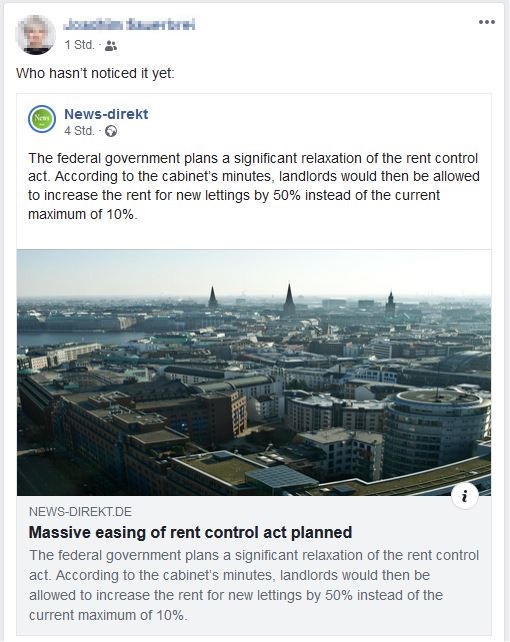
Volunteers were then asked to respond with whether they would block the person in question, based on what they’d shared.

“We thought, the bigger lie, the more newsworthy but also the more inaccurate the post, the more likely it would be blocked by people, and that was true,” Vaccari said. Across the political spectrum, volunteers were more likely to block users when the more implausible or extreme version of the article was shared.

Still, it was “mostly people on the left that engaged in this kind of behavior, and especially those who were extremely on the left,” Vaccari said. “People on the right are much less likely to block people based on their ideological dissimilarity.”

One reason to explain these political differences, although speculative, could be the need for similar social identity: “I think it’s probably something to do with identity more than belief,” Vaccari said. “You might not believe the information shared is accurate, but you might not block that person because it’s a relationship you value.”

Another reason might be related to what previous research has shown, which is that right-wing voters tend to share more misinformation on social media. “So it might be that if you are a left-wing voter, you are used to seeing quite a lot of misinformation shared by right-wing voters that you are in contact with on social media. And so you might have become more used to blocking these people because you know they are more likely to share misinformation,” Vaccari said.

One takeaway, as previous studies about echo chambers have shown, is that such partisan tendencies in blocking could further polarize people and lead to a less diverse flow of information on social media channels. “If people are biased in favor of their own party, it may get rid of misinformation, but it also gets rid of alternate views,” Vaccari said.

Of course, this comes with all the caveats of the study: The German political context, the fact that people were asked to decide their take based on posts about non-partisan issues, and the fact that people were only shown one post in order to make their decision (“In reality, people are likely to have things accumulate before they act,” Vaccari said).

“I think that probably the most important takeaway is that there are some drawbacks to the widespread assumption that one of the best ways to protect people against disinformation is to give users tools that enable them to limit contact with other people who share misinformation,” Vaccari told me. “If people applied those tools in a politically neutral way, then there would be no problem with that argument. But the problem, as this study shows, is that people apply those blocking and unfollowing tools in a way that is partisan.”

Image of unfriending on Facebook by Oliver Dunkley is being used under a Creative Commons License.

Adblock test (Why?)


"politic" - Google News
March 23, 2022 at 09:07PM
https://ift.tt/EXP9SBV

If someone shares your politics, you're less likely to block them when they post misinformation - Nieman Journalism Lab at Harvard
"politic" - Google News
https://ift.tt/D5w4a38
https://ift.tt/2n8L4Ia

Republicans greet a historic Supreme Court nomination with a political circus - CNN

unitedstatepolitics.blogspot.com

(CNN)Judge Ketanji Brown Jackson could make history as the first Black female Supreme Court justice but some Senate Republicans with their eyes on higher political office are making her confirmation hearing all about them.

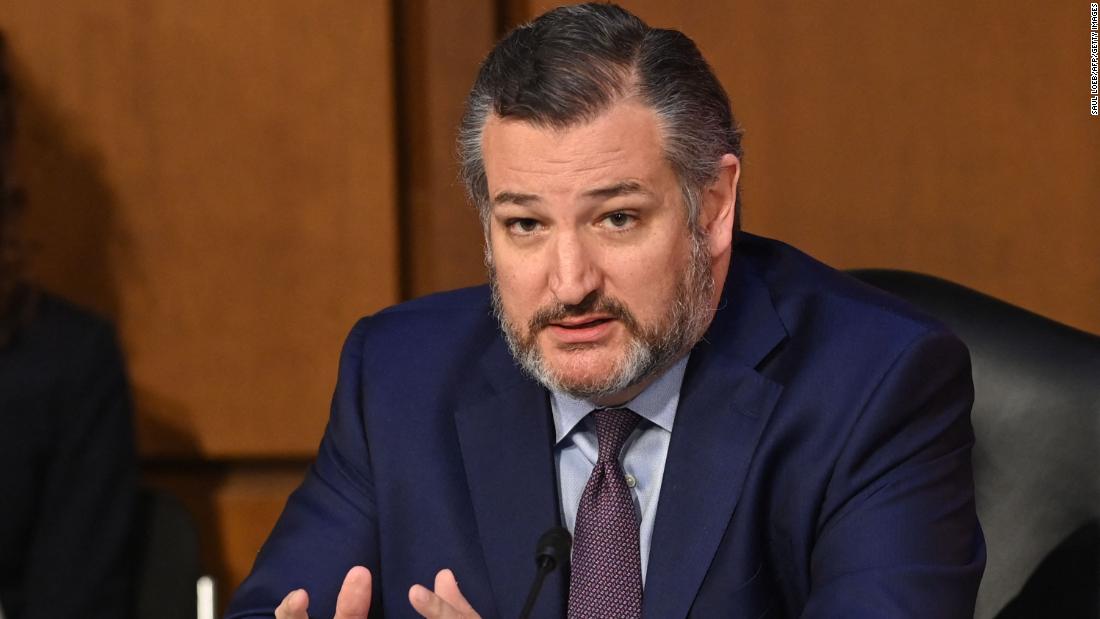
"Do you agree ... that babies are racist?" Sen. Ted Cruz of Texas asked Jackson at one point on Tuesday, as he mined books in the curriculum of her children's school in a made-for-conservative-TV grilling on cultural war issues that power Republican politics.
Nothing in Jackson's second day before the Senate Judiciary Committee suggested her nomination is in difficulty, given the narrow Democratic majority in the full chamber. But while they probably can't stop her taking a seat on the high court, some Republicans tried to turn her into a caricature of President Joe Biden's policies ahead of midterm elections in November and their own possible future White House bids.
Wary of being seen as bullying the historic nominee, Republican senators praised Jackson's credentials, character and intellect. But that didn't stop some of them from portraying her as an advocate for child predators, a friend of terrorists, associated with Marxist anti-White doctrine and also soft on crime. The latter charge -- that Democrats are against police and weak on crime -- is a centerpiece of the Republican midterm campaign message.
Given the intense media focus on the war in Ukraine and the fact that the ideological makeup of the court is not at stake, it is not yet clear whether this hearing will have the vote-moving potential of previous such sagas, especially more than seven months before the November elections. And even thunder clap moments in confirmation hearings hardly guarantee campaign trail success, as then-senator and now-Vice President Kamala Harris found out after skewering now-Justice Brett Kavanaugh, to the delight of liberals in 2018, ahead of her bid for the Democratic presidential nomination.
But yet another hyper-partisan Judiciary Committee circus over a potential Supreme Court justice is sure to further tarnish the reputation of a critical branch of government at an already fraught political moment.

A racial dimension

Nomination hearings should include a vigorous examination of a candidate's record. But many of Tuesday's questions -- especially from Republican senators like Missouri's Josh Hawley and Cruz, who may have presidential aspirations -- had little to do with the duties of a potential Supreme Court associate justice. The questions often selectively cited various trials over which she presided.
There was also a palpable racial undertone to some of the questions. Cruz, for example, called on Jackson to answer for critical race theory -- a concept that seeks to understand and address inequality and racism in the US. The term has been politicized by some conservatives into claims liberals are waging a battle against White America, and Republicans seem to believe it's become a potent motivating factor for their base.
But insinuations that Jackson is a cypher of a racist movement are ironic since her nomination actually highlights more than 200 years and counting of White male justices dominating a high court that has never had a Black woman.
Jackson's hearings are not taking place in a vacuum. The idea that the Supreme Court is an apolitical branch of government above the grubbiness of politics has always been quaint. But since 2000, when it decided a disputed presidential election, and after a conservative majority was built on hardball tactics by Senate Republicans, it's become ever more politicized. The antics of some GOP senators took the process even further on Tuesday.
Some implicitly justified their treatment of Jackson by referring to contentious 2018 hearings in which Democrats raised historic sexual misconduct allegations against Kavanaugh, which he denied and that the then-Republican Senate majority never fully investigated. Their attitude underscored how every Supreme Court nomination hearing is now a forum for Republicans and Democrats to grind their axes over long-simmering grievances about previous nominations -- dating back to Biden's treatment of President Ronald Reagan's conservative nominee, Robert Bork, in 1987.
Such hearings also drip with hypocrisy. One top Republican on the panel, Sen. Lindsey Graham of South Carolina, implied Jackson was a radical since her nomination was hailed by liberal outside groups. He ignored how the current 6-3 conservative majority on the court was built on the efforts of right-wing groups advocating for justices that share their political views.
The Supreme Court finds itself at a particular political crossroads, with a deeply conservative majority delivering rulings that will shape a sharply divided country for decades, on issues like abortion and gun control, which may often conflict with majority opinion in the United States. It can hardly afford spectacles that further taint its legitimacy in the eyes of many Americans. Yet that is what it got in Tuesday's hearing.

A misleading showdown over child porn offender sentencing

In one of the most obviously politicized moments, Cruz brought up books he said were taught at a private school Jackson's children attended and where she serves on the board of trustees. He showed a blown-up picture of a page in one book, "Antiracist Baby," that he described as "stunning" and criticized the school's curriculum as overflowing with critical race theory.
"Do you agree with this book that is being taught (to) kids that babies are racist?" Cruz asked. In response, Jackson sighed, in one of her few signs of impatience in a long day. She said she didn't believe any child should be told they were racist. "I've never studied critical race theory and I've never used it. It doesn't come up in the work that I do as a judge," Jackson told Cruz. How a school curriculum over which Jackson has no control was relevant to her nomination was unclear. But Cruz had his political moment.
Not all Republican senators went for histrionics. Utah Sen. Mike Lee, who is deeply conservative, held a respectful discussion with Jackson on the Constitution. Nebraska Sen. Ben Sasse, who is highly unlikely to vote to confirm her, tried to tease out her views on the late Justice Antonin Scalia's theory of originalism and on the more expansive theory of constitutional interpretation held by liberal justice Stephen Breyer, whom Jackson hopes to replace.
But the nominee was soon under fire for her handling of child porn offender cases in which she sometimes handed down sentences lighter than prosecutors were seeking and what was recommended by US sentencing guidelines set by Congress. But Jackson is in the mainstream of judges -- both liberal and conservative -- who regard the guidelines as out of date and hard to interpret for intricate cases.
Cruz said that he detected in Jackson a "record of activism and advocacy as it concerns sexual predators that stems back decades." And Hawley, another potential 2024 or 2028 presidential candidate, who originally raised her sentencing of child porn offenders, spent almost all of his allocated half hour on a single case in which she sentenced the offender to three months.
Prosecutors had sought 24 months, a recommendation far below the 97-121 month guidelines in the case. Hawley said he had a "hard time" getting his head around such an outcome. Jackson described the nuances of the case, which the Missouri Republican wasn't keen to accept.
She told Hawley she spoke as a judge and a mom tasked with reviewing evidence. "It is heinous. It is egregious."
Republican Sen. Marsha Blackburn of Tennessee closed the evening's questioning by narrowing in on another issue being used by Republicans in some political messaging -- transgender athletes. She asked Jackson to define "the word woman" and alluded to the success of University of Pennsylvania swimmer Lia Thomas, the first transgender athlete to win an NCAA Division I title. Jackson demurred on Blackburn's question about what message Thomas' victory sends, noting that related legal issues could come before the court.
Earlier, Jackson had rejected criticism of her time as a public defender for Guantanamo Bay detainees -- a role that ensures that defendants, even those charged with the most savage crimes, get their constitutional right to a fair trial.
"That's what makes our system the best in the world. That's what makes us exemplary," she said.
Sen. Tom Cotton, another Republican sometimes mentioned as a possible future presidential candidate, accused Jackson of twisting the law in another case because she was sympathetic to a drug kingpin. Jackson rejected the charge by the Arkansas senator, saying she was following guidelines laid down by Congress in sentencing. Blunt and somewhat condescending, Cotton posed a series of questions about whether police should arrest more criminals and whether sentences for those convicted should be longer.
Cotton, a graduate of Harvard Law School, would have been aware that many of these questions were policy orientated and beyond a judge's purview. But he now has TV footage he can use in a political context to argue that Biden's nominee for the Supreme Court couldn't say whether murderers should stay longer in jail.

Adblock test (Why?)


"politic" - Google News
March 23, 2022 at 12:03PM
https://ift.tt/8aUr4JM

Republicans greet a historic Supreme Court nomination with a political circus - CNN
"politic" - Google News
https://ift.tt/D5w4a38
https://ift.tt/2n8L4Ia

'Truth in Politics' group targets SPS board incumbent Charles Taylor in political ads - News-Leader

Search

Featured Post

Politics - The Boston Globe

unitedstatepolitics.blogspot.com Adblock test (Why?) "politic" - Google News February 01, 2024 at 03:47AM https://ift.tt...

Postingan Populer