Rechercher dans ce blog

Thursday, June 23, 2022

How 'vice-signalling' swallowed electoral politics - Financial Times

unitedstatepolitics.blogspot.com

On Friday June 30 2000, Tony Blair was addressing a theology conference in Tübingen, Germany, when he proposed a novel way to deal with crime and antisocial behaviour: on-the-spot fines. “A thug might think twice about kicking in your gate, throwing traffic cones around your street or hurling abuse into the night sky,” the then UK prime minister said, “if he thought he might get picked up by the police, taken to a cashpoint and asked to pay an on-the-spot fine of, for example, £100.”

Michael Mansfield, a human rights lawyer, condemned the proposal as “Orwellian in concept”, while the Conservative opposition did what opposition parties always do when confronted with a scheme they don’t think will work but they fear will be popular: they branded it a gimmick. 

And, of course, it was a gimmick. The policy barely survived the weekend. Having been floated by Blair on the Friday, it had essentially been abandoned by the following Monday, thanks to the opposition of police leaders. Although a limited version of the idea made its way into law in the 2001 Criminal Justice and Police Act, it fell far short of Blair’s vision.

The policy’s collapse was hardly surprising. The prospect that, of an evening, the UK police would have the time and resources to not only dispense summary justice but also to march people up to a cashpoint would always have been impossible to implement — even without the not-unreasonable liberal objections it provoked. 

A little under 15 years later, on June 16 2015 in New York, Donald Trump — back then only a businessman and reality-TV star — launched his bid for the Republican presidential nomination, pledging to build a wall between the United States and Mexico. “I would build a great wall, and nobody builds walls better than me, believe me. And I’ll build them very inexpensively. I will build a great, great wall on our southern border,” Trump said, adding for good measure: “And I will have Mexico pay for that wall.”

© Andrew Rae

In the end, President Trump extended the border fence separating the US from Mexico by just 80 miles. Mexico didn’t pay for a single cubic metre of concrete. 

In the years separating Tony Blair’s speech at Tübingen and Donald Trump’s launch at Trump Tower, the term “virtue signalling” started to emerge on the internet. Although the term’s precise origins are contested, it was popularised in a Spectator column by the writer James Bartholomew, who defined the act as “indicating you are kind, decent and virtuous” while being anything but.

When Disney uses the Star Wars Twitter account to spotlight LGBTQ+ characters from the franchise’s tie-in comics, while cutting a same-sex kiss from its cinematic releases, they are, fairly or unfairly, accused of virtue signalling. They want the cachet of being supportive of LGBTQ+ issues without potentially losing out on viewers, where it would hurt the bottom line.

We wouldn’t usually associate draconian measures on crime and punishment, or, indeed, a literal wall standing between two nations, as signs of virtue. These are examples of what you might instead call “vice signalling”: ostentatious displays of authoritarianism designed to reassure voters that you are “tough” on crime or immigration. And on that measure, both Blair’s on-the-spot fines and Trump’s border wall achieved their aim perfectly.

Blair’s Labour party was re-elected in 2001 and 2005 and, on both occasions, voters trusted it more than the opposition Conservatives on the vital issue of crime. In 2016, Trump’s hardline positioning on immigration issues allowed him to pivot his party’s policy platform to a more centre-ground position on social security and entitlements. Not only did this allow him to win over enough Democratic voters to enter the White House, equally importantly it also shifted the balance of the Republican coalition, making it even easier for his party to win power via the electoral college than it had been beforehand. 

Signalling matters in politics because most people vote on what political scientists call “valence” — your perceived competence on various issues. Now, there is no easy way to signal that you are competent at fighting crime or policing your nation’s borders, because most voters at any given time are not in direct contact with law enforcement or immigration agencies. But showy, conversation-starting pledges are a good way of -signalling your commitment. 

From a politician’s perspective, the other benefit of vice -signalling, as with virtue signalling, is that it can help force your opponent into tricky political terrain. In 1988, the Conservative government of Margaret Thatcher passed the Local Government Act into law, which included the now-infamous Section 28. It ruled that no local authority could “intentionally promote homosexuality or publish material with the intention of promoting homosexuality”, while no state school could “promote the teaching of the acceptability of homosexuality as a pretended family relationship”.

The law was essentially unenforceable, and no one was ever successfully prosecuted under the act. But it achieved its political aims, in causing internal divisions within the opposition Labour party, and signalling to socially conservative voters that the Thatcher government was “on their side”. 


Today in the UK, Boris Johnson’s government is engaging in some vice signalling of its own with its Rwanda resettlement policy. Under the terms of the arrangement, anyone journeying to the UK, whether in the back of a lorry, or on a boat across the Channel, faces a “heads I lose, tails you win” situation. If their application is successful, they are provided a home not in the UK but in Rwanda, and if their application is unsuccessful they are deported back to their country of origin.

The British government has embarked on the scheme because, after Brexit, the EU’s frontiers have come to the UK, and with them, an increased number of people seeking a better life here on boats of varying degrees of seaworthiness (the UK is no longer part of the EU’s Common European Asylum System, which effectively allowed the government to reduce the number of people eligible to claim asylum in the UK).

The boats spook MPs, whose hold on power relies on continuing to win the support of voters across the British right. The spectre of hundreds of people coming to the UK every day, Tory MPs fear, will send their voters either to parties to the Conservatives’ right or cause them not to vote at all. Either leaves them vulnerable to electoral defeat, thanks to the UK’s first-past-the-post electoral system.

© Andrew Rae

The policy is full of holes and has no realistic prospect of working any more effectively than Blair’s on-the-spot fines, Thatcher’s Section 28 or Trump’s wall. The theory is that the prospect of being sent to Rwanda will deter would-be migrants, but the very real prospect of, at worst, a briny death in the Channel or, at best, having to make a permanent living in the UK’s underground economy has not deterred would-be crossers.

A journey to Rwanda is not going to move the dial for most people. When Israel briefly embarked on a similar policy, it found that while it could send would-be immigrants to Rwanda, it was powerless when those very same people left Rwanda for a second crack at moving to Israel. 

The point of these policies isn’t to work. It’s to give Conservative MPs something to talk about when they are asked to explain why 300 or so people arrived by boat yesterday. If it can discomfort Labour, so much the better. 

And in some ways, it is just as well. Because the Rwanda policy does not work. The UK government has, at time of writing, failed to send even a single person there, though it did charter a private flight at considerable expense, before being forced to cancel it in the face of legal challenges. Just as with Section 28, however, that the policy may never in practice be enforced doesn’t mean it won’t cause real harm.

A gay teenager whose teacher feels they cannot reassure them that there is nothing wrong with their feelings experiences real harm. Someone who comes to the UK, gets a job working for a gangmaster and feels they cannot go to the authorities for help because they think they are better off being exploited in the UK than living in Rwanda experiences real harm. 

If you take the long view, Boris Johnson’s Rwanda policy and Donald Trump’s border wall are just the same old, same old. What separates the governments of Johnson and Trump from those of Thatcher and Blair is that Thatcher and Blair’s exercises in vice signalling were about creating the political space to do other things.

Thatcher’s government privatised large swaths of the UK economy and radically reformed the labour market. Blair pumped big sums of money into public services and introduced a raft of socially liberal reforms.

Donald Trump controlled the White House while his party had a majority in both houses of Congress for two years. His sole policy achievement in office was a programme of tax cuts that have since expired. The “big lie” of Obamacare, despite his best efforts and his promises, was neither repealed nor replaced. (His lasting impact, tilting the Supreme Court to the far right, likely for a generation, was largely executed by Republicans in the Senate.)

As for Boris Johnson and the ruling Conservatives, the party increasingly resembles a performance art installation rather than a serious governing project. Even when you talk to loyalist MPs, there is little sense that the government’s vice-signalling stunts have any greater political purpose other than to win another election and with it, more time for further vice-signalling stunts. No one seriously believes that a Johnson-led government will do anything of substance with its time in office. So what’s the point of the stunts?

That failure has real and serious implications. The big mistake that criticisms of virtue signalling make is to believe that virtue signalling doesn’t matter. The person or organisation doing it may have a shallow commitment to the virtues they are signalling, but to the people who care about the issue in question, those signals matter a great deal. They are a promise of serious action. When an ordinary person engages in an act of what we dismiss as “virtue signalling”, what they are actually doing is telling us what really matters to them. And when ordinary people “vice signal”, they are doing the same. 

The perception that Disney does not do enough for LGBTQ+ causes or for its employees ultimately forced the corporation into a political stand-off with Florida’s Republicans over the “Don’t Say Gay” bill, a piece of legislation that echoes Section 28 in -several ways. The belief that mainstream political parties do not do enough about supposedly virtue-signalling causes such as -climate change or international development has seen parties of the centre left lose votes to ecological and far-left policies. 

© Andrew Rae

While Blair’s on-the-spot fines never came into being, crime and antisocial behaviour did, in fact, fall under his government. His government’s vice signalling revealed real intent and was accompanied by measures that fulfilled the spiritual promise of his showy pledges.

In the US, the fact that the Trump administration didn’t really seem to care about doing anything other than winning is one reason why his refusal to accept defeat has caused so many political convulsions in that country. In the UK, the fact that Boris Johnson’s ostentatious commitment to reducing the amount of illegal immigration won’t solve the problem may result merely in Conservative defeat at the next election. 

But the government’s vice signalling on immigration and border control may also pave the way for a government that takes those signals seriously, and seeks to implement them through policies that the Johnson government is willing to wink at but not actually implement, be that leaving the European Court of Human Rights or tackling the movement of people by boat in ways that endanger more and more lives.

The real problem with vice signalling is that it risks sending what is, in a democracy, the most dangerous signal of all: that politicians do not really care about their electorate’s concerns, other than as a device to win and to hold on to their own power.

Stephen Bush is an FT associate editor and columnist

Follow @FTMag on Twitter to find out about our latest stories first

Adblock test (Why?)


"politic" - Google News
June 23, 2022 at 11:00AM
https://ift.tt/rQiZ0y3

How 'vice-signalling' swallowed electoral politics - Financial Times
"politic" - Google News
https://ift.tt/PbGpAiX
https://ift.tt/2TJgIP9

Wednesday, June 22, 2022

‘A real crisis of democracy’: France enters a political deadlock - Al Jazeera English

unitedstatepolitics.blogspot.com

Paris, France – In France, legislative elections are an opportunity for voters to give the president a strong majority in the country’s parliamentary body, the National Assembly, and thus a powerful political mandate.

But two months after President Emmanuel Macron was re-elected against far-right candidate Marine Le Pen, the French did not turn out in overwhelming support of their president’s political party.

Just 46 percent of registered voters cast a ballot in the second round of legislative elections.

“Macron lost a lot of supporters which shows that it is a crisis of the heart,” Philippe Marlière, professor of French and European politics at University College London, told Al Jazeera.

Just 29 percent of 18- to 24-year-olds voted in the legislative elections and 36 percent of eligible voters with a total monthly household income of less than 1,200 euros ($1,266). In comparison, 66 percent of people more than 70 years old and 51 percent of high-income voters cast a ballot.

France’s legislative results are a significant setback for Macron. The president’s coalition, Together (Ensemble), fell 44 seats short of an absolute majority, winning 245 – down by more than 100 seats from his previous mandate. This is the first time in 20 years that a newly-elected (or re-elected) president failed to win an absolute majority.

Without an absolute majority, Macron may struggle to pass key domestic reforms, such as the controversial raise in retirement pension age from 62 to 65.

‘Jupiter’

In his first term, Macron – nicknamed “Jupiter” by French media – was able to govern largely unopposed, but he now needs support from opposition lawmakers to pass legislation.

“There will be a re-adjustment towards bargaining with different political forces,” Rim-Sarah Alouane, PhD candidate and researcher in comparative law at the University Toulouse 1 Capitole, told Al Jazeera. “You need to find compromises, or you cannot pass legislation.”

Without a majority, the National Assembly could see total gridlock on key legislation. Macron faces challenges from both the newly-united left and the far right. The leader of conservative party The Republicans (Les Républicans) also affirmed that the party stands in opposition to Macron.

“There is no question of a pact, or a coalition, or an agreement of any form whatsoever,” Christian Jacob said after a council meeting of The Republicans on Monday.

Some of Macron’s parliamentary losses came from the left. In 2017, Macron’s party received some support from centre-left or moderate voters, but many of those voters either abstained or joined the united left.

In the 2017 elections, the left did not run under a united front, so votes were split among parties. But in 2022, the NUPES coalition, led by Jean-Luc Mélenchon, who took third place in the 2022 presidential election, presented a united opposition to Macron. The alliance won 131 seats.

‘Political, moral defeat’

Mélenchon called the elections a “political and moral defeat for Macron’s party”. Meanwhile, Marlière attributed Macron’s losses on the left to his politics and governing style.

“Since he was elected president, Macron has been drifting to the right economically, but also on cultural and political issues,” he told Al Jazeera.

It is unclear whether NUPES will be able to sustain an alliance in the National Assembly, or whether, now elected, the parties will proceed with their own agendas. Already, several have rejected Mélenchon’s proposal to form a single parliamentary group.

France’s far-right party, National Rally (Rassemblement National) had unprecedented success, winning 89 seats – an eleven-fold increase from the 8 seats held during Macron’s first term.

Marine Le Pen, the party’s leader and former presidential candidate, was reelected as a member of parliament in Pas-de-Calais with 61 percent of the vote. The far right is now the third largest group in the National Assembly.

Although Macron pledged to oppose the far right when he was elected in 2017, some of his politics have contributed to their success, according to Aurelien Mondon, senior lecturer and researcher on democracy, populism and racism at the University of Bath.

“He ended up mainstreaming a lot of their ideas, and also picked them as the alternative to the status quo. The status quo is so incredibly distrusted that it ended up playing right into the hands of Marine Le Pen,” Mondon told Al Jazeera.

For the legislative elections, Macron failed to stoke opposition against the far right.

When the NUPES were against National Rally candidates, 72 percent of Together! voters abstained from voting, while 16 percent voted for NUPES and 12 percent for National Rally, according to IPSOS data.

On the right, 58 percent of The Republicans voters abstained when it came to a vote between NUPES and National Rally, while 30 percent voted for National Rally and 12 percent for NUPES.

In previous elections, and as occurred in the recent presidential election, many voters chose to cast a ballot against the far-right candidate in the second round, regardless of the other candidate’s platform.

“This was a normal kind of thing to do in the past,” Mondon said. “This is a system of vote that should keep [the far right] out of the National Assembly.”

With 89 MPs, National Rally deputies will have more allotted speaking time during assembly meetings and more staff.

Although the far right does not have enough votes to create legislation on its own, the party will now receive 10 million euros ($10.5m) in public funding annually – essentially double the previous mandate.

Some of these funds will likely go towards paying off the National Rally’s debts to Russian banks, including a 9-million-euro ($9.5m) debt to Russian bank First Czech-Russian Bank (FCBR).

Beyond the implications in the National Assembly, the biggest concern is the “symbolic power” and the affirmation for their supporters, according to Mondon.

“We’re likely to see emboldened actions against various communities that have been the target of far-right politics,” he said.

Finding compromise

To seek an absolute majority, Macron could dissolve the National Assembly and call for snap elections, but he is unlikely to do so.

“The results will be the same or even worse for Macron, and clearly this will bring more instability,” Alouane said.

The only other path forward is compromise. The Élysée announced that the president invited party leaders in the National Assembly to meet with him on Wednesday.

But to reach a strong majority, experts worry that Macron will reach too far towards the far right. On Monday, justice minister Éric Dupond-Moretti suggested that Macron’s party would be willing to “move forward together” with the National Rally to advance legislation.

“The idea of them bargaining with the far right is still on the table,” Alouane said. “I wouldn’t be surprised if indeed they find compromises with the far right.”

Despite the need for a majority, Macron’s party should be “uncompromising” with the far right, according to Mondon. The focus should be re-engaging with voters who have lost faith in the system.

“There are far more French people who are disconnected from politics than French voters who are voting for the far right. Abstention shows that there is a real crisis of democracy in France,” he said. “What we’ve seen this time around is the end of the Republican Front, and Macron has just buried what was left of it.”

Adblock test (Why?)


"politic" - Google News
June 21, 2022 at 10:23PM
https://ift.tt/xzQYSaj

‘A real crisis of democracy’: France enters a political deadlock - Al Jazeera English
"politic" - Google News
https://ift.tt/PbGpAiX
https://ift.tt/2TJgIP9

Bennett said mulling timeout from politics, not running in next election - The Times of Israel

unitedstatepolitics.blogspot.com

Prime Minister Naftali Bennett has floated the idea of taking a break from political life and not running in the next elections, according to Israeli television reports Wednesday.

The Kan public broadcaster reported that Bennett raised the idea at a meeting with fellow members of his Yamina party, but said he has not made a final decision.

The prime minister has not publicly addressed the matter.

Yamina MKs reportedly urged Bennett to make a decision quickly, tying their fate to his. According to the Kan report, they are also likely to step away if Bennett does.

The Knesset approved a preliminary reading of a bill on Wednesday to dissolve itself. Once it passes the necessary legislative hurdles, Israel will head to its fifth election since 2019 and Foreign Minister Yair Lapid will become caretaker prime minister until a new government is formed. Bennett would then replace Lapid as alternate prime minister.

Polls aired on TV networks Tuesday showed that Bennett’s Yamina would only win four to five seats, compared to the seven the party picked up in the 2021 elections, which could play a role in encouraging the outgoing premier to hand over the reins of his party.

Yamina MK Nir Orbach, leading a Knesset House Committee meeting, 21, 2022. (Olivier Fitoussi/Flash90)

Meanwhile, Channel 13 reported Wednesday that before Bennett decided the prospect of salvaging the coalition was over, his proxies offered to appoint Yamina rebel Nir Orbach to a powerful position of his choosing in exchange for resigning from the Knesset.

Orbach was reportedly offered the chair of Mifal HaPais, Israel’s national lottery, or to serve as director-general of Keren Hayesod, the country’s official fundraising body.

Orbach apparently dismissed the proposition, citing his personal values.

The Yamina lawmaker recently dropped his support for the government, citing the refusal of coalition MKs who refused to back crucial legislation applying Israeli law to Israeli citizens living in the West Bank; the decision left the government with a parliamentary minority.

Bennett was first elected to the Knesset after leading the Jewish Home party to win 12 seats in the 2013 elections. He went on to serve as a minister in Netanyahu-led governments.

He failed to pass the electoral threshold with his New Right party in the April 2019 elections but was given a second chance when another round of elections was held in September that year, regaining a Knesset seat as part of the Yamina faction.

Following elections in 2021, Bennett broke from his old ally Netanyahu and formed a historic, diverse unity government, with himself as premier. The coalition collapsed under the weight of defections in recent months, many from his own party, due to ideological divisions with coalition partners.

Fresh elections will likely take place in late October or early November, after the Jewish High Holidays.

Adblock test (Why?)


"politic" - Google News
June 23, 2022 at 03:25AM
https://ift.tt/3zyKc20

Bennett said mulling timeout from politics, not running in next election - The Times of Israel
"politic" - Google News
https://ift.tt/PbGpAiX
https://ift.tt/2TJgIP9

Politics Podcast: Are 1 Percent Of Americans Evil? - FiveThirtyEight

unitedstatepolitics.blogspot.com
FiveThirtyEight
 

The latest redistricting cycle is almost over, and we have a somewhat finalized national map of new districts to assess. In this installment of the FiveThirtyEight Politics podcast, the crew breaks down how the new map falls along partisan lines and why there are a record-low number of competitive districts. They also discuss a new poll from YouGov that asked Americans where they fall on the Dungeons & Dragons alignment chart, ranging from good to evil as well as lawful to chaotic. Unsurprisingly, not many Americans identify as evil.

Finally, the team looks at the newest polling from FiveThirtyEight’s collaboration with Ipsos, in which Americans were asked about the most important political issues leading up to the midterms. This edition focused on political polarization, crime and gun violence.

You can listen to the episode by clicking the “play” button in the audio player above or by downloading it in iTunes, the ESPN App or your favorite podcast platform. If you are new to podcasts, learn how to listen.

The FiveThirtyEight Politics podcast is recorded Mondays and Thursdays. Help new listeners discover the show by leaving us a rating and review on iTunes. Have a comment, question or suggestion for “good polling vs. bad polling”? Get in touch by email, on Twitter or in the comments.

Adblock test (Why?)


"politic" - Google News
June 22, 2022 at 03:57AM
https://ift.tt/8slEXrO

Politics Podcast: Are 1 Percent Of Americans Evil? - FiveThirtyEight
"politic" - Google News
https://ift.tt/PbGpAiX
https://ift.tt/2TJgIP9
Saturday, June 18, 2022

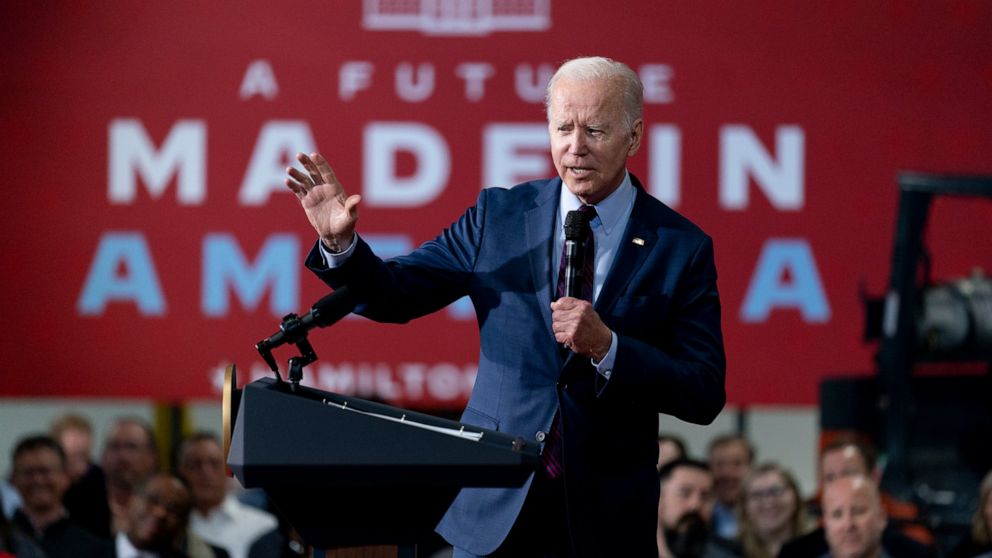
Biden's optimism collides with mounting political challenges - ABC News

unitedstatepolitics.blogspot.com

WASHINGTON -- Democrats are going to hold onto the House after November's midterm elections. They will pick up as many as four seats in the Senate, expanding their majority and overcoming internal dissent that has helped stifle their agenda.

As the challenges confronting President Joe Biden intensify, his predictions of a rosy political future for the Democratic Party are growing bolder. The assessments, delivered in speeches, fundraisers and conversations with friends and allies, seem at odds with a country that he acknowledged this week was “really, really down,” burdened by a pandemic, surging gas prices and spiking inflation.

Biden's hopeful outlook tracks with a sense of optimism that has coursed through his nearly five-decade career and was at the center of his 2020 presidential campaign, which he said was built around restoring the “soul of America.” In a lengthy Oval Office interview with The Associated Press on Thursday, Biden said part of his job as president is to “be confident.”

“Because I am confident," he said. “We are better positioned than any country in the world to own the second quarter of the 21st century. That’s not hyperbole. That’s a fact.”

While presidents often try to emphasize the positive, there is a risk in this moment that Biden contributes to a dissonance between Washington and people across the country who are confronting genuine and growing economic pain.

Few of Biden's closest political advisers are as bullish about the party's prospects as the president. In interviews with a half-dozen people in and close to the White House, there is a broad sense that Democrats will lose control of Congress and that many of the party's leading candidates in down-ballot races and contests for governor will be defeated, with Biden unable to offer much help.

The seeming disconnect between Biden's view and the political reality has some in the party worried the White House has not fully grasped just how bad this election year may be for Democrats.

“I don’t expect any president to go out and say, ‘You know what, 'We’re going to lose the next election,’” said Will Marshall, president and founder of the Progressive Policy Institute, which is in regular contact with the White House’s policy team. What might serve Biden well instead, Marshall said, would be “a sober sense of, ’Look, we’re probably in for a rough night in November and our strategy should be to remind the country what’s at stake.’”

The White House is hardly ignoring the problem.

After years in which Democrats have operated in political silos, there is a greater focus on marshaling resources. Jen O'Malley Dillon, Biden's 2020 campaign manager who now serves as one of his deputy chiefs of staff, runs the political team from the West Wing along with Emmy Ruiz, a longtime Texas-based Democratic political consultant.

O'Malley Dillon coordinates strategy among the White House, the Democratic National Committee and an array of outside party groups. Cedric Richmond, a former Louisiana congressman who co-chaired Biden's 2020 campaign and was one of his closest White House advisers, left for a job with the DNC in April. He characterized the move as underscoring the administration's full grasp of the importance of the midterms.

"We understand that you cannot govern if you can’t win,” Richmond said in an interview. “We are treating it with that sense of urgency.”

The president's political message is being honed by Mike Donilon, a longtime Biden aide who is a protector of Biden's public image, and veteran party strategist Anita Dunn, who is returning to the White House for a second stint.

Richmond praised Dunn’s political instincts and said he believes she will team with O’Malley Dillion, White House chief of staff Ron Klain and others to promote messaging that many in their own party may underestimate.

“If I had a penny for every time Democrats counted Joe Biden or Kamala Harris out, I’d be independently wealthy," Richmond said.

Biden turned to Dunn during an especially low political moment in February 2020, giving her broad control of his then-cash strapped presidential campaign as it appeared on the brink of collapse after a disastrous fourth-place showing in the Iowa caucus.

Barely a week later, Biden left New Hampshire before its primary polls had even closed, ultimately finishing fifth. But he took second in Nevada, won South Carolina handily and saw the Democratic establishment rally around him at breakneck speed in mere days after that. O'Malley Dillon then joined the campaign and oversaw Biden's general election victory.

A similar reversal of political fortune may be necessary now.

But where White House officials last year harbored hopes that voters could be convinced of Biden’s accomplishments and reverse their dismal outlook on the national direction, aides now acknowledge that such an uphill battle is no longer worth fighting. Instead, they have pushed the president to be more open about his own frustrations — particularly on inflation — to show voters that he shares their concerns and to cast Republicans and their policies as obstacles to addressing these issues.

Though he has increasingly expressed anger about inflation, Biden has publicly betrayed few concerns about his party's fortunes this fall. opting instead for relentlessly positivity.

“I think there are at least four seats that are up for grabs that we could pick up in the Senate,” the president told a recent gathering of donors in Maryland. “And we’re going to keep the House.”

Biden meant Ohio, Pennsylvania and Wisconsin, with potential longer shots in North Carolina or Florida possibly representing No. 4. Some aides admit that assessment is too optimistic. They say the president is simply seeking to fire up his base with such predictions. One openly laughed when asked if it was possible that Democrats could pick up four Senate seats.

The party's chances of maintaining House control may be bleaker. Still, Tim Persico, executive director of the Democratic Congressional Campaign Committee, which is charged with defending the party’s narrow majority, said Biden remains an asset.

“We love when the president is speaking to the country,” Persico said. “There’ll always be frustrations. I totally get that. But I think he’s his own best messenger.”

Biden has traveled more since last fall, promoting a $1 trillion public works package that became law in November, including visiting competitive territory in Minnesota, Virginia, Wisconsin, Michigan and New Hampshire. During a trip to Democratic Rep. Cindy Axne’s Iowa swing district, the president declared, “My name is Joe Biden. I work for Congresswoman Axne.”

But Bernie Sanders, the last challenger eliminated as Biden clinched the 2020 Democratic presidential nomination, is making his own Iowa trip this weekend to rally striking workers at construction and agriculture equipment plants.

The 80-year-old Vermont senator has not ruled out a third presidential bid in 2024 should Biden not seek reelection. That has revived questions about whether Biden, 79, might opt not to run — speculation that has persisted despite the White House political operation gearing up for the midterms and beyond.

“I do think a lot of folks in the Democratic Party, rightfully, are concerned about what’s going to happen in 2024. That doesn’t have to be mal intent,” said Linn County Supervisor Stacey Walker, whose district includes Cedar Rapids, Iowa, and who was a high-profile Sanders supporter during the last campaign. “I think folks are putting the question to the Democratic Party, ‘Is Joe Biden going to run again? Is he not going to run again?'”

Walker noted that other Democrats who could seek the White House in 2024 if Biden does not, including Massachusetts Sen. Elizabeth Warren, joined Sanders in signing a letter supporting 1,000-plus plant workers who have been striking for better pay and benefits for more than a month.

“It is responsible, I think, for those folks within the Democratic Party, who have the profile, who have the infrastructure, to make sure it’s all still in good working condition should they have to dust off the playbook," Walker said.

Asked if Biden was running again in 2024, White House press secretary Karine Jean-Pierre said the president has responded to such queries repeatedly and “his answer has been pretty simple, which is, yes, he’s running for reelection."

The more immediate question of Biden's midterm appeal could be even trickier. He campaigned for Democrat Terry McAuliffe in Virginia last November, after winning the state easily in 2020. McAuliffe lost by 2 percentage points, a potentially bad omen for the 16 governorships Democrats are defending this fall.

“We know there are going to be national headwinds, there always are," Stacey Abrams, the Democratic candidate for governor in Georgia, said recently. But she insisted she would be happy to campaign with Biden or top members of his administration: “I welcome anyone willing to lift Georgia up, to come to Georgia and help me get it done.”

That was a departure from Democrat Beto O'Rourke, running for governor in Texas, who told reporters, “I’m not interested in any national politician — anyone outside of Texas — coming into this state to help decide the outcome of this race.”

Biden political advisers say a possible Supreme Court ruling overturning the landmark Roe v. Wade decision, as well as recent mass shootings spurring renewed debate over gun violence, could give Democrats two issues that could energize voters. But they also acknowledge that one or both might help party candidates clinch already close races — not remake the political landscape nationwide.

In the meantime, Biden's overall approval rating hit a new low of 39% last month. Even among his own party, just 33% of respondents said the country is headed in the right direction, down from 49% in April. The president's approval rating among Democrats stood at 73%, falling sharply from last year, when Biden’s Democratic approval rating never slipped below 82%.

White House political advisers are already playing down the possibility that some of the party's most vulnerable candidates may carve out identities distinct from the president's. As a former senator, Biden understands such maneuvers, they say.

The White House also notes that the president and his party are in far better shape now than before the 2010 midterms, when a tea party wave saw Republicans win back Congress. Since taking office, Biden's political team has invested significantly in the DNC and state parties, and all sides are cooperating.

The DNC says it has never been larger, with 450 staff members on state party payrolls, or sported a more robust ground operation. It also raised $213 million so far, a midterm record. But DNC Chair Jaime Harrison nonetheless appeared to be trying to head off concerns donors' contributions might be going to waste, saying, “We're not promoting it all over the place.”

“When you're in the Super Bowl, do you think the coach puts all their plays up on Twitter, and says, 'Here's what we're going to run?," Harrison said at a Los Angeles fundraiser with Biden last weekend. “No. We don't put all of our stuff out there.”

He said the group is building out an operation "to make sure that, when those close elections happen November, we win them."

Adblock test (Why?)


"politic" - Google News
June 18, 2022 at 08:17PM
https://ift.tt/tW3nYRF

Biden's optimism collides with mounting political challenges - ABC News
"politic" - Google News
https://ift.tt/sxkhdNq
https://ift.tt/cNA8VlS

Friday, June 17, 2022

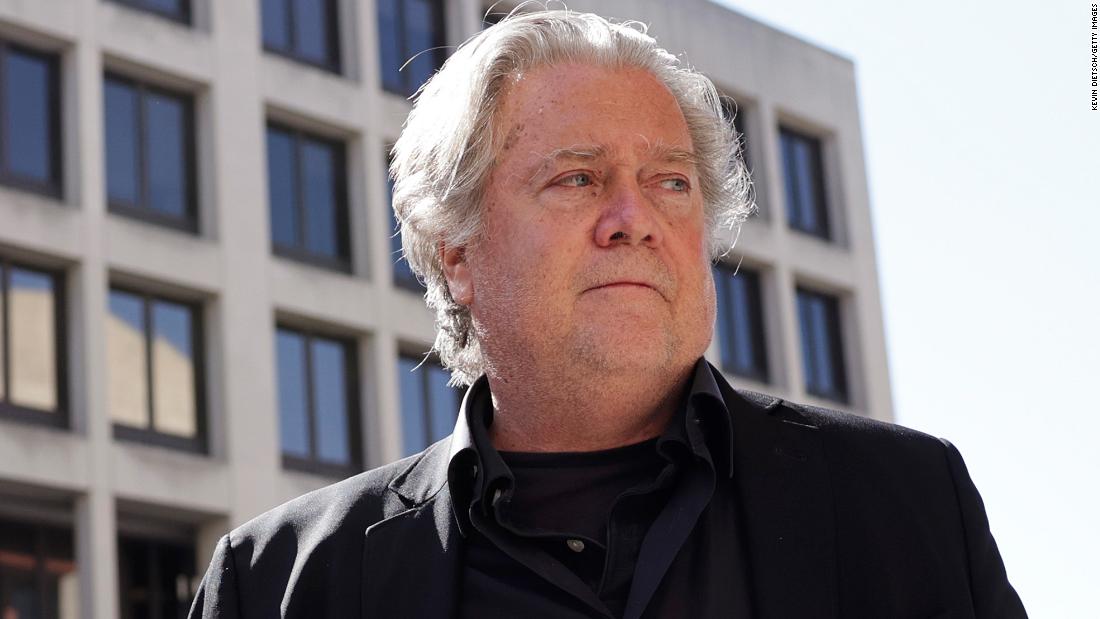
Bannon and DOJ don't want to talk politics or January 6 specifics at contempt trial - CNN

unitedstatepolitics.blogspot.com

(CNN)Longtime Trump political adviser Steve Bannon wants to block prosecutors from exploring the January 6, 2021, attack on the US Capitol before the jury at his criminal contempt trial next month. At the same time, prosecutors are trying to prevent Bannon from turning his trial into a "circus atmosphere," they said Friday.

Bannon's defense team says the details of the attack -- including testimony, photos, audio and video that could be used as evidence or in arguments -- should not become part of the trial because his case is only about compliance with a subpoena, and description of the attack could unfairly sway the jury against him.
Bannon is charged with criminal contempt of Congress for failing to testify or turn over documents in the House select committee investigation -- the first case of its kind to result from the landmark congressional investigation. He has pleaded not guilty to the contempt charges.
"Evidence about events that took place eight months earlier (than his subpoena) -- namely the January 6, 2021, attack on the U.S. Capitol -- have no bearing on whether Mr. Bannon willfully made default in response to the September 23, 2021, subpoena. Thus, any evidence or argument regarding those events should be precluded," Bannon's defense team wrote.
The Justice Department sent its own set of table-setting requests for the trial to the judge on Friday. Prosecutors asked to bar Bannon's team from raising at his trial: his own politics, the legitimacy and political composition of the House select committee, comparisons with others who were not prosecuted for criminal contempt following House subpoenas, accusations he was targeted for prosecution unfairly or that he was excused from complying with his subpoenas because of executive privilege.
"This case is about whether the Defendant was subpoenaed and whether he showed up thereafter. The Court should not allow him to make it about anything else and should grant this motion to exclude irrelevant evidence and argument at trial," prosecutors wrote. "In his filings, at oral argument, and during press conferences in front of the courthouse, the Defendant has repeatedly sought to inject into this case improper evidence and argument, make incendiary and baseless political attacks, and create a spectacle."
Prosecutors argued on Friday that they believe Bannon will try to sway jurors to set aside the law, even if he is proven guilty, and acquit him for other reasons -- a phenomenon called jury nullification.
Bannon, one of the right wing's most prominet showmen, has already made a habit of speaking about his case publicly as he walks in and out of court appearances. Just this week, minutes before appearing before a federal judge, he called the House committee derogatory names, saying its public hearings couldn't compete with the attention his case deserves. The judge denied his attempts to have the case thrown out.
At trial, Justice Department prosecutors, who received a referral from the House to prosecute him, will need to prove a relatively narrow case if they are to secure a conviction -- that Bannon willfully refused to respond to the congressional inquiry. He will not be able to argue he relied on the advice of his lawyer, the judge has already ruled.
The requests from both sides of the case on Friday are among filings that attempt to set the parameters of what the jury in Washington can hear when it convenes in a month. Filings like these are typical for establishing the rules of a trial before one takes place.
The Justice Department hasn't indicated yet how much it plans for its case to focus on Bannon's relationship to the January 6 investigation itself. Prosecutors will have the opportunity to reply to Bannon's request in court, as will Bannon to theirs, potentially revealing more about both sides' tactical approaches to the case. The judge, Carl Nichols of the DC District Court, will be able to ask questions about how such limitations would work.
Separately, Nichols is already weighing whether Bannon can subpoena Democratic congressional leaders and House select committee members for trial testimony. The House is attempting to block those subpoenas in court, saying it is protected by the Constitution, and the Justice Department on Friday said it hopes that if the House members don't testify, Bannon doesn't try to leverage that to help his case.
"The Defendant has indicated, in his ceaseless effort to make this case about anything other than the facts and the law, that he should be allowed to use his failure to secure the witnesses' appearances against the Government in this case," prosecutors wrote.
Bannon's team did not go into great detail in its three-page request to keep the trial from revisiting January 6.
"Even were one to assume that any evidence about January 6, 2021, was relevant -- and it is not -- the evidence and argument must nonetheless be excluded ... its probative value would be far outweighed by its prejudicial effect," his lawyers wrote. "This is especially true given that trial will take place in Washington, DC, where the U.S. Capitol is located, and because images and commentary about the attack, and the subsequent actions of the Select Committee, have saturated the local (and national) media."

Adblock test (Why?)


"politic" - Google News
June 18, 2022 at 05:56AM
https://ift.tt/GPrYQAM

Bannon and DOJ don't want to talk politics or January 6 specifics at contempt trial - CNN
"politic" - Google News
https://ift.tt/sxkhdNq
https://ift.tt/cNA8VlS

Thursday, June 16, 2022

Iraqi Shia leader al-Sadr withdraws from political process - Al Jazeera English

unitedstatepolitics.blogspot.com

Muqtada al-Sadr says he ‘will not participate in the next elections if the corrupt participate’.

Iraqi Shia leader Muqtada al-Sadr said he has decided to withdraw from the political process to avoid involvement with “corrupt” politicians, the state news agency reported.

According to a report on Wednesday, the leader of the Sadrist Movement in the Iraqi parliament insisted he “will not participate in the next elections if the corrupt participate” during a closed meeting with members of his bloc.

He also said that his decision to order his bloc to resign from parliament will not be retracted, in an announcement that came three days after he ordered 73 politicians from his party to quit the assembly.

The unprecedented mass withdrawal of the al-Sadr bloc has dramatically altered the political landscape in Iraq, throwing government formation talks into further doubt.

It was a huge gamble by al-Sadr, one of the most influential politicians in Iraq with a large street following, putting him outside of parliament for the first time since 2005.

Al-Sadr emerged as the winner of the October vote, giving him 73 of parliament’s 329 seats. The vote was a blow to his Iran-backed Shia rivals who lost about two-thirds of their seats and have rejected the results.

Since then, the two sides have been locked in a competition for power, even as the country faces growing challenges, including an impending food crisis resulting from severe drought and the war in Ukraine.

Al-Sadr has been intent on forming, along with his allies, a majority government that excludes the Iran-backed factions.

But he has not been able to corral enough legislators to parliament to get the two-thirds majority needed to elect Iraq’s next president – a necessary step ahead of naming the next prime minister and selecting a cabinet.

When he ordered his politicians to resign on Sunday, he called it a “sacrifice” he was making for the good of the country.

His cousin and nominee for prime minister, Jaafar al-Sadr, withdrew his candidacy on Monday.

The surprise move was an attempt to break a persisting political impasse, eight months after general elections were held. The question has since been whether the political parties will be able to form a government with al-Sadr in the opposition.

According to analysts, the Sadrist Movement’s resignations will not spell an end to Iraq’s political crisis. Instead, the coming phase will likely bring more instability to the oil-rich country, with a possible new wave of intense debate, and potential street protests.

With the resignation of Sadrist politicians, Iranian-backed groups are now expected to hold the majority in parliament.

According to Iraqi laws, if any seat in parliament becomes vacant, the candidate who obtains the second-highest number of votes in their electoral district replaces them.

In this case, it would be al-Sadr’s opponents from the so-called Coordination Framework Alliance, a coalition led by Iran-backed Shia parties and their allies. Many of the seats vacated by the Sadrists will therefore be filled by the Shia parties in the CFA, such as former Prime Minister Nouri al-Maliki’s State of Law and the Fatah Alliance, the political wing of the Iran-backed Popular Mobilisation Forces, or Hashd, militia.

Adblock test (Why?)


"politic" - Google News
June 16, 2022 at 04:43PM
https://ift.tt/iVH7bqk

Iraqi Shia leader al-Sadr withdraws from political process - Al Jazeera English
"politic" - Google News
https://ift.tt/W2c4gPx
https://ift.tt/7UnpsE9

Search

Featured Post

Politics - The Boston Globe

unitedstatepolitics.blogspot.com Adblock test (Why?) "politic" - Google News February 01, 2024 at 03:47AM https://ift.tt...

Postingan Populer