Rechercher dans ce blog

Thursday, July 21, 2022

The Hole in the Center of American Politics - The New York Times

unitedstatepolitics.blogspot.com

Republican politicians who don’t support Donald Trump have made starkly different choices over the last five years.

Some, like Senator Mitch McConnell of Kentucky, have tempered their criticism of the 45th president — opposing him at times, while accommodating him at others in service of their partisan objectives.

A smaller coterie of others, like Representative Liz Cheney of Wyoming, have opposed Trump vigorously — in her case, voting to impeach him and helping lead the House investigation into his conduct on Jan. 6, 2021. On Thursday evening, Cheney will again take center stage as the Jan. 6 panel holds what is expected to be its final prime-time hearing of July.

As Peter Baker writes, Cheney and her allies are betting that history’s judgment will eventually vindicate their choices, while insisting that her motives are not political.

“I believe this is the most important thing I’ve ever done professionally,” Cheney told Baker in an interview, “and maybe the most important thing I ever do.”

Thus far, however, the accommodationists have carried the day. McConnell worked closely with the Trump White House to stock the federal judiciary with more than 200 conservative judges, realizing a decades-long project that culminated with the hard-right transformation of the Supreme Court and the reversal of Roe v. Wade.

Republicans are also poised to retake the House in November, and possibly the Senate, even though the official organs of the party have rallied behind Trump and, in the case of the Republican National Committee, helped pay his considerable legal bills.

Still, Trump’s consolidation of the base of the Republican Party — the MAGA die-hards who wouldn’t blanch if he shot someone on Fifth Avenue, proverbially speaking — has left a vacuum at the center of American politics that both parties have jostled to fill.

Democrats seized the middle in the 2018 midterms, retaking the House by focusing on kitchen-table issues like health care, while setting themselves up to win full control of Congress two years later. Republicans have countered this year by seizing on inflation and various cultural issues in an attempt to portray Democrats as out of the mainstream.

One reason behind all this political volatility: College-educated suburban voters have bounced around from election to election, making that bloc a kind of no-man’s land between two entrenched camps.

Vacuums like this always attract political entrepreneurs, and there has been a flourishing of activity aimed at these voters. On Politics has covered a lot of that new energy over the past few months, from new parties popping up to megadonor-backed independent ballot initiatives to cash-flush super PACs mucking around in Republican primaries.

In previous years, groups with names like “No Labels” and “Third Way” have claimed the mantle of political centrism. But partisan voters have generally scoffed at those efforts, suspecting them of being Trojan horses for corporate donors. Other centrist initiatives, like the anti-communist, pro-labor group Americans for Democratic Action, faded in influence as their historical moment passed.

David Greenberg, a historian of American politics at Rutgers University, said there was a “huge number of people who are disaffected from where the Democratic Party seems to be going,” along with the exhaustively documented and better organized never-Trump Republicans.

But he noted that structural impediments like the Electoral College had made it difficult for third parties and other groups to establish themselves, even when voters seem sympathetic to their arguments.

Getty Images

On occasion, charismatic figures like Theodore Roosevelt, who ran for president in 1912 under the banner of the “Bull Moose Party,” have tried to galvanize the middle of the electorate and run against both poles. More often, though, attempts to break Democrats’ and Republicans’ chokehold on the system have foundered owing to a lack of strong leaders.

Greenberg marveled at the irony, too, that so many Americans now feel that the two major parties have been driven to appeal only to their respective bases.

“If you really go back historically, it was thought that our two-party system itself was a bulwark against extremism,” he said — as opposed to multiparty systems in places like Weimar Germany that allowed radical groups to assume power without ever commanding a majority of voters.

One of the more interesting centrist-y experiments out there is happening in Missouri, where a former Republican senator, John Danforth, is backing an independent candidate for Senate, John Wood. A former Danforth aide, Wood was most recently a prosecutor on the Jan. 6 panel.

In an interview, Danforth said his goal was to provide an alternative to two major political parties that, in his view, have each gone off course in their own way.

“The problem is not just in Trump or the Republican Party,” Danforth said, though he said he was disturbed that Republicans were attacking the legitimacy of the 2020 presidential election and of court cases ratifying the results.

“But on the other hand,” he added, “we have identity politics, we have the cancel culture. We have the whole sort of presentation of America as oppressors and victims. And that’s not healthy, either.”

“The whole point of this campaign is: We have to heal the country,” Danforth said.

A consummate Republican insider, Danforth grew up in elite circles in St. Louis and attended Princeton University and Yale Law School, where he also picked up a master’s degree in divinity. After a stint in corporate law, he was elected state attorney general, then became a senator at the dawn of the slow Republican takeover of Missouri politics.

At a time when politicians tend to find more success by railing against Washington elites, Danforth, 85, is an unapologetic defender of the old ways of doing business. He was especially offended by the storming of the Capitol, an event that led him to break with Senator Josh Hawley, a Missouri politician he mentored and helped usher into office in 2018.

Supporting Hawley, Danforth told The St. Louis Post-Dispatch after the freshman lawmaker greeted the Capitol mob with a raised fist on Jan. 6, was “the worst mistake I ever made in my life.”

And while Danforth professed optimism about Wood’s chances, which most Missouri political analysts rate as poor, he said he felt compelled to try.

“We are not a corrupt system,” he said. “We are not a system that people should attack, either in the Capitol Building or by this take-up-arms view of politics. That’s why I’m doing this. I have to do it. You know, I just feel that I must.”

— Blake

Is there anything you think we’re missing? Anything you want to see more of? We’d love to hear from you. Email us at onpolitics@nytimes.com.

Adblock test (Why?)


"politic" - Google News
July 22, 2022 at 06:00AM
https://ift.tt/ugw1oHC

The Hole in the Center of American Politics - The New York Times
"politic" - Google News
https://ift.tt/zrspacb
https://ift.tt/AxZCmis

Mario Draghi Resigns as Prime Minister, Throwing Italy Into Political Chaos - Bloomberg

unitedstatepolitics.blogspot.com

[unable to retrieve full-text content]

Mario Draghi Resigns as Prime Minister, Throwing Italy Into Political Chaos  Bloomberg

"politic" - Google News
July 21, 2022 at 03:11PM
https://ift.tt/g49LqUF

Mario Draghi Resigns as Prime Minister, Throwing Italy Into Political Chaos - Bloomberg
"politic" - Google News
https://ift.tt/huUp9Ld
https://ift.tt/blYdfPJ

Wednesday, July 20, 2022

This Political Neophyte Is a Lock for Congress. His Name Helps. - The New York Times

unitedstatepolitics.blogspot.com

Rob Menendez Jr., 37, is running his first race for office for a New Jersey congressional seat that his father, Senator Bob Menendez, once held.

Brian Varela’s odds of winning the Democratic congressional primary against the son of a powerful United States senator were always exceedingly long.

His main opponent, Robert Menendez Jr., was the handpicked darling of New Jersey’s Democratic elite. Mr. Varela was having trouble hiring field workers willing to risk offending Hudson County’s famously cutthroat political machine. And he had sold his house so that he could lend his campaign $600,000.

Still, the Hudson County Democratic Organization, which is backing Mr. Menendez, was taking no chances.

The 589 signatures Mr. Varela had gathered to get on the ballot were challenged in court, and roughly two-thirds were invalidated, an aggressive political tactic that disqualified him from the race. Another candidate, Eugene D. Mazo, an election law expert who had hoped to run under the slogan, “No to nepotism. No to Menendez,” was knocked out of contention the same way.

Two other lesser-known opponents remained on the ballot, and Mr. Menendez, a 37-year-old lawyer who has never held public office, coasted to an easy primary victory last month.

Barring an unlikely win in November by his Republican opponent, Marcos Arroyo, in a district where Democrats outnumber Republicans, five to one, Mr. Menendez will join his father, Senator Robert Menendez, in Congress next year.

Mr. Varela, 33, said he did not regret running.

“I don’t think that anyone should be able to just march right into Washington, D.C., because they’ve been anointed,” he said.

History is filled with examples of other famous families who have held generational power in Washington, including the Bushes, Kennedys, Cheneys and Gores. But in the Eighth Congressional District — a densely packed region in northern New Jersey known as much for its sordid history of political corruption as for its stark economic challenges — the Democratic Party’s decision to back Mr. Menendez has come to represent party politics at its worst.

Before December, Mr. Menendez was known mainly as the affable son of Senator Menendez — who, five years after facing federal corruption charges that ended with a mistrial, has emerged as one of Washington’s most powerful Democrats.

Unlike his father, who climbed New Jersey’s political ladder rung by rung — from the Union City school board to that city’s mayor’s office to the State Legislature to Congress — Mr. Menendez has no voting or policy record to scrutinize.

Yet as soon as Representative Albio Sires indicated he was stepping aside, a cascade of powerful Democrats, including the governor, quickly endorsed Mr. Menendez even though he had not officially entered the race.

One editorial decried the process as “gross,” and another said the quick endorsements for a candidate who had “never run for dogcatcher” were a symptom of the state’s political dysfunction.

“On a national level it’s all about: ‘Are we losing our democracy?’ ” said Ryan Dowling, 42, a Democrat who, like Mr. Menendez, lives in Jersey City. “And on a local level it’s just — ‘Why even vote?’”

Gov. Philip D. Murphy has said that his support for Mr. Menendez had little or nothing to do with the family name.

In a June radio broadcast, Mr. Murphy said Mr. Menendez was “an outstanding lawyer” with “a great personality,” and added, “When you’ve got a talent like that, that’s really impressive, you can’t let his family ties be held against him, either.”

Mr. Menendez said that he had taken nothing for granted during the campaign and had worked hard to win endorsements from an array of individuals, labor groups and advocacy organizations.

“All I can do is work as hard as I possibly can,” he said. “That’s what I’ve done every single day. I’m not going to stop. I’m not going to stop after November.”

Anna J. Brown, the chairwoman of the political science department at St. Peter’s University in Jersey City, said the bald display of nepotism carried insidious risk: eroding residents’ already fragile confidence in government.

“It contributes to that feeling of powerlessness,” Professor Brown said. “People just give up because they don’t really think that their voice is heard.”

“Is that really what we want right now?” she added. “I don’t think so.”

The Eighth Congressional District includes parts of some of the state’s largest cities: Newark, Jersey City, Elizabeth, Hoboken and Union City. Its poverty rate is 20 percent higher than in the rest of the country, and nearly half of its residents are foreign-born.

It is filled with residents who, like Mr. Sires, fled Cuba, as well as more recent arrivals from Mexico and South America. Roughly 54 percent of residents speak Spanish at home, census figures show.

It is a language that Mr. Menendez does not know but said he was trying to learn.

“That’s something that’s on me, that I am working on, because it is important,” he said in an interview at a campaign event where most people did not speak English.

Hector Oseguera, a left-leaning Democrat who lost an uphill primary challenge against Mr. Sires two years ago, said Mr. Menendez’s inability to speak Spanish was not an insurmountable liability. But he said it showed a lack of a true connection to the needs of the majority Latino district.

“Sure, he will be a secure vote for the Democrats,” Mr. Oseguera said. “But on the issues where we should be taking a lead — will he be a leader?”

Mr. Menendez was raised in Union City and joined a law firm known for its political clout in New Jersey, Lowenstein Sandler, after graduating from Rutgers Law School in 2011. Just over a year ago, after being nominated by Mr. Murphy, he was appointed to the Port Authority of New York and New Jersey, a post he intends to give up if he wins in November. He and his wife have a 2-year-old daughter and are expecting a second child in September.

At Lowenstein Sandler, Mr. Menendez mainly worked with clients in the private equity market, with a focus on venture-capital funds led by managers from underrepresented groups, said Gary M. Wingens, the firm’s managing partner.

If elected, Mr. Menendez will be leaving a job that last year paid $456,000, according to a federal financial disclosure form.

“He’s not doing this late in his career after he’s amassed his fortune,” Mr. Wingens said, adding, “I think he’s coming from a really sincere place: actually wanting to help people.”

Bryan Anselm for The New York Times

Mr. Menendez does not discount the influence his father still wields in a district he represented for 13 years. But he prefers to talk about his grandmother and her decision to flee Cuba to start a new life in Union City when asked about his political role model.

His eyes well up when he discusses his mother, who worked as a teacher, and the school shooting in Uvalde, Texas; he has indicated that gun control would be a priority if elected.

“The idea that in the most densely populated state in America, anyone — with absolutely no common-sense limits — would be allowed to carry a concealed gun is stunningly irresponsible,” he said in a statement after a Supreme Court ruling undermined New Jersey and New York’s ability to limit handgun licenses.

Only a handful of children have served in Congress at the same time as their parent, and there are no such pairs in the current 117th Congress, according to the Library of Congress. Several voters said the father-son partnership would be an asset to the district.

Yadira Guillen, 72, of Union City, said Senator Menendez had been a strong politician who “fights for us always.”

Ms. Guillen, who emigrated from Nicaragua decades ago, said she believed it was likely that his son had learned similar leadership skills. “His son is very good, too,” she said. “Will be — I think. I hope so. We are trusting.”

One endorsement Mr. Menendez sought but did not win was from New Jersey Working Families, a left-leaning group suing to abolish the state’s unique ballot-design system, which gives candidates backed by county leaders an often overwhelming advantage. During an interview with a Working Families panel, Mr. Menendez was asked about the last protest he attended.

He told them it was when he was in high school. Sue Altman, the Working Families’ state director, said that disclosure drew a tart quip from the back of the room: “That wasn’t a protest. That was a pep rally.”

The group endorsed no one.

Adblock test (Why?)


"politic" - Google News
July 19, 2022 at 04:00PM
https://ift.tt/25Fx3Hs

This Political Neophyte Is a Lock for Congress. His Name Helps. - The New York Times
"politic" - Google News
https://ift.tt/FnRqmyp
https://ift.tt/ODClAGk

Tuesday, July 19, 2022

Opinion | Climate Politics Are Worse Than You Think - The New York Times

unitedstatepolitics.blogspot.com

Texas is often hot, but not like this: Current forecasts have the temperature in Dallas hitting 109 degrees Tuesday, with highs in triple digits well into next week.

Britain, on the other hand, used to have a well-deserved reputation as a cool, rainy island. But as I write, the temperature in London is projected to hit 102 degrees Tuesday.

You have to be willfully blind — unfortunately, a fairly common ailment among politicians — not to see that global warming has stopped being a debatable threat that will catch up to us only years from now. It’s our current reality, and if climate scientists — whose warnings have been overwhelmingly vindicated — are right, it’s going to get much worse.

And Joe Manchin just pulled the plug on what may have been the Biden administration’s last chance to do something — anything — meaningful about climate change.

I don’t want to talk much about Manchin. In a few months he’ll probably be irrelevant, one way or another: The odds are either that Republicans will take the Senate or that Democrats, aided by the awfulness of many G.O.P. candidates, will gain some seats. And he wouldn’t have mattered in the first place but for the sickness that has infected America’s body politic.

Still, for what it’s worth, my take on Manchin is both less and more cynical than what you usually hear.

Yes, he represents a state that still thinks of itself as coal country, even though mining is now a trivial part of its economy, dwarfed by jobs in health care and social assistance — with much of the latter paid for by the federal government. Yes, he gets more political contributions from the energy industry than any other member of Congress. Yes, he has a large financial conflict of interest arising from his family’s ownership of a coal business.

Yet my guess is that his Lucy-with-the-football act has as much to do with vanity as with money. (And nothing at all to do with inflation.) His act has, after all, kept him in the political limelight month after month. And if you don’t believe that great events can be shaped, great disasters caused, by sheer personal pettiness, all I can say is that you probably haven’t read much history.

But none of this would have mattered if Republicans weren’t unified in their opposition to any action to limit global warming. This opposition has only grown more entrenched as the evidence for looming catastrophe has grown — and the likely financial cost of effective action has declined.

Let’s talk about the political economy of climate policy.

It has long been painfully obvious that voters are reluctant to accept even small short-run costs in the interest of averting long-run disaster. This is depressing, but it’s a fact of life, one that no amount of haranguing seems likely to change. This is why I’ve long been skeptical of the position, widely held among economists, that a carbon tax — putting a price on greenhouse gas emissions — has to be the central plank of climate policy. It’s true that emission taxes are the Econ 101 solution to pollution, but realistically they just aren’t going to happen in America.

Opinion Conversation The climate, and the world, are changing. What challenges will the future bring, and how should we respond to them?

The good news is that spectacular technological progress in renewable energy may offer a foundation for an alternative political strategy, one based on carrots rather than sticks. The idea — which underlay President Biden’s Build Back Better plan — was to rely not on taxes but on subsidies and public investment to encourage a transition to clean energy. That way climate action could be framed not as sacrifice but as opportunity, a way to create jobs wrapped up in a broader program of much-needed public investment.

The theory, which I naïvely subscribed to, was that such a strategy, while it might be less efficient than one centered on carbon taxes, would be much easier to sell to the American people and that there would be at least a few Republican politicians willing to sign on to policies that promised concrete rewards for workers, contractors and so on without imposing new burdens on their constituents.

But Republicans — and, of course, Manchin — were unmoved. I don’t think they were solely motivated by the desire to see Biden fail. They’re just deeply hostile to clean energy.

There’s an obvious parallel between the politics of green energy and the politics of Covid-19. Many people chafed at the restrictions imposed to limit the pandemic’s spread; even mask requirements involve a bit of inconvenience. But vaccination seemed to offer a win-win solution, letting Americans protect themselves as well as others. Who could possibly object?

The answer was much of the G.O.P. Vaccination became and remains an intensely partisan issue, with deadly consequences: Death rates since vaccines became widely available have been far higher in strongly Republican areas than in Democratic areas.

The fact is that one of America’s two major political parties appears to be viscerally opposed to any policy that seems to serve the public good. Overwhelming scientific consensus in favor of such policies doesn’t help — if anything, it hurts, because the modern G.O.P. is hostile to science and scientists.

And that hostility, rather than the personal quirks of one small-state senator, is the fundamental reason we appear set to do nothing while the planet burns.

The Times is committed to publishing a diversity of letters to the editor. We’d like to hear what you think about this or any of our articles. Here are some tips. And here’s our email: letters@nytimes.com.

Follow The New York Times Opinion section on Facebook, Twitter (@NYTopinion) and Instagram.

Adblock test (Why?)


"politic" - Google News
July 19, 2022 at 06:00AM
https://ift.tt/HKwkLZB

Opinion | Climate Politics Are Worse Than You Think - The New York Times
"politic" - Google News
https://ift.tt/FnRqmyp
https://ift.tt/ODClAGk

Monday, July 18, 2022

Climate Change Legislation Stalls Amid Growing Inflation Concerns - The New York Times

unitedstatepolitics.blogspot.com

Summers in Maricopa County, Ariz., have become at times unbearable, Kyle Hawkinson said on Friday. Smog and haze hung heavily over Phoenix, and residents were bracing for fire season, when the heat and air pollution would only grow worse. Climate change, he said, is at least partly to blame.

But when Mr. Hawkinson, a 24-year-old cashier, voted for Joseph R. Biden Jr. in 2020, climate wasn’t really a factor in his choice, he said. As for voting in November, when the Arizona governor’s mansion and one of the state’s Senate seats are on the line, “that’s going to be a big maybe,” he said, adding, “Climate change is always going to be a problem. That’s just a given. Honestly, there’s only so much our leaders of the country can do.”

News on Thursday that even a stripped-down compromise to address a warming planet appeared to be dead was greeted in Washington by brutal condemnations from environmentalists and Democrats, some accusing Senator Joe Manchin III, Democrat of West Virginia, of dooming human life on Earth. Representative Pramila Jayapal, Democrat of Washington, called Mr. Manchin’s decision “nothing short of catastrophic.”

But an electorate already struggling with inflation, exhausted by Covid and adjusting to tectonic changes like the end to constitutionally protected abortions may give the latest Democratic defeat a resigned shrug. And that may be why climate change remains an issue with little political power, either for those pressing for dramatic action or for those standing in the way.

“People are exhausted by the pandemic, they’re terribly disillusioned by the government,” said Anusha Narayanan, climate campaign director for Greenpeace USA, the environmental group known for its guerrilla tactics but now struggling to mobilize supporters. She added: “People see climate as a tomorrow problem. We have to make them see it’s not a tomorrow problem.”

Josh Haner/The New York Times

The evidence that a climate crisis is well underway appears to be everywhere: the Great Salt Lake in Utah drying up, severe weather regularly imperiling the electric grid in Texas, wildfires scorching the drought-plagued West, “climate refugees” seeking higher land in Louisiana and tidal floods swamping the streets of Miami.

Still, just 1 percent of voters in a recent New York Times/Siena College poll named climate change as the most important issue facing the country, far behind worries about inflation and the economy. Even among voters under 30, the group thought to be most energized by the issue, that figure was 3 percent.

“This challenge is not as invisible as it used to be, but for most people, even those who live in greater Miami, this isn’t something they encounter every day, whereas their encounters with a gas pump are extremely depressing,” said Carlos Curbelo, a former Republican House member from South Florida who pressed his party to act on climate change. He added: “In healthier economic times, it’s easier to focus on issues like this. Once people get desperate, all that goes out the window.”

Two years ago, millions of high school students were leaving school early on “climate strikes.” Greta Thunberg, the teenage Swedish activist, was a hero as she sailed across the Atlantic Ocean for United Nations climate talks and Representative Alexandria Ocasio-Cortez of New York was preaching a Green New Deal. In 2020, Mr. Biden campaigned on a transformative, $2 trillion program to wean the nation from fossil fuels.

By this week, what remained of that program — mainly clean energy tax breaks and subsidies to purchase electric vehicles — appeared dead, killed by Mr. Manchin, who fretted that it could exacerbate inflation. The bipartisan infrastructure bill signed by Mr. Biden did include $2.5 billion to help communities install charging stations, but consumers appeared to be on the hook for the full cost of the cars and trucks that need the juice.

Gabby Jones for The New York Times

In another setback for climate activists, the Supreme Court severely limited the ability of the Environmental Protection Agency to regulate climate-warming carbon dioxide from electric power plants.

Even the soaring cost of gasoline seems to have undermined a central belief of the climate movement: that higher prices for fossil fuels would naturally spark a rush toward more efficient vehicles and alternate energy sources. Instead, gas prices over $5 a gallon produced a bipartisan call for more oil production.

Even strong advocates of action acknowledge that voters are shelving their climate worries for now. Peter Franchot, the Maryland state comptroller who faces a primary on Tuesday in his run for governor, has a history of commitment to environmental issues and the endorsement of Senator Ed Markey of Massachusetts, one of the original sponsors of the Green New Deal.

But, Mr. Franchot, who worked for Mr. Markey as an aide in the 1980s, said climate is not what voters are focused on now. “The No. 1 issue facing most of the public in Maryland is the volatility and uncertainty about the economy. That’s what people are concerned about, and they’re particularly concerned about the rate of inflation,” he said.

Mr. Markey argued there would be political consequences if Democrats didn’t show they were doing all they could on climate. Young voters and liberals already are deflated by Democrats’ failures on other priorities, as well as the Supreme Court’s decisions. A major drop-off in turnout would sink Democrats’ chances of holding Senate seats in Georgia, New Hampshire and Nevada.

Mr. Markey called on President Biden to declare a national emergency on climate, an action, he argued, that would energize climate voters.

“Every high school and every college campus has environmental groups,” he said, “and executive actions by the Biden administration will send a strong signal to them that it is critical that they need to get out the vote.”

Mr. Biden said he would “take strong executive action to meet this moment” if the Senate did not, but he did not lay out specifics.

Pete Marovich for The New York Times

Much of Democrats’ frustration surrounding Congress’s climate failures has been directed not toward Republicans, but toward Mr. Manchin, who said repeatedly that even a stripped-down budget bill should address the issue — only to pull the plug last week on any climate provisions.

Others voiced broader concerns.

“To have those negotiations, to go on as long as they have, and now to say that’s out, that is frustrating,” Gov. Roy Cooper of North Carolina, a Democrat, said of the party’s imperiled domestic agenda, without singling out Mr. Manchin. “The administration needs to continue to push.”

Some activists focused their rage on Democrats beyond Mr. Manchin, such as Speaker Nancy Pelosi, who they said continued to back moderate incumbents such as Representative Henry Cuellar of Texas against a younger and more diverse cast of liberals.

“There is a felt sense of a party-wide leadership failure,” said Varshini Prakash, executive director of the Sunrise Movement, a group of young climate activists. “Among young people there is a deep frustration that the issue of our time that is existential to our survival is not being met with the level of fight that it deserves.”

She and other organizers argued that anger over the tanked environmental legislation would only push young voters to double down on their commitment to elect progressive Democrats.

“I think they see there is no room to remake the Republican Party, but there is room in states to remake the Democratic Party,” said Cristina Tzintzún Ramirez, president of NextGen America, the progressive political action committee founded by the billionaire Tom Steyer to mobilize young voters.

NextGen has earmarked $15.1 million to mobilize students on 186 college campuses in the battlegrounds of Arizona, Michigan, North Carolina, New Hampshire, Nevada, Pennsylvania, Texas and Wisconsin. It is aiming to reach 9.6 million progressive voters.

The Sunrise Movement is planning to focus on swing states like Pennsylvania and on competitive House races. The nonpartisan Environmental Voter Project is targeting eight million people it has identified as environmentalists who did not vote in the 2020 presidential election.

While Democrats blamed Mr. Manchin, there was little sign that Republicans felt political pressure to move toward action on climate — and certainly none of the moderate voter outcry that recently prompted a rare bipartisan compromise on gun laws.

Bryan Tarnowski for The New York Times

Republicans are responding to the localized effects of climate change with calls for action — Representative Kevin McCarthy of California, the Republican leader, on Friday pleaded for passage of legislation to save the Giant Sequoias in his district, which are threatened by fire and drought — but those calls don’t cite the underlying cause, a warming planet.

Benjamin Backer, president of the American Conservation Coalition, a right-of-center environmental organization, said Republicans had no incentive to come to the table. Their own voters aren’t demanding action, and liberal activists, drifting leftward, are unlikely to be satisfied with compromises Republicans could accept.

“The problem with the environment movement right now is it’s so one-sided, if anyone votes the right way, it’s deemed not good enough, and if a Republican votes that way, the voters who care won’t vote for him anyway.”

Mr. Backer and other Republicans involved in the issue insist there is movement on their side. Outright denial of climate change is almost gone, at least among elected Republicans. Many in the G.O.P. had moved to arguing that rising temperatures were simply natural.

Now, after members of Congress took bipartisan fact-finding trips over recent years to watch Greenland melt and Alaska’s permafrost burn, the predominant argument has shifted again: Tough action by the United States is pointless, many say, because carbon pollution from India and China will swamp it.

Still, House Republicans have offered incremental proposals to answer more sweeping Democratic offerings — such as investments in American renewable energy manufacturers and forest and wetland restorations. They may suddenly seem more acceptable in the face of the Democrats’ failures, Mr. Backer said.

Representative Nancy Mace, a Republican from coastal South Carolina, believes that for both parties, climate change is a generational issue — younger voters and politicians want action; older people don’t.

Logan R. Cyrus for The New York Times

But how any action can be bipartisan remains unclear. Ms. Mace said the Democrats’ approach of offering tax breaks for the purchase of electric vehicles or clean energy was “picking winners and losers.” She said Republicans wanted broad tax cuts that would give people more money to make such investments if they chose to do so.

Democrats tried on Friday to stay upbeat. Mr. Manchin, speaking on a West Virginia radio broadcast, said that if Democratic leaders were willing to wait until September, perhaps something could be worked out.

Democrats say they still have time to energize their voters before November.

And Gov. Phil Murphy of New Jersey, a Democrat and the new chairman of the National Governors Association, said “there’s too much at stake here” to give up.

“Whether it’s prescription drugs, whether it’s climate, whether it’s other stuff that Democrats historically have rallied around and stood for, I think party unity matters a lot right now, and so I would just hope that we could all come together,” he said.

Katie Glueck and Reid J. Epstein contributed reporting.

Adblock test (Why?)


"politic" - Google News
July 19, 2022 at 12:22AM
https://ift.tt/AxQHI3j

Climate Change Legislation Stalls Amid Growing Inflation Concerns - The New York Times
"politic" - Google News
https://ift.tt/gBodeWn
https://ift.tt/ws2uRpO

Pence to head back to New Hampshire for high-profile politics forum - The Hill

unitedstatepolitics.blogspot.com

Former Vice President Mike Pence is once again heading to New Hampshire, this time for an appearance at the state’s storied Politics and Eggs forum, the latest move stirring speculation of a potential 2024 White House bid. 

Pence is set to appear at the event on Aug. 17. While the Politics and Eggs series — a joint initiative between the New Hampshire Institute of Politics at Saint Anselm College and The New England Council — features a wide array of elected officials and political figures, it’s also a common stop for current and prospective presidential hopefuls looking to grow their footprint in the Granite State.

For Pence, in particular, the appearance in New Hampshire will mark only his latest stop in a busy political tour. 

He’s already traveled to Iowa, the first-in-the-nation presidential caucus state, and New Hampshire, which holds the first presidential primaries. 

He’s also given a series of high-profile speeches across the country and is set to address the conservative Heritage Foundation in Washington, D.C., later this month, just one day before former President Trump returns to the nation’s capital for the first time since leaving the White House.

Unlike many would-be Republican presidential contenders, Pence has been less shy about his ambitions. He’s declined to rule out a run for the White House, even if Trump decides to mount another campaign of his own. And he’s maintained a more aggressive public schedule than most prospective candidates. 

Pence’s maneuvering threatens to put him in direct competition with his former boss, who has made clear that the 2024 GOP nomination should be his for the taking if he decides to run again. 

Adblock test (Why?)


"politic" - Google News
July 18, 2022 at 09:37PM
https://ift.tt/bXYOmh4

Pence to head back to New Hampshire for high-profile politics forum - The Hill
"politic" - Google News
https://ift.tt/gBodeWn
https://ift.tt/ws2uRpO

Biden returns from Middle East trip with a narrowing window for political wins ahead of November - CNN

unitedstatepolitics.blogspot.com

(CNN)President Joe Biden and his team were enthusiastic Saturday when they boarded Air Force One in Saudi Arabia, congratulating each other on what they viewed as a successful four-day swing through the Middle East.

The political environment Biden returned to in Washington appears far less inspiring. While he was gone, his polling hit a new low, inflation hit a new high and his domestic agenda suffered yet another blow, rendering it interminably stalled.
Even the results from his tour of Israel and Saudi Arabia may not be felt by Americans for months. More immediate was the condemnation of his fist-bump with the Saudi crown prince, whom he accused of orchestrating a dissident's murder.
Biden's aides say he often uses the return flight from abroad to discuss with exhausted staffers the domestic items that are next on his list. A week ago, that would likely have included renewed attempts to pass the sweeping social safety net and climate bill he's been pushing for more than a year.
With that effort on ice after yet another objection from West Virginia Sen. Joe Manchin, Biden is left with a vanishing set of options for political wins in the months before November's midterm elections but a growing list of problems that continue to fuel voter anger.
"He had so many hopes and plans for things he wanted to do," first lady Jill Biden told Democratic donors on Nantucket this weekend while her husband was overseas. "But every time you turned around, he had to address the problems of the moment."
It is a sentiment shared widely in the West Wing and among Biden's Democratic allies, many of whom view the past year -- beginning with a resurgent Covid-19 after Biden declared "freedom from the virus" followed by the messy and deadly US withdrawal from Afghanistan -- as one crisis after another.
A set of decisions -- including whether to ease some tariffs on China and addressing student loan debt -- have been put off, but are likely to come due in the next several weeks after months of deliberation, internal disagreement and, according to some officials, delays by Biden in making up his mind.
White House officials point to declining gas prices, progress on drug pricing reform and a competitiveness bill meant to counter China as potential upcoming victories, though it remains unclear what political benefit Democrats can reap before November.
Meanwhile, as Republicans appear poised to win the House majority, Biden's legal team continues to prepare for what they expect will be an onslaught of oversight investigations from a newly powerful GOP.
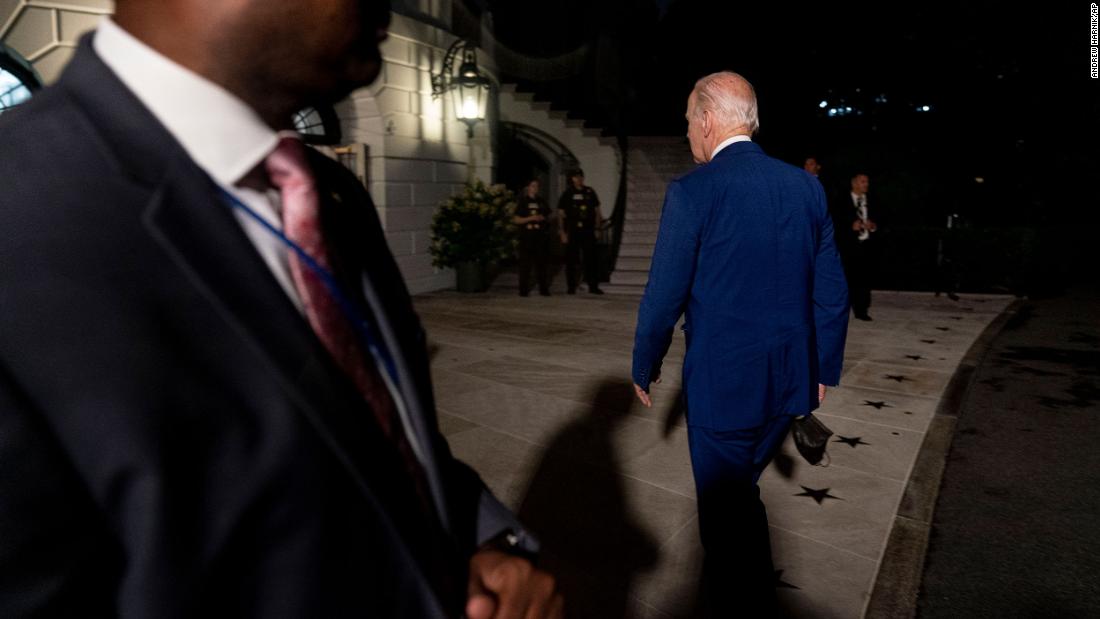
Biden was in a punchy mood when he returned to the White House just before midnight this weekend, chiding a reporter who asked him if he regretted fist-bumping Crown Prince Mohammed bin Salman.
"Why don't you guys talk about stuff that matters? I'm happy to answer a question that matters," he said, holding his hand over his eyes to shield them from a bright spotlight.
It was the most recent in a string of testy replies Biden has given lately to questions about his decisions or political standing.
He told a reporter standing on the beach in Rehoboth, Delaware, she sounded "like a Republican politician" for asking about economic experts who predict a recession. And he tartly dismissed a question in Saudi Arabia about whether he could be sure an incident like the 2018 murder of Washington Post columnist Jamal Khashoggi wouldn't be repeated.
"God love you, what a silly question," the President said.
On the day he left for the Middle East, Biden was departing a festive congressional barbecue on the South Lawn when a reporter asked what his message was for Democrats who don't want him to run again.
"They want me to run," Biden said, walking over to him. "Read the polls. Read the polls, jack. You guys are all the same. That poll showed that 92% of Democrats, if I ran, would vote for me."
Biden's familiarly with the New York Times/Siena College poll released last week was hardly surprising, even though he once claimed he didn't believe polling about his approval ratings. The survey showed nearly two-thirds of Democratic primary voters would prefer another candidate to Biden in 2024, though it also showed a close race between him and former President Donald Trump in a potential rematch.
Concerns among Democrats over Biden's leadership -- and, increasingly, his age -- have become louder over the past weeks. Runaway inflation has caused some Democrats to distance themselves from the White House, which has struggled to contain voter anger.
"I have said for a while that I thought he and the administration have been too slow to react to it," Sen. Maggie Hassan, a vulnerable New Hampshire Democrat up for reelection this fall, told CNN's Manu Raju this week. Asked if she would support Biden in 2024, Hassan said: "If he runs, I'll support him."
Rep. Elissa Slotkin, a Democrat from a competitive Michigan district, said inflation and the economy "should be the start of every press conference at the White House and every other relevant department and agency." She said attempts by some senior Democrats to downplay or project an end of inflation were being poorly received among voters.
"I'm from Michigan," she told Brianna Keilar on CNN. "We're just kind of straight about what's going on and I think people can feel and see spin, and I don't think they like it."
Jared Bernstein, a top White House economic adviser, said in a CNN interview Sunday that gas prices declining for the past month was an achievement worth touting.
"If we're going to talk about the damage that these high energy prices are having on family budgets, I think we have to talk about the benefits for when those prices come down a little," he told Dana Bash on "State of the Union."
Still, he acknowledged the roughly 47-cent-per-gallon reduction from a month ago wasn't likely to register for many Americans.
"The President is unequivocal by not calling mission accomplished on any of this. We're talking about a decline that's completely insufficient when it comes to delivering the relief to family budgets that they need."

Democratic frustration with the White House on abortion and guns

It's not only inflation where Biden faces blowback from fellow Democrats. His cautious response to the Supreme Court decision wiping away the nationwide right to abortion has been lambasted by progressives, who were dismayed as the President and the White House ruled out options like trying to expand the high court or allowing abortions to be performed on federal property.
Some Democratic activists were also enraged when it emerged Biden had plans to nominate an anti-abortion Republican as a federal judge in Kentucky, part what sources described as a potential deal with Senate Minority Leader Mitch McConnell, who represents the state. Last week, the White House said it had scrapped the plan, citing opposition from Kentucky's other Republican senator, Rand Paul.
Biden did sign an executive order before going abroad aimed at protecting access to abortion. But many of his allies have pushed him to do more, including declaring a public health emergency -- a step some officials view skeptically.
"I think that there's more that we can and must do in this moment, especially where women in states like mine are in crisis," Democratic Rep. Lizzie Fletcher of Texas told CNN's Poppy Harlow last week.
On guns, too, Biden is under pressure to do more. While a signing ceremony last week for the first piece of major gun legislation in the past several decades was a moment to celebrate, it was briefly interrupted when a father whose son was killed in the 2018 Parkland mass shooting stood in protest.
"We have to do more than that," Manuel Oliver shouted. "I've been trying to tell you this for years!"
On abortion, guns and other issues -- including taming inflation -- Biden and his aides point out their options for acting through executive power are limited, and suggest some proposals from fellow Democrats wouldn't hold up in court.
Biden did say this week he was prepared to take executive action to address climate change after Manchin torpedoed what had been another attempt at passing new clean energy spending, along with tax hikes on the wealthy, citing concerns over inflation.
It was a discouraging, but for some administration officials not entirely surprising, outcome. Attempts at courting the West Virginian, including a rare invite to Biden's Delaware home for breakfast last fall, had previously resulted in similar disappointments. This time, administration officials left the negotiating to Senate Majority Leader Chuck Schumer -- and many felt their skepticism confirmed after Manchin's announcement last week.
Still, it was a seemingly decisive blow to the sweeping legislative ambitions Biden entered office hoping to achieve. While Manchin says he is open to another look once new inflation numbers are released next month, the window for passing even a scaled-down version of the President's agenda is rapidly closing.
Even Biden, who describes himself as a "congenital optimist," told reporters in Saudi Arabia he had "no idea" whether Manchin was negotiating in good faith.
As he returned to a quiet White House late on Saturday night, Biden offered about as much optimism as he could muster when asked if inflation would start going down.
"I'm hoping," he told reporters gathered in the dark.

Adblock test (Why?)


"politic" - Google News
July 18, 2022 at 02:01PM
https://ift.tt/tjsWcTu

Biden returns from Middle East trip with a narrowing window for political wins ahead of November - CNN
"politic" - Google News
https://ift.tt/gBodeWn
https://ift.tt/ws2uRpO

Search

Featured Post

Politics - The Boston Globe

unitedstatepolitics.blogspot.com Adblock test (Why?) "politic" - Google News February 01, 2024 at 03:47AM https://ift.tt...

Postingan Populer