Friday, January 27, 2023

Ex-boyfriend of George Santos speaks out to CNN - CNN
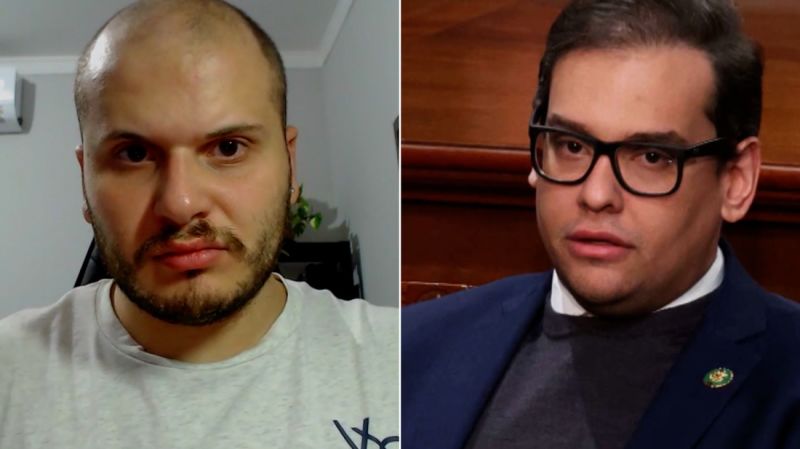
Ex-boyfriend of George Santos speaks out to CNN
CNN's Erin Burnett talks to the former boyfriend of embattled Rep. George Santos (R-NY) about their relationship and the many false claims Santos has publicly made.
"politic" - Google News
January 27, 2023 at 09:28AM
https://ift.tt/8GPsuaY
Ex-boyfriend of George Santos speaks out to CNN - CNN
"politic" - Google News
https://ift.tt/fjEoY3B
https://ift.tt/kGgjaSY
Thursday, January 26, 2023
New questions arise around George Santos' campaign loans - CNN
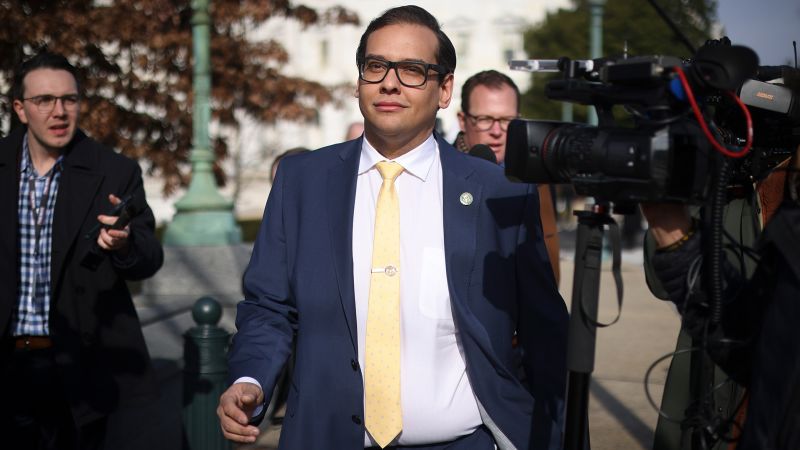
The campaign of embattled Rep. George Santos on Tuesday filed updated reports with federal regulators that appear to raise fresh questions about the source of the substantial personal loans he said he made to his campaign.
The New York Republican, the subject of multiple inquiries into his finances and fabrications about his biography and resume, previously claimed he lent his campaign more than $700,000.
But in two of the new filings with the Federal Election Commission, boxes indicating that loans of $500,000 and $125,000 had come from personal funds were unmarked.
The Daily Beast first reported on the amended FEC filings.
Campaign-finance experts say it was not immediately clear what those changes meant.
“I have no idea what’s going on with the loans,” Jordan Libowitz of the watchdog group, Citizens for Responsibility and Ethics in Washington, told CNN on Wednesday. “It is without a doubt the most confusing FEC filing I’ve seen.”
In all, Santos filed 10 amended reports with the FEC on Tuesday – stretching back to early 2021 – as his campaign faces intense scrutiny. The campaign has a history of filing multiple amendments to its original filings. And the agency has sent nearly two dozen letters to his campaign over the course of two election cycles, seeking clarification about his filings.
“It could be that this is the single sloppiest bookkeeping of any candidate that we’ve ever seen,” Libowitz said. But he said if Santos didn’t provide the money for the loans, it raises questions about whether it came from a prohibited source.
While candidates can contribute – or lend – an unlimited amount of their own funds to their campaigns, it is illegal to accept a six-figure contribution from another person. It also is against the law for a corporation to donate a sum of any size directly to a congressional candidate.
In a tense exchange with reporters Wednesday morning, Santos would not explain why the campaign reports were amended and refused to discuss the source of the funds.
“Let’s make it very clear: I don’t amend anything, I don’t touch any of my FEC stuff, right?” he told CNN. “So don’t be disingenuous and report that I did because you know that every campaign hires fiduciaries.”
CNN has reached out to Santos’ personal lawyer Joe Murray and to his campaign treasurer Nancy Marks for comment.
Some of the biggest questions around Santos’ campaign activity have centered on the financial windfall that allowed the Republican to lend $705,000 to his successful 2022 campaign. Santos flipped a Democratic-held seat on Long Island in November, helping Republicans seize a narrow House majority.
In Santos’ previous, failed bid for Congress, in 2020, his personal financial disclosure form listed no assets and a salary of $55,000. Two years later, Santos reported a $750,000 salary from a firm called the Devolder Organization.
He has given various explanations about the nature of Devolder’s business activities.
In an interview with Semafor, Santos described Devolder as carrying out “deal building” and “specialty consulting” for “high net worth individuals” and said he had “landed a couple of million-dollar contracts” within the first six months of starting the firm. A recent FEC complaint against Santos from the Campaign Legal Center notes that Santos previously called it “his family’s firm” and described himself as overseeing $80 million in assets under management.
Adav Noti, the legal director of the Campaign Legal Center, said Santos’ filings remain confusing.
Over the course of the cycle, the campaign has been “inconsistent” in marking the personal-funds box as it relates to loans, he said. So, it’s not clear if Tuesday’s changes were intentional.
“Like everything else Santos-related, it’s a mystery,” Noti said.
In addition, he said, the new filings do not appear to address some of the pressing questions about Santos’ campaign spending, such as the dozens of disbursements just under $200.
CNN has previously reported that the campaign reported 37 expenses of $199.99, one penny below the threshold above which campaigns are required to retain receipts. In its complaint, the Campaign Legal Center argued that the sheer number of these $199.99 expenses is “implausible” and asked the FEC to investigate whether Santos has falsified his filings.
Noti said it’s time for the agency to launch a formal investigation or undertake a thorough audit of Santos’ campaign.
Judith Ingram, an FEC spokeswoman, declined to comment, citing the agency’s policy of not commenting on enforcement or potential enforcement matters.
This story has been updated with additional reporting.
CNN’s Manu Raju contributed to this story.
"politic" - Google News
January 26, 2023 at 12:19AM
https://ift.tt/inZvyGV
New questions arise around George Santos' campaign loans - CNN
"politic" - Google News
https://ift.tt/UHhzrR8
https://ift.tt/ae16UY3
With newfound powers, statehouse Democrats race to expand voting rights - CNN
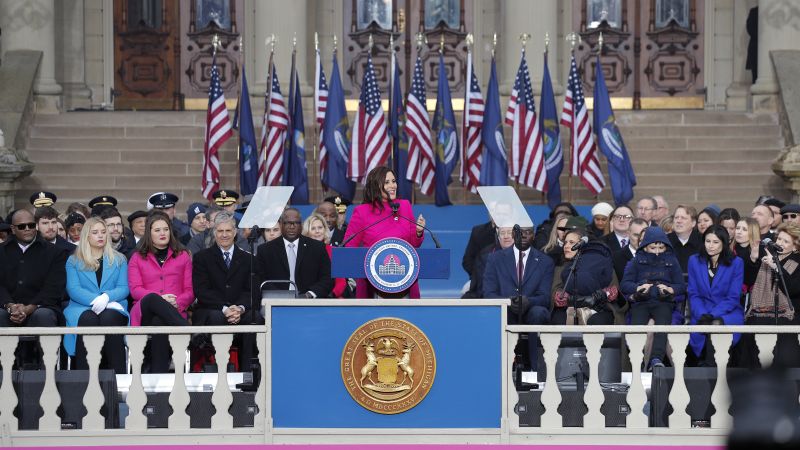
After strong electoral results in the midterm elections, Democrats in some key states are moving quickly this year on voting rights – pushing ambitious plans to expand access to the ballot ahead of the 2024 presidential election.
In the presidential swing state of Michigan – where Democrats have gained the governorship and both legislative chambers for the first time in roughly four decades – Democratic Secretary of State Jocelyn Benson and a group of legislators recently announced a package of voting-related priorities. They range from criminalizing the harassment of election workers to carrying out a voter-approved expansion of early voting.
Newly empowered Democrats in Minnesota, meanwhile, are advancing a suite of election changes through the legislature that include instituting automatic voter registration and restoring voting rights to people convicted of felonies.
And in Arizona – a battleground state where Democrats flipped key statewide offices – the new Democratic Attorney General Kris Mayes recently announced plans to shift the focus of an “election integrity unit” established by her Republican predecessor from investigating voter fraud to “protecting voter access” and fighting voter suppression.
“No one thinks it’s going to be easy, but there’s a general feeling in the air that change is possible,” said Lilly Sasse, campaign director of We Choose Us – a 26-group coalition that’s backing the election package introduced by Democratic lawmakers this month in the Minnesota legislature.
Republicans control more state legislative seats across the country, but Democrats defied the political odds in 2022 by not losing any of their legislative majorities. The midterms also saw Democrats gain four new trifectas at the state level, winning the governorship and both legislative chambers in Massachusetts, Maryland, Minnesota and Michigan.
‘Hard reset’ in Michigan
In Michigan, Democrats benefited politically in 2022 from a surge in liberal voter turnout to back a successful ballot measure that enshrined abortion rights in the state Constitution, along with new legislative maps drawn by an independent commission.
Democratic state Sen. Jeremy Moss, the newly minted chair of the Senate Elections and Ethics Committee, said Michigan lawmakers now are engaged in a “very hard reset” after repeated attempts by the Republicans who previously controlled the state legislature to pass new voting restrictions and seek ways to circumvent Democratic Gov. Gretchen Whitmer’s veto pen.
Last year, Whitmer and two other top Democrats in the state – Benson, the top elections official; and Attorney General Dana Nessel – defeated a slate of Republican challengers who falsely claimed that former President Donald Trump won the 2020 election. (President Joe Biden won the state by more 154,000 votes.)
“Now, we have proof on our side of the aisle that Michigan voters want to back away from these falsehoods and lies,” Moss said.
And last November, Michigan voters approved a constitutional amendment that eased voting rules in several ways. Among other things, it established nine days of early, in-person voting, mandated ballot drop boxes and required pre-paid postage to return absentee ballots. It also allowed voters to sign a statement affirming their identity if they don’t have photo identification.
Democratic priorities during the newly convened legislative session include passing legislation to implement parts of the new constitutional amendment. Other proposals seek to make it a crime to spread election misinformation or to harass and threaten election workers. Moss said he’d like to ban the practice of paying petition-gathers per signature, saying it provides an incentive for fraud.
A scandal over fraudulent signatures knocked several Republican candidates off the ballot in Michigan last year.
Benson, Michigan’s secretary of state, said she will ask the legislature to tap into a projected $9.2 billion budget surplus to provide $100 million to help local jurisdictions to carry out elections.
She also is launching a bipartisan elections policy working group to review and suggest election proposals on a rolling basis. It is slated to hold its first meeting Wednesday.
“There’s a sense of urgency and a sense of opportunity,” Benson told CNN.
No room for error
Democrats in Michigan and Minnesota hold narrow majorities in their legislative chambers, leaving little room for any defections in their ranks as they scramble to enact their election priorities in the weeks ahead.
In Minnesota, Democratic legislators this month introduced an elections package that includes measures that would automatically register qualified Minnesotans to vote when they get a new driver’s license, give 16-year-olds the option of preregistering to vote and grant the franchise to people convicted of felonies as soon as they are released from prison.
Currently, ex-felons in Minnesota must complete all parts of their sentence, including any probation, parole or supervised release before they can register to vote.
But Democrats also are moving on a parallel track and advancing some of their priority bills as standalone measures. A separate bill restoring voting rights for ex-felons, for instance, has cleared an election committee and is slated to be considered by a House judiciary panel Thursday.
Its sponsor, state Rep. Cedrick Frazier, said he and his fellow Democrats don’t want to squander this opportunity. He’s spoken with lawmakers who served in the legislature a decade ago when Democrats last held a trifecta in state government. “There is really some regret that we didn’t get this done then,” he said.
Roughly 50,000 Minnesotans would have their voting rights restored under the proposal, Frazier said. “What we are telling them by not allowing them to participate in the electoral process is that even though they are back in the community ‘You’re still not whole, ‘” he said.
If successful, Minnesota would join 21 other states that automatically restore the right to vote to some or all ex-felons once they are released from prison, according to a tally by the Voting Rights Lab, which tracks election laws at the state level.
In three jurisdictions — Vermont, Maine and Washington, DC – convicted felons never lose the franchise, even while incarcerated. In Oregon, another state where Democrats control the governor’s seat and both legislative chambers, a bill introduced this month would grant voting rights to those still in prison.
In New York, another Democratic stronghold, the state Senate has swiftly passed an array of election bills this month that allow ballot drop boxes, portable early voting locations and other ways to ease voting.
Voting rights activists are watching the action in the states closely – particularly after Biden and his fellow Democrats failed last year to pass sweeping federal voting rights legislation when their party controlled both chambers of Congress.
Republicans now control the US House of Representatives, making the prospect of passage virtually impossible. GOP House members, who cast the elections bill as federal overreach, voted as a bloc against it last year. In the US Senate, Democrats failed to change the chamber’s filibuster rules to advance the measure on a simple majority vote.
“This is what we’ve been saying: ‘When you get that power, when you control that trifecta, you’ve got to use it,’” said Cliff Albright, the co-founder of Black Voters Matter Fund, who has argued for federal intervention. “Hopefully, these states will do what Democrats at the federal level were not able to do.”
Still on ‘defense’
The moves among Democrats in Minnesota and Michigan follow a raft of voting restrictions enacted in other key states after the 2020 election sparked unfounded claims of a stolen election from Trump and his allies.
Last year alone, at least seven states enacted 10 restrictive voting laws, according to the liberal-leaning Brennan Center for Justice at New York University’s law school.
And lawmakers continue to propose new laws this year that critics say would make it harder to vote or serve to intimidate voters.
In Texas, where the Republican-controlled legislature has passed sweeping voting restrictions, new proposals this year focus on rooting out election crimes and would bestow additional enforcement powers to the state attorney general or new “election marshals.”
In Ohio, home to what is expected to be one of the most hotly contested US Senate races of the 2024 cycle, a law signed this month by Republican Gov. Mike DeWine, requires photo ID to vote and sets tighter deadlines for requesting and returning mail ballots. Several liberal-leaning groups already have challenged the law in federal court.
Veteran progressive strategist David Donnelly said pro-voting groups will remain deeply engaged in “defensive work” this year, despite electoral gains in places like Michigan.
Donnelly is the lead strategist for two organizations, the Pro-Democracy Center and the Pro-Democracy Campaign, that spent $32 million ahead of last year’s midterms on organizing efforts to promote ballot access.
Roughly $4 million of that went to groups that were active in Michigan and Minnesota during the midterms – including a $250,000 grant to Promote the Vote, the organization that backed the successful Michigan constitutional amendment.
“It’s good to shift from being on defense everywhere to being on offense in some places,” Donnelly said, “but it doesn’t mean that the defensive fights aren’t as critical as they were last year.”
"politic" - Google News
January 25, 2023 at 07:04PM
https://ift.tt/ocC5eAO
With newfound powers, statehouse Democrats race to expand voting rights - CNN
"politic" - Google News
https://ift.tt/UHhzrR8
https://ift.tt/ae16UY3
Wednesday, January 25, 2023
The Democratic Party’s Political Gift to Ron DeSantis - The New Yorker
The Democratic Party’s Political Gift to Ron DeSantis

The story of Doral began as an immigrant’s dream. In the nineteen-fifties, a Polish real-estate developer and his wife set their eyes on a vast swampland, where they planned to construct a premier golf course. The resort, which they named the Doral Hotel and Country Club, attracted scores of Latin American visitors throughout the years. Luxury condominiums filled pastures where cows once grazed, and a sprawling downtown area featured schools, parks, and a trolley system. With time, Doral also drew in corporate executives, among them Donald Trump, who made a hundred-and-fifty-million-dollar offer for the club, in 2012, and renamed it Trump National Doral.
When Trump ran for President in 2016, his resort was seen as a Republican island in Miami-Dade County, an area that has been a Democratic stronghold for decades. That year, Hillary Clinton beat Trump by thirty points there. In the midterms of 2018, Governor Ron DeSantis lost Miami-Dade by twenty points. Democrats’ hopes of flipping Florida long rested in the southeast of the state. But the Democratic Party’s dominance in Florida’s most populous county has been slowly eroding. In 2020, Trump cut the Party’s lead, losing to Biden by a mere seven points in Miami-Dade.
State Democrats issued a clarion call to the Party’s national leadership, urging them to double down on their investment in the county. The opposite happened: after investing nearly sixty million dollars in the 2018 midterm election, Democrats spent less than two million in last year’s race. For the first time in twenty years, Miami-Dade went Republican, with Ron DeSantis beating his Democratic opponent, Charlie Crist, by eleven points. It was clear that the Democrats’ passivity had come at a cost, but also that the G.O.P. messaging on everything from parental rights to the threat of communism was appealing to a growing segment of the electorate.
In the midterms, Florida proved to be the only state in the country where the red wave fully panned out. Along with DeSantis’s trouncing of Crist, Republicans flipped three House seats, and the number of registered Republicans in Florida surpassed that of Democrats—a historic first. Andrea Mercado, who leads the liberal advocacy group Florida Rising, estimated that Republicans had outspent Democrats by more than three hundred and fifty million dollars. Some losses, as in Doral, where Republican turnout far exceeded that of Democrats, were particularly hard to process. Mercado saw them as an unmistakable sign of entrenched G.O.P. gains, and she said that Democrats had only themselves to blame. “The reality is,” Mercado said, “you just don’t win the races that you don’t run.”
This year, Fabio Andrade, a sixty-five-year-old Colombian American executive, spent most of his time in Doral. The city—also known as Doralzuela, for its growing Venezuelan diaspora—is where Republicans, last winter, opened the Party’s first Hispanic Community Center in Miami-Dade County. Andrade is the founder of Republican Amigos, a group of Latinos dedicated to energizing the Party’s base in South Florida. In the months leading up to the midterms, Andrade participated in G.O.P.-run citizenship drives, domino contests, and talks with Senators Marco Rubio and Rick Scott—many held at the community center. He commemorated the liberation of Auschwitz alongside a Holocaust survivor, and publicly denounced the election of Gustavo Petro, a leftist leader, in Colombia. A framed portrait of Andrade was hung next to the center’s entrance, and labelled, in Spanish, “It is important that our party gets involved with our community.”
As if to prove his simple maxim, Andrade invited me to join him at a speed-networking event on a recent night, held in a pub across the street from Trump National Doral. The event drew a crowd of small-business owners who oversee restaurants, insurance firms, and banquet halls. Andrade, who is short and bald, was wearing rimmed glasses and a trim blue shirt, and carried himself like a master of ceremonies. “O.K., cambio!” he yelled to the crowd, signalling that it was time to find a new conversation partner. Like Andrade, the majority of those present were of Colombian origin—the second-largest Latino group in Miami-Dade, after Cubans. His outreach efforts paid off last November. After the midterms, G.O.P. operatives told Andrade that the Party had earned unprecedented support from Colombian voters. “That is huge,” he said gleefully.
Halfway into the networking session, Andrade slid into a booth and urged everyone around him to fill up their drinks. His party’s gains, Andrade told me, hadn’t happened overnight. For him, it went back to the mid-nineties, when he settled in Miami and took a job as an airline manager. Thousands of Colombians were fleeing the country’s protracted conflict between leftist guerrillas and the conservative government; many of them landed in South Florida. At the time, Andrade saw the need to rally local politicians around the Colombian government’s cause. He reached out to members of Congress and lobbied for their support. Chief among the Colombian community’s demands was the need for asylum. “They listened to us,” Andrade said, of the Florida Republicans in Congress. “I guess they were making an investment in the future—making sure they did it right for us, because tomorrow we would be there voting.”
Networking has also been one of the ways that Andrade has drawn people to politics. For two decades, he has been at the helm of a nonprofit whose mission is to help Latino newcomers thrive in South Florida. Its members have praised Andrade’s group for helping them “rebuild their networks” in a country other than their own, and for welcoming them into a new “herd.” Many share Andrade’s views on politics in Colombia, where he supports the right-wing Democratic Center Party of the former President Álvaro Uribe Vélez. He also positioned himself as a go-to person for candidates wishing to court Colombian American voters. In 2018, DeSantis named Andrade his campaign’s hispanic-coalitions coördinator, and he was seated next to Trump two years later, when the former President held a roundtable with Latino leaders in Doral. Andrade is blunt about the motivations behind these overtures. “It’s all about votes, let’s be honest,” he said. “This is not because they love my community—they want to get elected.”
The Colombian community’s growing electoral weight comes with greater leverage over the political discourse. What the embargo is to Cubans, the fight against “Marxist socialism” is to Colombians. And Republicans, Andrade argued, have embraced such issues as their own. In the lead-up to the 2020 election, Trump’s national-security adviser, Robert O’Brien, stopped by South Florida on his way to see Colombia’s President. The purpose of his trip was to announce a five-billion-dollar investment in the country, which O’Brien presented to a group of Latino leaders, among them Andrade. Though such acts are political, they send a strong message to members of the diaspora in South Florida, who are made to feel that there is a space for them at the table. In the eyes of Andrade, these measures are proof that Republicans understand a central “pillar” for the community: their homeland.
Over time, in Miami-Dade, an alternate version of the truth—what some now call la verdad sentimental, or the sentimental truth—has taken hold. For Amore Rodriguez, a twenty-nine-year-old manager at a nonprofit health-care organization, that truth is the sum of her family’s myths. Her mother’s side of the family moved from Havana to Miami, in the aftermath of the Cuban Revolution, after Rodriguez’s grandmother, a university professor, was tortured for defying the new regime. Like many other Cubans, she found in Miami a chance to start anew and raise a family away from the threat of repression. “We’ve all grown up our entire lives honoring my grandmother and her sacrifices,” Rodriguez said. “This is a reality across many Cuban tables.” Republicans publicly condemned Fidel Castro’s regime and presented themselves as the stewards of freedom. In Rodriguez’s family, support for the Party was considered a matter of principle, more so than choice.
In 2018, Rodriguez graduated from Florida State University and returned home with two pieces of news: she had realized that she was gay, and she also became a Democrat. “They brainwashed you!” Rodriguez recalled her grandmother saying. The older woman was convinced that a communist clique had infiltrated the university halls. To this day, Rodriguez said, her mother’s eyes well with tears every time the subject comes up. Her relatives maintain that the 2020 election was stolen, and Rodriguez has given up on trying to change their minds. But, at times, she makes it a point to call her grandmother out. “Abuela, do you know how crazy it is that you left Cuba because you didn’t have a choice, because you were silenced, because you didn’t have an opportunity to even vote?” Rodriguez tells her. “And here I am being proud about my choice, and you’re looking at me, telling me that I am a shame to you?”
Away from her family circle, Rodriguez found like-minded Cubans yearning for political change in Florida. But they, along with other Democrats in Miami-Dade, say that their party has walked away from the state. After Trump carried Florida by around four hundred thousand votes, in 2020—more than twice the margin that he received four years earlier—Rodriguez and others started the Florida Grassroots Coalition, in the hopes of preventing Republicans from making further inroads, particularly in South Florida.
On a recent Sunday, some of the group’s founders got together at a one-story home nestled among trees, in Coral Gables, to reflect on their party’s losses. Miguel Rodriguez (no relation to Amore), a forty-eight-year-old drama instructor born in Puerto Rico, hosted the meeting at his house. “We all know what happened,” he declared, with an air of regret. A lack of money and strong candidates, along with rampant disinformation, were to blame, he said. But so was political inertia. “We’re talking about a Party that is at once alive and dead,” he added.
Seated around the living room, members of the group recalled what Election Day had been like last November. Their mission was to enliven the Democratic Party’s operation through events and canvassing, but, as they walked the county’s precincts, put up signs, and rallied as many voters as possible, they found themselves asking, “If it were not for us, who would be doing this?” One candidate running for the Florida state legislature ended up leading his entire get-out-the-vote operation with his mother, because there were so few canvassers. In contrast, the attendees all agreed, Republicans’ presence on the ground was consistent and relentless—and so was their messaging.
Just as in 2020, Republicans cast voters’ choice as one between communism and democracy, socialism and capitalism. DeSantis established a Victims of Communism Day on November 7th, a day before the midterm election. “When we comprehend the horrors of the past brought about as a result of this evil ideology,” the Governor declared, hours before the polls closed, “we are inspired to defend our nation’s republican government.”
Amore Rodriguez and her colleagues intimately understood why this messaging worked so well. “The fear of socialism is ingrained in our minds,” Marco Frieri, a Colombian consultant in his thirties, said. After Venezuela’s democracy collapsed, Colombia had borne the brunt of its neighbor’s mass exodus—the two countries share a thirteen-hundred-mile border—and many of his fellow-citizens, Frieri said, feared that Petro, Colombia’s new, left-leaning President, could become a version of Hugo Chávez. “We see domestic politics in the States through the eyes of Colombia,” he said.
In the midterms, though, Democratic leaders made little effort to counter this messaging or challenge its premises. It was as if the notion that their party could be equated with communism or socialism was too absurd to even engage with. Frieri argued that the problem wasn’t just the message—it was its prevalence. “Republicans have a year-round presence,” he said. “They’re peddling their talking points on the radio and inside community centers. We don’t do that—we usually show up a month before the election.”
These shortcomings seemed apparent to the Democratic Party’s leadership in Florida. Earlier this month, the Party’s chairman, Manny Diaz, resigned, after two years in the role. A veteran political operative, Diaz characterized his party in an open letter as “practically irrelevant” in the state. Its strategy relied on building “field operations only around elections” and expecting a vote “without engaging voters.” His hands were tied because the Party had “been starved” over time, Diaz argued. But, as someone who had started his career as an organizer, in the early seventies, and who went on to be elected mayor of Miami twice, he was convinced that there remained a different path—one where the Democratic Party could compete and energize voters, as it had in the past. “Florida is not a red state,” Diaz wrote. “We have a history of extremely close elections.”
Diaz and others cited Barack Obama’s victories in the state, in 2008 and 2012, as an example. The former President’s campaigns were well funded, driven by data, and bolstered by a sustained presence on the ground. Fernand Amandi, a Democratic strategist and pollster, who worked for Obama in both elections, told me that the campaign had scrapped “a lot of the old rules” in Florida, such as pouring in millions of dollars at the last minute. It maximized Obama’s support among Black voters, limited losses among white voters, and reached unprecedented levels of support among Latinos. “It resulted in Obama winning both times—both times!—on the basis of the Hispanic shift,” Amandi noted. Today, he said, Florida was no longer part of the Democrats’ victory map, either because other states had taken its place in terms of viability or because the Party had deemed it too expensive to compete. “It’s a case of demolition by neglect,” Amandi said.
When Fabio Andrade’s speed-networking event in Doral drew to a close, people huddled around him in the pub to say their goodbyes. “Ciao, gordita!” and “Nos vemos, amor!” he told an enthusiastic crowd of women. Among the last to leave was Camila Kaemmer, a voluble Colombian American woman of forty-seven, whom Andrade had met a few years back. Kaemmer had come to ask for Andrade’s advice, as she had just started a program to help elderly Latino immigrants assimilate to American culture. The group offered workshops and English-as-a-second-language classes, but Kaemmer wanted to find a space where they could also socialize over Latin music and food. Why not try Trump’s resort across the street, Andrade suggested. She had already made plans to go there the following afternoon and invited me to come along.
Over Colombian fare the next day, in a restaurant outside the golf club, Kaemmer told me how her family had fled to Venezuela in the nineties to escape Colombia’s civil war. At the age of twenty-one, before finishing her university studies, she applied for a student visa to the U.S. and moved to Orlando. It was there that she met her husband, a German chemist, with whom she had two boys.
When Trump first ran for the Presidency, in 2016, Kaemmer started to get involved with the Republican Party. In Trump, Kaemmer saw a hands-on leader, one who would shake up politics with his business acumen and directness. When he ran for reëlection, Kaemmer attended a Trump rally at the King Jesus International Ministry, a megachurch on Miami’s southwestern edge. “I was dying to meet him,” Kaemmer said. She was blown away by the energy in the room—the feeling of joining thousands in prayer, surrounded by the Stars and Stripes, and having a shared sense of patriotism. Kaemmer began volunteering at these Trump rallies, no matter if the President himself, his daughter, or one of his sons was in attendance.
She did the same for DeSantis in the midterm election. “I’ve been to pretty much all of the events his campaign has held in Miami and Broward,” Kaemmer said. In her eyes, she told me, the Governor was maravilloso, or marvellous. She praised his administration for keeping Florida open during the pandemic, promoting tourism, and buoying the economy. “Our fiscal year ended with a surplus of twenty-one billion!” Kaemmer exclaimed, with an air of deep satisfaction. Compared to New York or California, she said, where residents faced strict lockdown rules and saw their states devolve into chaos, the Sunshine State had thrived all along.
But there was another reason behind her support for DeSantis. The Governor, Kaemmer said, had shielded her sons from la decadencia moral, or moral decadence. She was convinced that children in liberal states were being indoctrinated with pornography. In contrast, DeSantis had signed “Don’t Say Gay” legislation into law, banning instruction on “sexual orientation or gender identity” through third grade. “He did away with books on masturbation and oral sex for children, which you obviously have in New York,” she said sternly. Kaemmer seemed unperturbed by the fact that hundreds of books were being banned and that the teaching of history was being altered. (The Governor’s office recently outlawed an Advanced Placement course on African American studies, on the grounds that it was not “historically accurate.”) Under DeSantis’s leadership, she said, school boards were run by conservatives and parental rights were upheld.
Kaemmer then pulled out her phone and showed me a video of Charlie Crist seemingly endorsing transgender treatments for children of all ages. “This went viral,” she said. The candidate’s words appeared to have been manipulated, so I asked if she was aware that the video might be fake. Kaemmer didn’t rule out that possibility, but its content seemed too popular for her to seriously entertain it. She said that she gets most of her news from WhatsApp chat groups, along with right-wing newspapers and sites such as the Epoch Times, the Daily Wire, and PragerU, an online platform founded by the conservative talk-show host Dennis Prager.
In the months before the midterms, Kaemmer, who had recently resumed her university studies, enrolled in a political-science program at Florida International University, where Marco Rubio has taught for more than a decade. “I couldn’t believe that I could take a class with him!” she said. The course, which is titled Political Parties, had given Kaemmer an opportunity to learn from the senator and his assigned readings, among them “The Great Revolt,” a book based on interviews with Trump voters across the Rust Belt. During the first class, someone in the room had asked Rubio where he would be paying the closest attention on Election Day. To everyone’s surprise, the senator responded, “Miami-Dade.”
Around six o’clock, Kaemmer suggested that we stop by Trump’s resort in Doral before it got too late. Past a winding road, lined with palm trees, we came across the hotel: a lavish, colonnaded building, surrounded by villas named after celebrities. Every person we encountered, from the guard at the entrance to the concierge, wore a nametag that identified their country of origin. They had all come from Latin America. Inside the hotel’s marbled lobby, Kaemmer was greeted by an amiable young man in a linen suit. He offered to pass on her contact details to his manager and thanked Kaemmer for her initiative. Before we parted ways, he said, “My grandmother would immensely benefit from it.”
Kaemmer left the resort with a smile, knowing that she would be back soon. A group of Republican women had organized a raffle and a party there, which Kaemmer planned to attend with her husband. While driving, she told me that she was feeling uneasy about the next Presidential election. “A lot of people in Florida don’t want DeSantis to run,” Kaemmer said. Part of her worried that his candidacy would splinter the G.O.P. into two—and weaken Trump’s appeal. Another part of her saw value in having DeSantis consolidate his leadership in Florida. In Kaemmer’s opinion, the Governor’s tasks weren’t finished yet. Above all, he could continue to bolster his party’s position in the long run. Who knew if Democrats could regain power there? “The fact that Florida turned red,” Kaemmer said, “doesn’t mean it cannot turn blue again.” ♦
"politic" - Google News
January 25, 2023 at 06:00PM
https://ift.tt/ucd6Vqa
The Democratic Party’s Political Gift to Ron DeSantis - The New Yorker
"politic" - Google News
https://ift.tt/l2bgSZL
https://ift.tt/DeA1Lvi
Tuesday, January 24, 2023
How the most unenviable job in Washington keeps getting harder - CNN
Washington’s most impossible job gets harder by the day.
Attorney General Merrick Garland was already facing the grave responsibility of whether to indict a former president and current 2024 candidate depending on the results of a special counsel investigation into Donald Trump. He’s now grappling with another growing political nightmare – this time courtesy of President Joe Biden’s lax handling of classified documents from his time as vice president. It remains to be seen whether the attorney general can convince the public – especially conservative voters – of the fairness of the justice system with investigations targeting two presidents, especially if they reach different outcomes.
Garland has spent the last two years trying to drag the Department of Justice out of the politicized quagmire into which it’s been slipping ever deeper since many Democrats blamed the FBI for costing Hillary Clinton the 2016 election.
He’s made some progress – two separate special counsels now investigating the previous and current presidents hint at even-handedness at least. A steady procession of convictions of January 6, 2021, rioters – including against some of the highest-profile defendants Monday, such as Richard Barnett, who was famously pictured with his feet up on a desk in then-House Speaker Nancy Pelosi’s office – shows justice being done.
But this has not stopped a moderate and temperate former judge from becoming a political lightning rod.
The extreme pressure Trump imposed on the DOJ as he sought to use the department as a political weapon while in office has never been erased. Out of office, the former president has continued to paint any attempt to tame his excess as political bias, which has contributed to some conservatives’ skepticism of the justice system.
A new Republican House majority packed with Trump allies is standing up an extraordinary committee intended to find proof to back up often wild claims by Trump and conservative media that the DOJ and the FBI are little more than a huge conspiracy to bring him down. That comes as Garland confronts the most serious question facing any attorney general of the modern era: Whether to indict Trump over his hauls of classified documents and his inciting of the US Capitol insurrection. This decision could hardly be more politically dicey given the electoral context and Trump’s record of moving some of his aggrieved supporters toward violence.
Garland is mired in the legal storms of two presidents
And now, after the discovery of more classified documents at Biden’s house last week in an FBI search, Garland faces another treacherous task of balancing simultaneous special counsel probes into two presidents. Even though the cases are distinct and Trump’s scandal seems to include evidence of obstruction, they will eventually pose yet another fateful question for Garland and his department about the perceptions of equal justice.
Garland weighed in on the question in one of his rare appearances before reporters on Monday. (Calling such a session a news conference would be a stretch since Garland frequently warns journalists in advance he’s scrupulously trying to not make any comment on ongoing cases that could be considered news.)
“We do not have different rules for Democrats or Republicans, different rules for the powerful or powerless, different rules for the rich or for the poor. We apply the facts and the law in each case in a neutral, nonpartisan manner,” Garland said.
Apart from Trump and Biden’s classified documents cases, the attorney general is also likely to eventually have to consider conclusions from another area probed by special counsel Jack Smith – Trump’s role in attempting to steal the 2020 election and incitement of the Capitol riot, after the House January 6 committee last year recommended he be charged.
But there other matters that touch Biden too. The Justice Department is overseeing an investigation into another intensely politicized figure – the president’s son, Hunter Biden, who is the central target in a GOP effort to paint their entire family as corrupt. Federal prosecutors in Delaware are weighing whether to charge the younger Biden with tax crimes and a false statement. President Biden, consistent with his vow to rebuild the invisible wall between the White House and the DOJ after the serial meddling of the Trump years, has pledged not to interfere in the case. Hunter Biden has so far not been charged with any crime.
Washington’s hopeless polarization
The attorney general’s mantra of nonpartisan justice is consistent with the broader goal of his tenure – lifting the DOJ clear of the political mire in which it’s wallowed for years and restoring its reputation for independence and nonpartisanship.
But after a period in which, at various times, partisans from both sides have convinced themselves that the department and the FBI intervened in elections to harm their candidates, it also feels like a statement dating from a less turbulent age. It raises the question of how the DOJ will defend itself in a coming showdown with the new GOP House majority, which has already decided the department was “weaponized” against Trump and his allies by the current and past Democratic administrations.
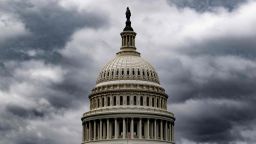
The FBI and DOJ have always occupied an exposed and often politicized space in Washington. The idea that justice is blind, is not prey to partisan influences and that there is a cone of silence between the department and the White House is noble but not always observed.
Unscrupulous presidents have long sought to put heavy fingers on the scale. Powerful heads of the DOJ and the FBI – most notoriously former bureau Director J. Edgar Hoover – often struck fear in the hearts of presidents.
Recent years have, however, been deeply damaging for the FBI and the Justice Department. The fury of Democrats when then-FBI Director James Comey reopened the Clinton email probe days before the 2016 election still fixates liberals. Months later, President Trump was whispering in Comey’s ear at a White House event and inviting him to a private dinner in an attempt to enlist his loyalty. The FBI chief sidestepped the request and was fired shortly afterward. Strong suspicions of political interference hung over the DOJ for Trump’s entire tenure. When special counsel Robert Mueller delivered a report into links between Trump’s 2016 campaign and Russia, the president’s handpicked attorney general, William Barr, appeared to discredit multiple possible instances of obstruction of justice. As the House January 6 committee showed, Trump sought to drag the Justice Department into his 2020 election stealing scheme, although Barr publicly infuriated him by debunking his false claims of widespread voter fraud.
Any hope that Garland could quickly cleanse the political aftertaste around the department was dashed by the ever more damaging revelations about Trump’s behavior on January 6, and his showdown with the National Archives over classified documents he claimed were his property at his Mar-a-Lago resort. That struggle erupted into public view – and a poisoned political arena – after an unprecedented search of an ex-president’s home by the FBI. Trump accused the bureau of planting evidence and claimed he was the victim of a politicized effort to destroy his hopes of a return to the White House. Thus, he ensured that the DOJ and the FBI, like it or not, will be central players in a third straight US presidential election, likely in a way that ends up damaging their image again.
A political lightning rod
One of the most detrimental aspects of Trump’s legacy has been the way in which he has claimed any legal ruling or judge that goes against him is incontrovertible proof of bias. In office, his claims that judges who ruled against him on his norm breaking immigration or census policies because they were appointed by Democratic presidents drew an extraordinary rebuke from Supreme Court Chief Justice John Roberts. “We do not have Obama judges or Trump judges, Bush judges or Clinton judges,” he said in a 2018 statement. Trump’s frequent attacks on the judiciary since have come from a similar mindset.
The question of whether justice is being fairly administered by Garland’s department – as the DOJ brings up multiple cases and wins successive convictions at trials in Washington – was also brought up by William Shipley, one of the attorneys for Roberto Minuta, an Oath Keepers member among four men found guilty Monday of seditious conspiracy for their role in the insurrection. Shipley raised the question of whether justice could ever be fairly handed down in the city where the crimes took place.
“We got a trial by residents of a small judicial district who in one way or another were almost all impacted by the events of January 6, and I think that raises some real troubling issues,” Shipley said.
Such issues are likely to be among the many raised by the House Judiciary Committee under new hardline Republican chairman Jim Jordan. The partisan nature of the body – and the panel probing political “weaponization” in the US government and intelligence agencies – will make Garland’s life even more testing in the coming two years.
Ironically, for a judge who was highly regarded by all his peers during years on the bench, including on the US Court of Appeals for the DC Circuit, Garland has become a hugely political figure later in his career. That was baked into his legacy ever since he was the victim of the then-GOP-controlled Senate’s controversial refusal to confirm him as President Barack Obama’s third Supreme Court pick in 2016.
But any hopes Garland harbored when he was sworn in as attorney general of steering his department away from the partisan storm have long since been dashed. That says more about Washington and modern politics than it does about him.
"politic" - Google News
January 24, 2023 at 12:02PM
https://ift.tt/5qTAZV6
How the most unenviable job in Washington keeps getting harder - CNN
"politic" - Google News
https://ift.tt/56ymQGV
https://ift.tt/i4x710D
Treasury takes more extraordinary measures to avoid debt default - CNN
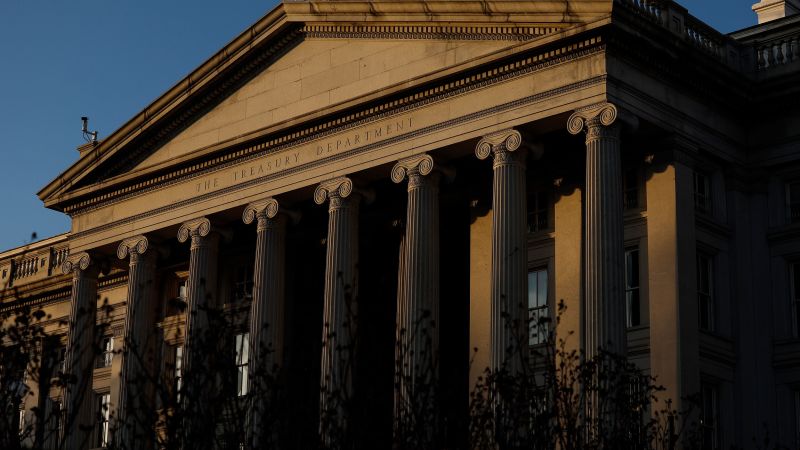
Treasury Secretary Janet Yellen is taking another step to temporarily delay the US defaulting on its debt.
Less than a week after announcing that the nation hit its $31.4 trillion debt ceiling set by Congress, Yellen wrote to House Speaker Kevin McCarthy on Tuesday to say that she is adding to the extraordinary measures that will allow the government to keep paying its bills on time and stall the catastrophic economic and fiscal consequences of a default.
She will stop fully investing the Government Securities Investment Fund of the Thrift Savings Fund, part of the Federal Employees’ Retirement System, in interest-bearing securities of the US.
This is in addition to the measures announced last week, when Yellen said Treasury will begin to sell existing investments and suspend reinvestments of the Civil Service Retirement and Disability Fund and the Postal Service Retiree Health Benefits Fund.
These funds are invested in special-issue Treasury securities, which count against the debt limit. Treasury’s actions would reduce the amount of outstanding debt subject to the limit and temporarily allow it to continue paying the government’s bills on time and in full.
Yellen’s actions are mainly behind-the-scenes accounting maneuvers. No federal retirees or employees will be affected, and the funds will be made whole once the impasse ends, she wrote.
The extraordinary measures should last at least until early June, Yellen has said, though she stressed that her forecast is subject to “considerable uncertainty.”
Political standoff continues
Despite Yellen’s warnings to Congress to act promptly, little, if any, progress toward a resolution has been made between House Republicans and the White House.
White House press secretary Karine Jean-Pierre reiterated Monday that the Biden administration is not open to negotiating on the debt limit, pushing back against comments from West Virginia Democratic Sen. Joe Manchin that the position was “a mistake.”
“It was done three times in the past, in the past administration under Donald Trump, so this is nothing unusual,” she told CNN during a White House briefing. “This is something that should be done without conditions, and we should not be taking hostage key programs that the American people really earned and care about – Social Security, Medicare should not be put into a hostage situation.”
McCarthy also blasted the administration’s position, tweeting last week that he’s ready to meet to discuss “a responsible debt ceiling increase to address irresponsible government spending.” He noted that he accepts President Joe Biden’s invitation to sit down, though no such meeting has been set.
As part of the drawn-out negotiations to win the speaker vote earlier this month, McCarthy promised his conservative members that any effort to lift the debt ceiling would be accompanied by spending cuts.
The Senate, meanwhile, is taking a back seat in the standoff for now. Senate Republicans say they will wait to see how the House GOP maneuvers a way to raise the borrowing limit before deciding if they need to insert themselves into the process.
Despite the current situation, Senate Republican Leader Mitch McConnell told CNN Monday that “we won’t default,” without elaborating.
Senate Majority Leader Chuck Schumer on Tuesday laid out the severe consequences of a default, saying “every single American will pay the price.” He called on House Republicans to reveal the fiscal measures they want to take.
“Well, I say to my Republican colleagues: If you want to talk about spending cuts, then you have an obligation – an obligation – to show the American people precisely what kind of cuts you are talking about,” he said.
CNN’s Donald Judd, Phil Mattingly, Manu Raju and Ted Barrett contributed to this report.
"politic" - Google News
January 25, 2023 at 03:15AM
https://ift.tt/k7gTvjh
Treasury takes more extraordinary measures to avoid debt default - CNN
"politic" - Google News
https://ift.tt/56ymQGV
https://ift.tt/i4x710D
Featured Post
Politics - The Boston Globe
unitedstatepolitics.blogspot.com Adblock test (Why?) "politic" - Google News February 01, 2024 at 03:47AM https://ift.tt...
/cloudfront-us-east-1.images.arcpublishing.com/bostonglobe/VNG7YMZTRWJ5WBFTJ5NVETPCQI.jpg)
Postingan Populer
-
unitedstatepolitics.blogspot.com The president diverges from both Donald Trump and Barack Obama with a complex vision of coalition-building...
-
unitedstatepolitics.blogspot.com What happens after the electoral college meets? Alright, so the (other) big vote happens tomorrow. Then w...
-
unitedstatepolitics.blogspot.com CNN — An appointee to Florida Gov. Ron DeSantis’ new oversight board in control of Disney’s special t...


