This article was featured in One Story to Read Today, a newsletter in which our editors recommend a single must-read from The Atlantic, Monday through Friday. Sign up for it here.
To spend time around Dean Phillips, as I have since his first campaign for Congress in 2018, is to encounter someone so earnest as to be utterly suspicious. He speaks constantly of joy and beauty and inspiration, beaming at the prospect of entertaining some new perspective. He allows himself to be interrupted often—by friends, family, staffers—but rarely interrupts them, listening patiently with a politeness that almost feels aggravating. With the practiced manners of one raised with great privilege—boasting a net worth he estimates at $50 million—the gentleman from Minnesota is exactly that.
But that courtly disposition cracks, I’ve noticed, when he’s convinced that someone is lying. Maybe it’s because at six months old he lost his father in a helicopter crash that his family believes the military covered up, in a war in Vietnam that was sold to the public with tricks and subterfuge. I can hear the anger in his voice as he talks about the treachery that led to January 6, recalling his frantic search for some sort of weapon—he found only a sharpened pencil—with which to defend himself against the violent masses who were sacking the U.S. Capitol. I can see it in his eyes when Phillips, who is Jewish, remarks that some of his Democratic colleagues have recently spread falsehoods about the Israeli-Palestinian conflict, and others in the party have refused to condemn blatant anti-Semitism.
Deception is a part of politics. Phillips acknowledges that. But some deceptions are more insidious than others. On the third Saturday of October, as we sat inside the small, sun-drenched living room of his rural-Virginia farmhouse, Phillips told me he was about to do something out of character: He was going to upset some people. He was going to upset some people because he was going to run for president. And he was going to run for president, Phillips explained, because there is one deception he can no longer perpetuate.
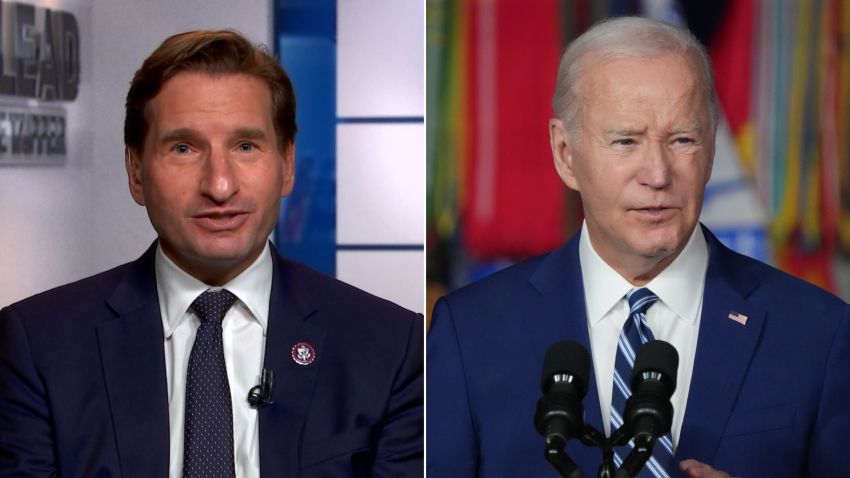
“My grave concern,” the congressman said, “is I just don’t think President Biden will beat Donald Trump next November.”
This isn’t some fringe viewpoint within the Democratic Party. In a year’s worth of conversations with other party leaders, Phillips told me, “everybody, without exception,” shares his fear about Joe Biden’s fragility—political and otherwise—as he seeks a second term. This might be hyperbole, but not by much: In my own recent conversations with party officials, it was hard to find anyone who wasn’t jittery about Biden. Phillips’s problem is that they refuse to say so on the record. Democrats claim to view Trump as a singular threat to the republic, the congressman complains, but for reasons of protocol and self-preservation they have been unwilling to go public with their concerns about Biden, making it all the more likely, in Phillips’s view, that the former president will return to office.
Phillips spent the past 15 months trying to head off such a calamity. He has noisily implored Biden, who turns 81 next month—and would be 86 at the end of a second term—to “pass the torch,” while openly attempting to recruit prominent young Democrats to challenge the president in 2024. He name-dropped some Democratic governors on television and made personal calls to others, urging someone, anyone, to jump into the Democratic race. What he encountered, he thought, was a dangerous dissonance: Some of the president’s allies would tell him, in private conversations, to keep agitating, to keep recruiting, that Biden had no business running in 2024—but that they weren’t in a position to do anything about it.
What made this duplicity especially maddening to Phillips, he told me, is that Democrats have seen its pernicious effects on the other side of the political aisle. For four years during Trump’s presidency, Democrats watched their Republican colleagues belittle Trump behind closed doors, then praise him to their base, creating a mirage of support that ultimately made them captives to the cult of Trumpism. Phillips stresses that there is no equivalence between Trump and Biden. Still, having been elected in 2018 alongside a class of idealistic young Democrats—“the Watergate babies of the Trump era,” Phillips said—he always took great encouragement in the belief that his party would never fall into the trap of elevating people over principles.
“We don’t have time to make this about any one individual. This is about a mission to stop Donald Trump,” Phillips, who is 54, told me. “I’m just so frustrated—I’m growing appalled—by the silence from people whose job it is to be loud.”
Phillips tried to make peace with this. As recently as eight weeks ago, he had quietly resigned himself to Biden’s nomination. The difference now, he said—the reason for his own buzzer-beating run for the presidency—is that Biden’s numbers have gone from bad to awful. Surveys taken since late summer show the president’s approval ratings hovering at or below 40 percent, Trump pulling ahead in the horse race, and sizable majorities of voters, including Democratic voters, wishing the president would step aside. These findings are apparent in district-level survey data collected by Phillips’s colleagues in the House, and have been the source of frenzied intraparty discussion since the August recess. And yet Democrats’ reaction to them, Phillips said, has been to grimace, shrug, and say it’s too late for anything to be done.
“There’s no such thing as too late,” Phillips told me, “until Donald Trump is in the White House again.”
In recent weeks, Phillips has reached out to a wide assortment of party elders. He did this, in part, as a check on his own sanity. He was becoming panicked at the prospect of Trump’s probable return to office. He halfway hoped to be told that he was losing his grip on reality, that Trump Derangement Syndrome had gotten to him. He wanted someone to tell him that everything was going to be fine. Instead, in phone call after phone call, his fears were only exacerbated.
“I’m looking at polling data, and I’m looking at all of it. The president’s numbers are just not good—and they’re not getting any better,” James Carville, the Democratic strategist, told me, summarizing his recent conversations with Phillips. “I talk to a lot of people who do a lot of congressional-level polling and state polling, and they’re all saying the same thing. There’s not an outlier; there’s not another opinion … The question is, has the country made up its mind?”
Jim Messina, who ran Barack Obama’s 2012 campaign, told me the answer is no. “This is exactly where we were at this stage of that election cycle,” Messina said. He pointed to the November 6, 2011, issue of The New York Times Magazine, the cover of which read, “So, Is Obama Toast?” Messina called the current situation just another case of bedwetting. “If there was real concern, then you’d have real politicians running,” he said. “I’d never heard of Dean Phillips until a few weeks ago.”
The bottom line, Messina said, is that “Biden’s already beaten Trump once. He’s the one guy who can beat him again.”
Carville struggles with this logic. The White House, he said, “operates with what I call this doctrine of strategic certainty,” arguing that Biden is on the same slow-but-steady trajectory he followed in 2020. “Joe Biden has been counted out by the Beltway insiders, pundits, DC media, and anonymous Washington sources time and time again,” the Biden campaign wrote in a statement. “Time and time again, they have been wrong.” The problem is that 2024 bears little resemblance to 2020: Biden is even older, there is a proliferation of third-party and independent candidates, and the Democratic base, which turned out in record numbers in the last presidential election, appears deflated. (“The most under-covered story in contemporary American politics,” Carville said, “is that Black turnout has been miserable everywhere since 2020.”) Carville added that in his own discussions with leading Democrats, when he argues that Biden’s prospects for reelection have grown bleak, “Nobody is saying, ‘James, you’re wrong,’” he told me. “They’re saying, ‘James, you can’t say that.’”
Hence his fondness for Phillips. “Remember when the Roman Catholic Church convicted Galileo of heresy for saying that the Earth moves around the sun? He said, ‘And yet, it still moves,’” Carville told me, cackling in his Cajun drawl. The truth is, Carville said, Biden’s numbers aren’t moving—and whoever points that out is bound to be treated like a heretic in Democratic circles.
Phillips knows that he’s making a permanent enemy of the party establishment. He realizes that he’s likely throwing away a promising career in Congress; already, a Democratic National Committee member from Minnesota has announced a primary challenge and enlisted the help of leading firms in the St. Paul area to take Phillips out. He told me how, after the news of his impending launch leaked to the press, “a colleague from New Hampshire”—the congressman grinned, as that description narrowed it down to just two people—told him that his candidacy was “not serious” and “offensive” to the state’s voters. In the run-up to his launch, Phillips tried to speak with the president—to convey his respect before entering the race. On Thursday night, he said, the White House got back to him: Biden would not be talking to Phillips.
Cedric Richmond, the onetime Louisiana congressman who is now co-chair of Biden’s reelection campaign, told me Phillips doesn’t “give a crap” about the party and is pursuing “a vanity project” that could result in another Trump presidency. “History tells us when the sitting president faces a primary challenge, it weakens him for the general election,” Richmond said. “No party has ever survived that.”
But Phillips insists—and his friends, even those who think he’s making a crushing mistake, attest—that he is doing this out of genuine conviction. Standing up and leaning across a coffee table inside his living room, Phillips pulled out his phone and recited data from recent surveys. One showed 70 percent of Democrats under 35 wanting a different nominee; another showed swing-state voters siding with Trump over Biden on a majority of policy issues, and independents roundly rejecting “Bidenomics,” the White House branding for the president’s handling of the economy. “These are not numbers that you can massage,” Phillips said. “Look, just because he’s old, that’s not a disqualifier. But being old, in decline, and having numbers that are clearly moving in the wrong direction? It’s getting to red-alert kind of stuff.”
Phillips sat back down. “Someone had to do this,” the congressman told me. “It just was so self-evident.”
If the need to challenge the president is so self-evident, I asked, then why is a third-term congressman from Minnesota the only one willing to do it?
“I think about that every day,” Phillips replied, shaking his head. “If the data is correct, over 50 percent of Democrats want a different nominee—and yet there’s only one out of 260 Democrats in the Congress saying the same thing?”
Phillips no longer wonders whether there’s something wrong with him. He believes there’s something wrong with the Democratic Party—a “disease” that discourages competition and shuts down dialogue and crushes dissent. Phillips said his campaign for president won’t simply be about the “generational schism” that pits clinging-to-power Baby Boomers against the rest of the country. If he’s running, the congressman said, he’s running on all the schisms that divide the Democrats: cultural and ideological, economic and geographic. He intends to tell some “hard truths” about a party that, in its attempt to turn the page on Trump, he argued, has done things to help move him back into the Oval Office. He sounded at times less like a man who wants to win the presidency, and more like someone who wants to draw attention to the decaying state of our body politic.
Over the course of a weekend on Phillips’s farm, we spent hours discussing the twisted incentive structures of America’s governing institutions. He talked about loyalties and blind spots, about how truth takes a back seat to narrative, about how we tell ourselves stories to ignore uncomfortable realities. Time and again, I pressed Phillips on the most uncomfortable reality of all: By running against Biden—by litigating the president’s age and fitness for office in months of town-hall meetings across New Hampshire—isn’t he likely to make a weak incumbent that much weaker, thereby making another Trump presidency all the more likely?
“I want to strengthen him. If it’s not me, I want to strengthen him. I won’t quit until I strengthen him. I mean it,” Phillips said of Biden. “I do not intend to undermine him, demean him, diminish him, attack him, or embarrass him.”
Phillips’s friends tell me his intentions are pure. But they fear that what makes him special—his guileless, romantic approach to politics—could in this case be ruinous for the country. They have warned him about the primary campaigns against George H. W. Bush in 1992 and Jimmy Carter in 1980, both of whom lost in the general election.
Phillips insisted to me that he wouldn’t be running against Biden. Rather, he would be campaigning for the future of the Democratic Party. There was no scenario, he said, in which his candidacy would result in Trump winning back the White House.
And in that moment, it was Dean Phillips who was telling himself a story.
He didn’t see the question coming—but he didn’t try to duck it, either.
It was July of last year. Phillips was doing a regular spot on WCCO radio, a news-talk station in his district, when host Chad Hartman asked the congressman if he wanted Biden to run for reelection in 2024. “No. I don’t,” Phillips replied, while making sure to voice his admiration for the president. “I think the country would be well served by a new generation of compelling, well-prepared, dynamic Democrats to step up.”
Phillips didn’t think much about the comment. After all, he’d run for Congress in 2018 promising not to vote for Nancy Pelosi as speaker of the House (though he ultimately did support her as part of a deal that codified the end of her time in leadership). While he has been a reliable vote in the Democratic caucus—almost always siding with Biden on the House floor—Phillips has simultaneously been a squeaky wheel. He’s a centrist unhappy with what he sees as the party’s coddling of the far left. He’s a Gen Xer convinced that the party’s aging leadership is out of step with the country. He’s an industrialist worried about the party’s hostility toward Big Business. (When he was 3 years old, his mother married the heir of a distilling empire; Phillips took it over in his early 30s, then made his own fortune with the gelato company Talenti.)
When the blowback to the radio interview arrived—party donors, activists, and officials in both Minnesota and Washington rebuked him as disloyal—Phillips was puzzled. Hadn’t Biden himself said, while campaigning in 2020, that he would be a “bridge” to the future of the Democratic Party? Hadn’t he made that remark flanked by Michigan Governor Gretchen Whitmer on one side and future Vice President Kamala Harris on the other? Hadn’t he all but promised that his campaign was about removing Trump from power, not staying in power himself?
Phillips had never seriously entertained the notion that Biden would seek reelection. Neither had many of his Democratic colleagues. In fact, several House Democrats told me—on the condition of anonymity, as not one of them would speak on the record for this article—that in their conversations with Biden’s inner circle throughout the summer and fall of 2022, the question was never if the president would announce his decision to forgo a second term, but when he would make that announcement.
Figuring that he’d dealt with the worst of the recoil—and still very much certain that Biden would ultimately step aside—Phillips grew more vocal. He spent the balance of 2022, while campaigning for his own reelection, arguing that both Biden and Pelosi should make way for younger Democratic leaders to emerge. He was relieved when, after Republicans recaptured the House of Representatives that fall, Pelosi allowed Hakeem Jeffries, a friend of Phillips’s, to succeed her atop the caucus.
But that relief soon gave way to worry: As the calendar turned to 2023, there were rumblings coming from the other end of Pennsylvania Avenue that Biden might run for reelection after all. In February, Phillips irked his colleagues on Capitol Hill when he gave an extensive interview to the Politico columnist Jonathan Martin shaming Democrats for suppressing their concerns about Biden. At that point, his friends in the caucus still believed that Phillips was picking a fight for no reason. When Biden announced his candidacy two months later, several people recalled to me, some congressional Democrats were stunned.
“Many actually felt, I think, personally offended,” Phillips said. “They felt he had made a promise—either implicitly, if not explicitly.”
Around the time Biden was launching his reelection campaign, Phillips was returning to the United States from an emotional journey to Vietnam. He had traveled to the country, for the first time, in search of the place where his father and seven other Americans died in a 1969 helicopter crash. (Military officials initially told his mother that the Huey was shot down; only later, Phillips says, did they admit that the accident was weather related.) After a local man volunteered to lead Phillips to the crash site, the congressman broke down in tears, running his hands over the ground where his father perished, reflecting, he told me, on “the magnificence and the consequence of the power of the American presidency.”
Phillips left Vietnam with renewed certainty of his mission—not to seek the White House himself, but to recruit a Democrat who stood a better chance than Biden of defeating Donald Trump.
Back in Washington, Phillips began asking House Democratic colleagues for the personal phone numbers of governors in their states. Some obliged him; others ignored the request or refused it. Phillips tried repeatedly to get in touch with these governors. Only two got back to him—Whitmer in Michigan, and J. B. Pritzker in Illinois—but neither one would speak to the congressman directly. “They had their staff take the call,” Phillips told me. “They wouldn’t take the call.”
With a wry grin, he added: “Gretchen Whitmer’s aide was very thoughtful … J. B. Pritzker’s delegate was somewhat unfriendly.”
By this point, Phillips was getting impatient. Trump’s numbers were improving. One third-party candidate, Cornel West, was already siphoning support away from Biden, and Phillips suspected that Robert F. Kennedy Jr., who had declared his candidacy as a Democrat, would eventually switch to run as an independent. (That suspicion proved correct earlier this month.) As a member of the elected House Democratic leadership, Phillips could sense the anxiety mounting within the upper echelons of the party. He and other Democratic officials wondered what, exactly, the White House would do to counter the obvious loss of momentum. The answer: Biden’s super PAC dropped eight figures on an advertising blitz around Bidenomics, a branding exercise that Phillips told me was viewed as “a joke” within the House Democratic caucus.
“Completely disconnected from what we were hearing,” Phillips said of the slogan, “which is people getting frustrated that the administration was telling them that everything is great.”
Everything was not great—but it didn’t seem terrible, either. The RealClearPolitics average of polls, as of late spring, showed Biden and Trump running virtually even. As the summer wore on, however, there were signs of trouble. When Phillips and certain purple-district colleagues would compare notes on happenings back home, the readouts were the same. Polling indicated that more and more independents were drifting from the Democratic ranks. Field operations confirmed that young people and minorities were dangerously disengaged. Town-hall questions and donor meetings began and ended with questions about Biden’s fitness to run against Trump.
Phillips decided that he needed to push even harder. Before embarking on a new, more aggressive phase of his mission—he began booking national-TV appearances with the explicit purpose of lobbying a contender to join the Democratic race—he spoke to Jeffries, the House Democratic leader, to share his plans. He also said he called the White House and spoke to Biden’s chief of staff, Jeff Zients, to offer a heads-up. Phillips wanted both men to know that he would be proceeding with respect—but proceeding all the same.
In August, as Phillips dialed up the pressure, he suddenly began to feel the pressure himself. He had spent portions of the previous year cultivating relationships with powerful donors, from Silicon Valley to Wall Street, who had offered their assistance in recruiting a challenger to Biden. Now, with those efforts seemingly doomed, the donors began asking Phillips if he would consider running. He laughed off the question at first. Phillips knew that it would take someone with greater name identification, and a far larger campaign infrastructure, to vie for the party’s presidential nomination. Besides, the folks he’d met with wanted someone like Whitmer or California Governor Gavin Newsom or Georgia Senator Raphael Warnock, not a barely known congressman from the Minneapolis suburbs.
In fact, Phillips had already considered—and rejected—the idea of running. After speaking to a packed D.C.-area ballroom of Gold Star families earlier this year, and receiving an ovation for his appeals to brotherhood and bipartisanship, he talked with his wife and his mother about the prospect of doing what no other Democrat was willing to do. But he concluded, quickly, that it was a nonstarter. He didn’t have the experience to run a national campaign, let alone a strategy of any sort.
Phillips told his suitors he wasn’t their guy. Flying back to Washington after the summer recess, he resolved to keep his head down. The congressman didn’t regret his efforts, but he knew they had estranged him from the party. Now, with primary filing deadlines approaching and no serious challengers to the president in sight, he would fall in line and do everything possible to help Biden keep Trump from reclaiming the White House.
No sooner had Phillips taken this vow than two things happened. First, as Congress reconvened during the first week of September, Phillips was blitzed by Democratic colleagues who shared the grim tidings from their districts around the country. He had long been viewed as the caucus outcast for his public defiance of the White House; now he was the party’s unofficial release valve, the member whom everyone sought out to vent their fears and frustrations. That same week, several major polls dropped, the collective upshot of which proved more worrisome than anything Phillips had witnessed to date. One survey, from The Wall Street Journal, showed Trump and Biden essentially tied, but reported that 73 percent of registered voters considered Biden “too old” to run for president, with only 47 percent saying the same about Trump, who is just three and a half years younger. Another poll, conducted for CNN, showed that 67 percent of Democratic voters wanted someone other than Biden as the party’s nominee.
Phillips felt helpless. He made a few last-ditch phone calls, pleading and praying that someone might step forward. No one did. After a weekend of nail-biting, Phillips logged on to X, formerly Twitter, on Monday, September 11, to write a remembrance on the anniversary of America coming under attack. That’s when he noticed a direct message. It was from a man he’d never met but whose name he knew well: Steve Schmidt.
“Some of the greatest acts of cowardice in the history of this country have played out in the last 10 years,” Schmidt told me, picking at a piece of coconut cream pie.
“Agreed,” Phillips said, nodding his head. “Agreed.”
The three of us, plus the congressman’s wife, Annalise, were talking late into the night around a long, rustic table in the farmhouse dining room. Never, not even in the juicy, adapted-to-TV novels about presidential campaigns, has there been a stranger pairing than Dean Phillips and Steve Schmidt. One is a genteel, carefully groomed midwesterner who trafficks in dad jokes and neighborly aphorisms, the other a swaggering, bald-headed, battle-hardened product of New Jersey who specializes in ad hominem takedowns. What unites them is a near-manic obsession with keeping Trump out of the White House—and a conviction that Biden cannot beat him next November.
“The modern era of political campaigning began in 1896,” Schmidt told us, holding forth a bit on William McKinley’s defeat of William Jennings Bryan. “There has never been a bigger off-the-line mistake by any presidential campaign—ever—than labeling this economy ‘Bidenomics.’ The result of that is going to be to reelect Donald Trump, which will be catastrophic.”
Schmidt added: “A fair reading of the polls is that if the election were tomorrow, Donald Trump would be the 47th president of the United States.”
Schmidt, who is perhaps most famous for his work leading John McCain’s 2008 presidential campaign—and, specifically, for recommending Sarah Palin as a surprise vice-presidential pick—likes to claim some credit for stopping Trump in the last election. The super PAC he co-founded in 2019, the Lincoln Project, combined quick-twitch instincts with devastating viral content, hounding Trump with over-the-top ads about everything from his business acumen to his mental stability. Schmidt became something of a cult hero to the left, a onetime conservative brawler who had mastered the art and science of exposing Republican duplicity in the Trump era. Before long, however, the Lincoln Project imploded due to cascading scandals. Schmidt resigned, apologizing for his missteps and swearing to himself that he was done with politics for good.
He couldn’t have imagined that inviting Phillips onto his podcast, via direct message, would result in the near-overnight upending of both of their lives. After taping the podcast on September 22, Schmidt told Phillips how impressed he was by his sincerity and conviction. Two days later, Schmidt called Phillips to tell him that he’d shared the audio of their conversation with some trusted political friends, and the response was unanimous: This guy needs to run for president. Before Phillips could respond, Schmidt advised the congressman to talk with his family about it. It happened to be the eve of Yom Kippur: Phillips spent the next several days with his wife and his adult daughters, who expressed enthusiasm about the idea. Phillips called Schmidt back and told him that, despite his family’s support, he had no idea how to run a presidential campaign—much less one that would have to launch within weeks, given filing deadlines in key states.
“Listen,” Schmidt told him, “if you’re willing to jump in, then I’m willing to jump in with you.”
Phillips needed some time to think—and to assess Schmidt. Politics is a tough business, but even by that standard his would-be partner had made lots of enemies. The more the two men talked, however, the more Phillips came to view Schmidt as a kindred spirit. They shared not just a singular adversary in Trump but also a common revulsion at the conformist tactics of a political class that refuses to level with the public. (“People talk about misinformation on Twitter, misinformation in the media,” Schmidt told me. “But how is it not misinformation when our political leaders have one conversation with each other, then turn around and tell the American people exactly the opposite?”) Schmidt had relished working for heterodox dissenters like McCain and California Governor Arnold Schwarzenegger. Listening to Schmidt narrate his struggles to prevent the Republican Party’s demise, Phillips felt a strange parallel to his own situation.
Back on January 6, 2021, as he’d crawled for cover inside the House gallery—listening to the sounds of broken glass and the gunshot that killed the Trump supporter Ashli Babbitt, overhearing his weeping colleagues make goodbye calls to loved ones—Phillips believed that he was going to die. Later that night, reflecting on his survival, the congressman vowed that he would give every last measure to the cause of opposing Trump. And now, just a couple of years later, with Trump’s recapturing of power appearing more likely by the day, he was supposed to do nothing—just to keep the Democratic Party honchos happy?
“My colleagues, we all endured that, and you’d think that we would be very intentional and objective and resolute about the singular objective to ensure he does not return to the White House,” Phillips said. “We need to recognize the consequences of this silence.”
On the first weekend of October, Phillips welcomed Schmidt to his D.C. townhome. They were joined by six others: the congressman’s wife and sister; his campaign manager and one of her daughters; Bill Fletcher, a Tennessee-based consultant; and a Democratic strategist whom I later met at the Virginia farm—one whose identity I agreed to keep off the record because he said his career would be over if he was found to be helping Phillips. Commanding the room with a whiteboard and marker, Schmidt outlined his approach. There would be no org chart, no job titles—only three groups with overlapping responsibilities. The first group, “Headquarters,” would deal with day-to-day operations. The second, “Maneuver,” would handle the mobile logistics of the campaign. The third, “Content,” would be prolific in its production of advertisements, web videos, and social-media posts. This last group would be essential to Phillips’s effort, Schmidt explained: They would contract talent to work across six time zones, from Manhattan to Honolulu, seizing on every opening in the news cycle and putting Biden’s campaign on the defensive all day, every day.
When the weekend wrapped, Phillips sat alone with his thoughts. The idea of challenging his party’s leader suddenly felt real. He knew the arguments being made by his Democratic friends and did his best to consider them without prejudice. Was it likely, Phillips asked himself, that his candidacy might achieve exactly the outcome he wanted to avoid—electing Trump president?
Phillips decided the answer was no.
Running in the Democratic primary carried some risk of hurting the party in 2024, Phillips figured, but not as much risk as letting Biden and his campaign sleepwalk into next summer, only to discover in the fall how disengaged and disaffected millions of Democratic voters truly are.
“If it’s not gonna be me, and this is a way to elevate the need to listen to people who are struggling and connect it to people in Washington, that to me is a blessing for the eventual nominee,” Phillips said. “If it’s Joe Biden—if he kicks my tuchus in the opening states—he looks strong, and that makes him stronger.”
It sounds fine in theory, I told Phillips. But that’s not usually how primary campaigns work.
He let out an exaggerated sigh. “I understand why conventional wisdom says that’s threatening,” Phillips said. “But my gosh, if it’s threatening to go out and listen to people and talk publicly about what’s on people’s minds, and that’s something we should be protecting against, we have bigger problems than I ever thought.”
It was two weeks after that meeting in D.C. that Phillips welcomed me to his Virginia farmhouse. He’d been staying there, a 90-minute drive from the Capitol, since far-right rebels deposed House Speaker Kevin McCarthy, sparking a furious three-week search for his replacement. The irony, Phillips explained as he showed me around the 38-acre parcel of pastureland, is that he and Schmidt couldn’t possibly have organized a campaign during this season had Congress been doing its job. The GOP’s dysfunctional detour provided an unexpected opportunity, and Phillips determined that it was his destiny to take advantage.
With Congress adjourned for the weekend as Republicans sought a reset in their leadership scramble, Phillips reconvened the kitchen cabinet from his D.C. summit, plus a Tulsa-based film production crew. Content was the chief priority. Phillips would launch his campaign on Friday, October 27—the deadline for making the New Hampshire ballot—at the state capitol in Concord. From there, he would embark on a series of 120 planned town-hall meetings, breaking McCain’s long-standing Granite State record, touring in a massive DEAN-stamped bus wrapped with a slogan sure to infuriate the White House: “Make America Affordable Again.”
The strategy, Schmidt explained as we watched his candidate ad-lib for the roving cameras—shooting all manner of unscripted, stream-of-consciousness, turn-up-the-authenticity footage that would dovetail with the campaign’s policy of no polling or focus grouping—was to win New Hampshire outright. The president had made a massive tactical error, Schmidt said, by siding with the Democratic National Committee over New Hampshire in a procedural squabble that will leave the first-in-the-nation primary winner with zero delegates. Biden had declined to file his candidacy there, instead counting on loyal Democratic voters to write him onto the primary ballot. But now Phillips was preparing to spend the next three months blanketing the state, drawing an unflattering juxtaposition with the absentee president and maybe, just maybe, earning enough votes to defeat him. If that happens, Schmidt said, the media narrative will be what matters—not the delegate math. Americans would wake up to the news of two winners in the nation’s first primary elections: Trump on the Republican side, and Dean Phillips—wait, who?—yes, Dean Phillips on the Democratic side. The slingshot of coverage would be forceful enough to make Phillips competitive in South Carolina, then Michigan. By the time the campaign reached Super Tuesday, Schmidt said, Phillips would have worn the incumbent down—and won over the millions of Democrats who’ve been begging for an alternative.
At least, that’s the strategy. Fanciful? Yes. The mechanical hurdles alone, starting with collecting enough signatures to qualify for key primary ballots, could prove insurmountable. (He has already missed the deadline in Nevada.) That said, in an age of asymmetrical political disruption, Phillips might not be the million-to-one candidate some will dismiss him as. He’s seeding the campaign with enough money to build out a legitimate operation, and has influential donors poised to enter the fray on his behalf. (One tech mogul, who spoke with Phillips throughout the week preceding the launch, was readying to endorse him on Friday.) He has high-profile friends—such as the actor Woody Harrelson—whom he’ll enlist to hit the trail with him and help draw a crowd. Perhaps most consequentially, his campaign is being helped by Billy Shaheen, a longtime kingmaker in New Hampshire presidential politics and the husband of the state’s senior U.S. senator, Jeanne Shaheen. “I think the people here deserve to hear what Dean has to say,” Billy Shaheen told me. If nothing else, with Schmidt at the helm, Phillips’s campaign will be energetic and highly entertaining.
Yet the more time I spent with him at the farm, the less energized Phillips seemed by the idea of dethroning Biden. He insisted that his first ad-making session focus on saluting the president, singing his opponent’s praises into the cameras in ways that defy all known methods of campaigning. He told me, unsolicited, that his “red line” is March 6, the day after Super Tuesday, at which point he will “wrap it up” and “get behind the president in a very big way” if his candidacy fails to gain traction. He repeatedly drifted back to the notion that he might unwittingly assist Trump’s victory next fall.
Whereas he once spoke with absolute certainty on the subject—shrugging off the comparisons to Pat Buchanan in 1992 or Ted Kennedy in 1980—I could sense by the end of our time together that it was weighing on him. Understandably so: During the course of our interviews—perhaps five or six hours spent on the record—Phillips had directly criticized Biden for what he described as a detachment from the country’s economic concerns, his recent in-person visit to Israel (unnecessarily provocative to Arab nations, Phillips said), and his lack of concrete initiatives to help heal the country the way he promised in 2020. Phillips also ripped Hunter Biden’s “appalling” behavior and argued that the president—who was acting “heroically” by showing such devotion to his troubled son—was now perceived by the public to be just as corrupt as Trump.
All of this from a few hours of conversation. If you’re running the Biden campaign, it’s fair to worry: What will come of Phillips taking thousands of questions across scores of town-hall meetings in New Hampshire?
At one point, under the dimmed lights at his dinner table, Phillips told me he possessed no fear of undermining the eventual Democratic nominee. Then, seconds later, he told me he was worried about the legacy he’d be leaving for his two daughters.
“Because of pundits attaching that to me—” Phillips suddenly paused. “If, for some circumstance, Trump still won …” He trailed off.
Schmidt had spent the weekend talking about Dean Phillips making history. And yet, in this moment, the gentleman from Minnesota—the soon-to-be Democratic candidate for president in 2024—seemed eager to avoid the history books altogether.
“In other words, if you’re remembered for helping Trump get elected—” I began.
He nodded slowly. “There are two paths.”
Phillips knows what path some Democrats think he’s following: that he’s selfish, maybe even insane, recklessly doing something that might result in another Trump presidency. The way Phillips sees it, he’s on exactly the opposite path: He is the last sane man in the Democratic Party, acting selflessly to ensure that Trump cannot reclaim the White House.
“Two paths,” Phillips repeated. “There’s nothing in the middle.”



/cloudfront-us-east-1.images.arcpublishing.com/bostonglobe/VNG7YMZTRWJ5WBFTJ5NVETPCQI.jpg)


